What Does the Best Digital Marketing Company in India Really Cost in 2026?
What Does the Best Digital Marketing Company in India Really Cost in 2026? In 2026, agency retainers in India commonly sit between 25,000 and 3,00,000 rupees a month depending on scope, seniority and city. Percentage of spend models typically run at 10 to 15 percent of managed budget. Ad spend is always separate. For ecommerce brands, a practical rule is to budget the retainer at 15 to 25 percent of monthly ad spend, with creative production often billed on top. The three cost components founders forget to separate Retainer. The agency fee for strategy, management, reporting and a defined amount of creative. Media spend. Money paid to Meta, Google and other platforms. This is usually the largest line and it is not the agency’s revenue. Production and tooling. Video shoots, user generated content creator fees, product photography, landing page builds, and subscriptions for email, WhatsApp, analytics and heatmap tools. This line is routinely underbudgeted and then blamed on the agency. A proposal that blends these three into one number is difficult to evaluate and should be unbundled before comparison. Get Free Growth plan What each budget level realistically achieves Under 50,000 a month, expect competent execution of one or two channels without strategic depth, store conversion work or structured creative testing at volume. Between 50,000 and 1,50,000, expect multi-channel coordination with a senior strategist at plan level. The risk is that the senior name contributes only a few hours a month. Ask for the split. Above 1,50,000, expect senior daily decision making, in-house creative production, conversion rate work on the store, and owned lifecycle channels. On a brand spending 10 lakh a month on media, a five percent efficiency improvement covers the difference several times over, which is why this tier is often cheaper in total cost. Get Free Growth plan The percentage of spend model, honestly assessed Charging 10 to 15 percent of managed spend aligns the agency with growth and misaligns it with efficiency, since revenue rises with spend regardless of profitability. It is workable if paired with an efficiency floor such as a maximum cost per order or a minimum contribution margin, below which the percentage does not apply. Any credible digital marketing company in India should accept a structure of that kind. Get Free Growth plan Why brands work with us Most of our engagements run as a monthly retainer covering strategy, execution, optimisation and reporting, and we are comfortable linking part of the commercial structure to orders, cost per order and payback period. Aim n Launch works exclusively with direct to consumer and ecommerce brands, has produced over 55 crore in tracked client revenue at a 4.2X average return, and has worked with more than 200 ecommerce brands including some that have appeared on Shark Tank India. Creative is produced in house, which keeps a meaningful production cost inside the retainer rather than on a separate invoice, and keeps testing velocity high because nothing waits on an external vendor. We also insist on fixing the page, the offer and the tracking before raising spend, since the fastest way to waste a budget is to scale a funnel that leaks. Our full service scope is set out on our ecommerce digital marketing services page. Get Free Growth plan Frequently Asked Questions How much should a startup spend on digital marketing in India? A common starting point is 5 to 10 percent of target monthly revenue on media for an early D2C brand, rising during launch or festive pushes. In absolute terms, most brands need at least 1.5 to 2 lakh a month in media spend before paid social produces statistically useful test data. Below that, organic and lifecycle channels usually give better returns. Is a percentage of ad spend model better than a flat retainer? Flat retainers are more predictable and do not reward overspending. Percentage models scale naturally with the account and suit brands with volatile budgets. The safest structure is a base retainer plus a performance component tied to cost per order or contribution margin, so the agency is rewarded for efficiency as well as volume. What hidden costs come with hiring a digital marketing agency? The usual ones are video and photo production, creator fees for user generated content, landing page development, marketing tool subscriptions for email, WhatsApp and analytics, stock assets, and platform fees. Ask for an itemised list of what sits outside the retainer before signing, and budget roughly 10 to 20 percent of the retainer for these. Why do agency prices vary so much for the same services? Because the same service name covers very different amounts of work and seniority. Twelve template posts and twenty tested video angles are both called social media marketing. The variables that drive price are senior hours per week, creative volume, reporting frequency and whether tracking and conversion work is included. Compare those four inputs, not the labels. When does it make sense to bring marketing in-house? Usually above roughly 25 to 40 lakh a month in ad spend, when the retainer equivalent could fund a dedicated media buyer, a creative producer and an analyst. Many brands run a hybrid permanently, keeping brand, community and content in-house while an external team owns performance media and lifecycle analytics.
Hiring the Best Digital Marketing Company in Lucknow? Ask These 7 Questions First
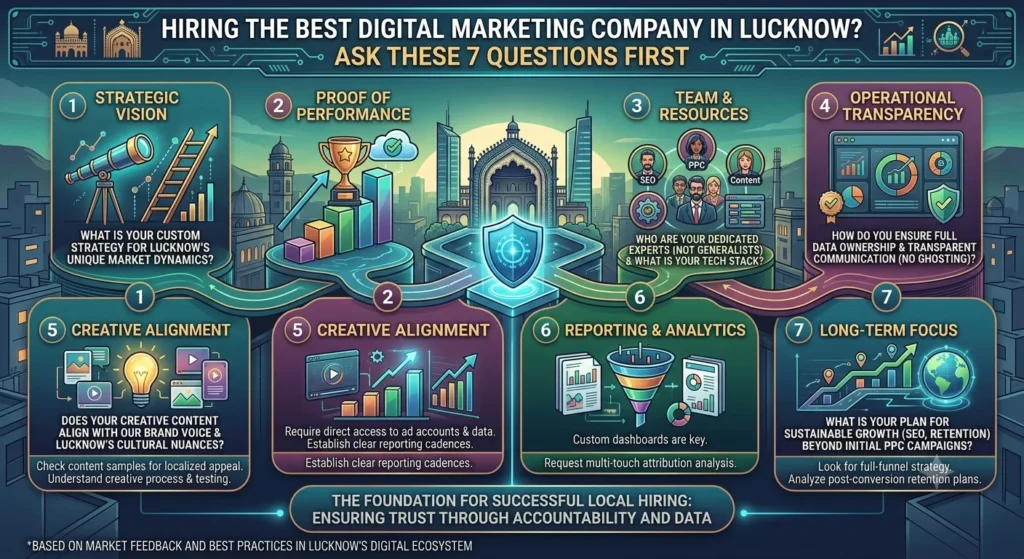
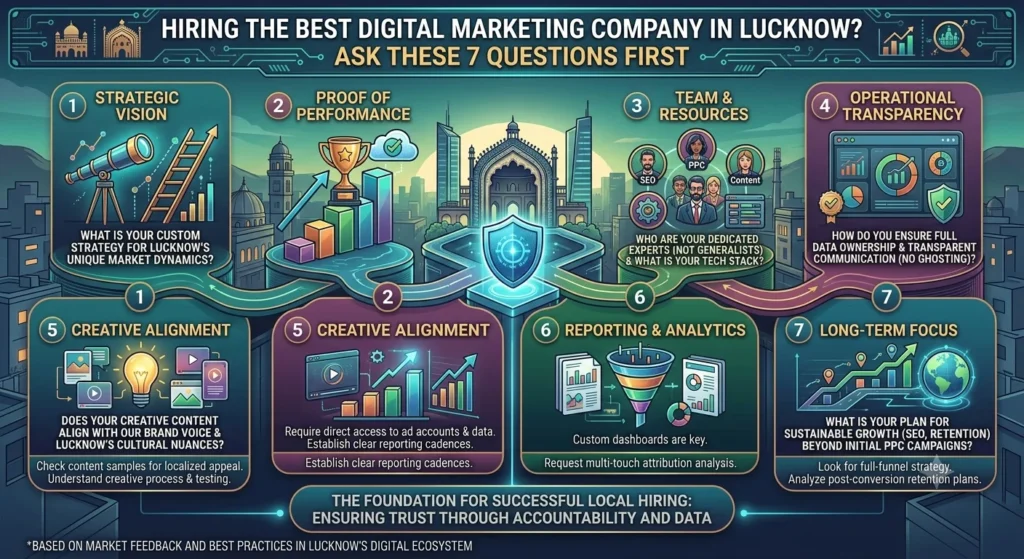
Hiring the Best Digital Marketing Company in Lucknow? Ask These 7 Questions First Ask seven questions before signing: who runs the account daily and how many accounts they carry, how conversion tracking will be validated, what the first ninety days will produce, how many creative concepts will be tested monthly, which three metrics lead the report, who owns the accounts and creative, and what the exit terms are. Written answers to all seven separate serious agencies from the rest. Why a question list beats a proposal comparison Proposals are written to be compared favourably. They use the same vocabulary, list the same services, and present the same case study structure. Comparing them rewards the best writer. A live question list does something different. It tests whether the person in front of us has actually run accounts. Operators answer with specifics and caveats. Salespeople answer with frameworks and reassurance. The difference is audible within two questions. Lucknow’s agency market has grown quickly alongside the wider Uttar Pradesh business base, and quality ranges widely from strong regional teams to very thin operations. A question list is the cheapest filter available. Get Free Growth plan The seven questions Who runs my account day to day, and how many other accounts do they carry? Look for a name, a tenure and an honest load. Above five to seven active accounts per operator, daily optimisation is not realistic. How will you validate conversion tracking before we spend anything? Look for server-side setup, conversion API, event deduplication, value and currency parameters, and reconciliation against backend orders. What will the first ninety days produce, week by week? Look for a diagnostic phase, then a structured test phase, then a scaling decision. Look for named deliverables rather than service categories. How many distinct creative concepts will be tested each month, and what is the kill rule? Look for a number and a threshold. Creative volume and test discipline move performance more than bid strategy does. What are the top three numbers on the monthly report? Look for orders, cost per order and payback period. Reach and engagement at the top of a report is a design decision, not an accident. Who owns the ad accounts, analytics, pixel, creative files and contact lists? The correct answer is the brand, from day one. Anything else builds a switching cost into the relationship. What are the exit terms, and what is the notice period? Look for a notice period under sixty days and a clean handover clause covering account access and creative assets. Get Free Growth plan What we would add for an ecommerce brand specifically Two more, if the brand sells products online. First, what is the plan for cart and browse abandonment recovery on email and WhatsApp, and when does it go live? This is often the fastest incremental revenue available and it is routinely ignored. Second, what will be changed on the product page before spend increases? Any experienced digital marketing company in India will have an opinion on the page before it has an opinion on the bid. Get Free Growth plan Why brands work with us We work only with direct to consumer and ecommerce brands, and we answer all nine of the questions above in writing before an engagement starts. Aim n Launch has generated over 55 crore in tracked client revenue at a 4.2X average return, worked with more than 200 ecommerce brands, and scaled brands that have appeared on Shark Tank India. Our media buyers hold Google Ads, Meta Ads and Shopify certifications. Our operating model is deliberately narrow. We keep account load per operator low enough for daily decisions, we produce user generated content in house so creative testing never waits on a vendor, and we own email and WhatsApp recovery rather than leaving it to a separate tool owner. The brand owns every account and asset throughout. The same structure underpins our work for D2C brands in Delhi and our ecommerce marketing in Gurgaon. Get Free Growth plan Frequently Asked Questions How much does a digital marketing agency in Lucknow cost per month? Lucknow retainers typically range from about 15,000 to 80,000 rupees a month, among the lower bands in India, reflecting local cost structures. Entry pricing generally means one channel and a junior executive. Ad spend is additional. For ecommerce brands, budget the retainer at roughly 15 to 25 percent of monthly ad spend. Is digital marketing worth it for a small business in Lucknow? Usually yes, but the sequence matters. Local search presence through a well-optimised Google Business Profile, accurate listings and review generation often delivers better early returns than paid ads for service businesses. Product businesses selling online benefit more from paid social and search. Start with whichever channel matches how customers already look for the category. What is the difference between a digital marketing agency and a freelancer? A freelancer typically owns one skill such as ads or design and costs less. An agency provides multiple skills, redundancy when someone is unavailable, and defined processes. For brands spending under about 2 lakh a month on ads, a strong freelancer plus clear owner oversight can outperform a thin agency retainer. How do I write a brief for a digital marketing agency? Include current monthly revenue and ad spend, target cost per acquisition and contribution margin, the top three products by revenue, known funnel problems, existing tracking setup, past agency history and what went wrong, and a clear definition of success at ninety days. Briefs with real numbers get serious proposals. Vague briefs get template ones. Can an agency guarantee results? No agency can responsibly guarantee a ranking position or a specific return on ad spend, because both depend on competition, seasonality, product margin and factors outside the agency’s control. What can be committed to is process: tested creative volume, reporting cadence, tracking standards and review points. Treat a hard guarantee as a warning sign.
Best Digital Marketing Company in Jaipur: How Local Brands Decide Who to Trust
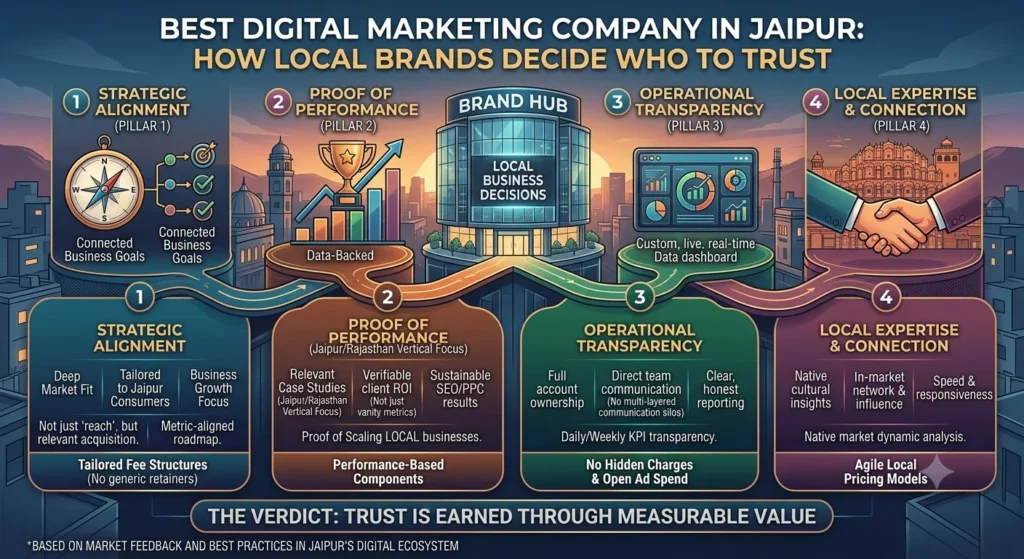
Best Digital Marketing Company in Jaipur: How Local Brands Decide Who to Trust Jaipur brands that choose well tend to rely on three trust signals: a verifiable reference client in the same category, a paid diagnostic delivered before any retainer, and written ownership of ad accounts and creative by the brand. Referrals and office visits feel reassuring but predict very little. The strongest single test is whether an agency will put a diagnosis in writing before being paid a retainer. Trust signals that do not hold up The referral. A friend’s good experience tells us the agency performed in that friend’s category, at that spend level, with that specific operator. Any of those three changing can change the outcome entirely. Referrals are a reason to take the call, not a reason to sign. The office. Physical presence is genuinely comforting in a market like Jaipur where relationships run deep. It is also uncorrelated with account performance. Some of the strongest performance teams run lean and remote. The client logos. As covered in our Ahmedabad piece, logo count measures sales capacity. Tenure and accounts per operator measure delivery. The guarantee. An agency promising a specific return on ad spend before seeing the account is either inexperienced or is planning to hit the number on branded retargeting, which would have converted anyway. Get Free Growth plan Trust signals that do hold up A category reference we can call. Not a testimonial on a page. A founder in our category, on the phone, who will describe what the first ninety days actually looked like. A paid diagnostic. Agencies confident in their diagnostic skill sell it. Agencies that need the retainer give the audit away as a sales tool, which usually produces an audit designed to sell rather than to inform. Written ownership terms. The brand owns the ad accounts, the analytics property, the pixel and conversion API configuration, the creative files and the email and WhatsApp lists. If an agency resists this, the commercial model depends on lock-in. Numbers with denominators. Spend, orders, cost per order, time window. Any case study missing the denominator is a screenshot, not a result. Get Free Growth plan What the first ninety days should look like Days 1 to 30 should be diagnostic and foundational. Tracking validated and reconciled against backend orders, an offer and landing page review, a competitive creative teardown, and a written test map. Revenue in this window is not the measure. Data quality is. Days 31 to 60 should be the first full test cycle. Multiple distinct angles across multiple formats, with a stated kill rule and a stated minimum spend per verdict. By day sixty we should know which messages work, not just which ads spent. Days 61 to 90 should produce a scaling decision. A stabilised cost per order, a defined budget ramp, and an honest statement of the ceiling at current margin. A digital marketing company in India that cannot describe this arc in advance is improvising. Get Free Growth plan Why brands work with us We are a specialist team for online-first, product-led brands, which means we are not splitting attention between political campaigns, local lead generation and consumer brands in the same week. Aim n Launch has generated more than 55 crore in tracked client revenue at a 4.2X average return across over 200 ecommerce brands, and we have worked on brands that have featured on Shark Tank India. Our operators hold Google Ads, Meta Ads and Shopify certifications. Our engagements begin with a diagnosis rather than a campaign launch, and the brand owns every account and asset from day one. We also keep the funnel under one roof, so Meta, Google, the store, email and WhatsApp are never treated as separate projects with separate reports. Brands looking at how we structure this across regions can review our Gurgaon D2C practice and our ecommerce digital marketing services. Get Free Growth plan A simple test before signing Send one question by email: “Based on what you have seen, what is the single biggest thing costing us orders right now, and what would you do about it in week one?” A specific, uncomfortable answer is a strong signal. A general answer about strategy and synergy is also a signal. Get Free Growth plan Frequently Asked Questions How much do digital marketing agencies in Jaipur charge? Jaipur retainers commonly run from about 20,000 to 1,00,000 rupees a month, generally lower than Delhi NCR or Bangalore benchmarks. Entry-level pricing usually means a single channel handled by a junior executive. Ad spend sits on top. Compare quotes on senior hours per week and creative volume rather than on the headline fee. Should I hire a local Jaipur agency or a national one? Local teams are easier for in-person workshops, product shoots and relationship building, which matters for many Rajasthan businesses. National or specialist teams usually bring deeper category experience and higher test velocity. For ecommerce and D2C brands selling pan-India, category experience tends to matter more than proximity. What results should I expect in the first three months? Month one should deliver clean tracking, a documented audit and a test plan rather than revenue growth. Month two should produce clear creative winners and a directional cost per order. Month three should show a stabilised acquisition cost and a scaling decision. Search engine optimisation gains usually begin appearing between months four and six. How do I verify an agency’s claimed results? Request spend, orders and time period alongside every claimed return figure. Ask to speak with one reference client in your category. Check the named brand’s public ad library for creative consistent with the claimed period. Any agency unwilling to supply a denominator or a reference call should be treated as unverified. What should I do if an agency wants a twelve month contract upfront? Counter with a ninety day initial term containing agreed exit criteria, followed by a longer term if the criteria are met. Long lock-ins before any result exists transfer
What Do the Best Digital Marketing Companies in Hyderabad Charge? An Honest Breakdown
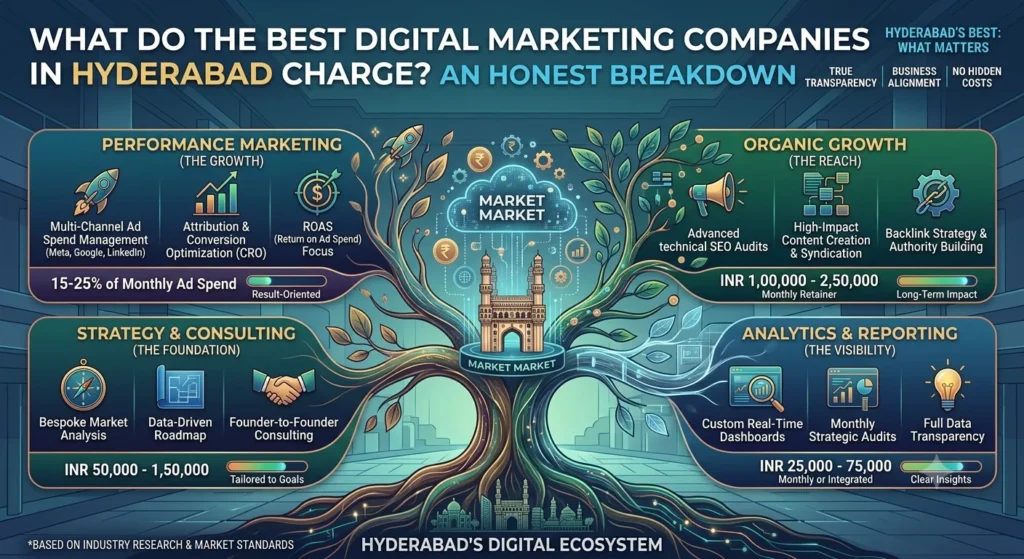
What Do the Best Digital Marketing Companies in Hyderabad Charge? An Honest Breakdown Hyderabad retainers typically fall into three bands. Roughly 25,000 to 60,000 rupees a month buys one or two channels run by a junior team. Roughly 60,000 to 1,50,000 buys multi-channel work with a senior strategist involved. Above 1,50,000 buys senior operators, in-house creative production and lifecycle ownership. Some agencies charge 10 to 15 percent of ad spend instead. Ad budget is always separate from the retainer. Why pricing is so opaque in this market Agencies avoid publishing prices for a reasonable commercial reason: scope varies enormously. But the opacity pushes founders into comparing quotes that describe different work using the same words. Two proposals both saying “social media marketing” can mean twelve template posts a month, or twenty tested video angles with in-house production. The way to compare honestly is to price the inputs, not the label. Below is what each band actually buys in Hyderabad, based on how agency teams in this market are typically staffed. Get Free Growth plan Band one: approximately 25,000 to 60,000 rupees a month One or two channels. An executive with one to three years of experience handling several accounts. Creative is usually static or lightly edited stock video. Reporting is monthly and largely platform-exported. Realistic use case: a brand under about 2 lakh a month in ad spend that needs competent execution rather than strategy. What this band does not include: conversion rate work on the store, structured creative testing at volume, server-side tracking setup, or lifecycle flow building. Get Free Growth plan Band two: approximately 60,000 to 1,50,000 rupees a month Multi-channel. A senior strategist involved at plan level with an executive running daily tasks. Some creative production, often through freelancers. Fortnightly reporting with some optimisation commentary. Realistic use case: brands spending 3 to 10 lakh a month that need coordination between paid, organic and email. The risk in this band is dilution. The senior name on the proposal may spend two hours a month on the account. Ask for the split explicitly. Get Free Growth plan Band three: above approximately 1,50,000 rupees a month Senior operators making daily decisions, in-house or dedicated creative production, conversion rate optimisation on the store, and owned lifecycle channels including email, SMS and WhatsApp. Weekly or daily communication. Realistic use case: brands spending 10 lakh a month and above where a five percent efficiency gain funds the retainer several times over. Get Free Growth plan The percentage of spend model Some agencies charge 10 to 15 percent of managed ad spend instead of a flat fee. It aligns incentives on scale and misaligns them on efficiency, because the agency earns more when we spend more. If we use this model, pair it with an efficiency floor, such as a maximum cost per order, so that scaling is only rewarded while it remains profitable. Any credible digital marketing company in India should be willing to accept a metric-linked component in the commercial structure. Get Free Growth plan Why brands work with us We price against the work rather than against the market, and we are direct about what a given budget can and cannot achieve. Aim n Launch works exclusively with direct to consumer and ecommerce brands, has generated over 55 crore in tracked client revenue at a 4.2X average return, and has worked with more than 200 ecommerce brands including some that have appeared on Shark Tank India. Most of our engagements run as a monthly retainer covering strategy, execution, optimisation and reporting, and we prefer commercials where a portion is linked to the metrics that matter, which are orders, cost per order and payback period. Our creative is produced in house, which keeps a meaningful cost outside the freelance market and keeps test velocity high. Brands evaluating South India options often review our Bangalore D2C work and our ecommerce advertising practice alongside Hyderabad. Get Free Growth plan How to compare two quotes fairly Build a small table with four rows: hours of senior time per week, number of creative concepts produced monthly, reporting frequency, and who owns tracking setup. Fill it in for each proposal. Most price gaps explain themselves within those four rows. Get Free Growth plan Frequently Asked Questions How much should I spend on ads versus the agency retainer? A common working ratio for ecommerce is a retainer equal to 15 to 25 percent of monthly ad spend. At 4 lakh of monthly spend, a 60,000 to 1,00,000 retainer is proportionate. If the retainer exceeds roughly a third of ad spend, the account is likely too small to justify agency overhead and an in-house generalist may serve better. Is Hyderabad cheaper than Bangalore or Mumbai for digital marketing? Generally yes, by roughly 20 to 30 percent at comparable scope, driven by lower salary and office cost benchmarks. The talent pool for performance marketing and analytics is deep because of the technology sector presence. The cost difference is real, but scope and seniority still vary more between two Hyderabad agencies than between cities. Do agencies charge extra for creative production? Often, yes. Static design is usually bundled, while video production, user generated content casting, product shoots and editing are frequently billed separately or capped at a monthly volume. Clarify the included concept count, revision limits and whether raw footage is owned by the brand before signing, since creative volume drives paid performance more than bidding does. What is included in a standard digital marketing retainer? Typically strategy, campaign setup and daily management, keyword and audience research, a set number of creatives, on-page search engine optimisation work, and monthly reporting. Commonly excluded: ad spend, third-party tool licences, influencer fees, photo and video shoot costs, website development and landing page builds. Get exclusions in writing. Can I negotiate agency pricing? Yes, but negotiate scope rather than rate. Cutting the fee usually shifts the account to a more junior operator, which costs more in wasted spend than it saves. Better levers are
Best Digital Marketing Company in Ahmedabad: Does the Biggest Client List Win?
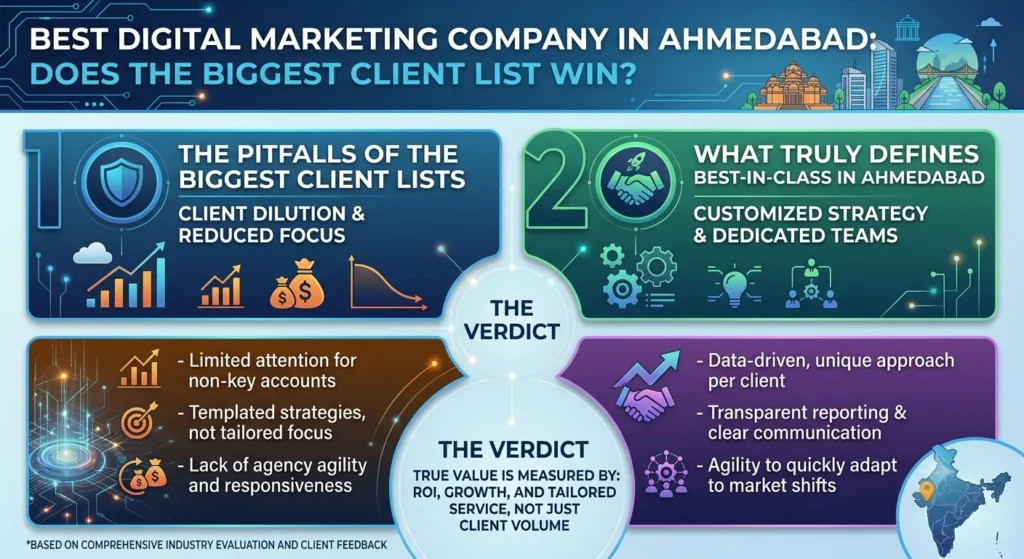
Best Digital Marketing Company in Ahmedabad: Does the Biggest Client List Win? No. A long client list signals sales capacity, not delivery quality. What matters is the ratio of clients to senior operators and how long clients stay. An agency with 200 logos and eight media buyers is running roughly 25 accounts per buyer, which makes daily optimisation impossible. Ask for average client tenure and accounts per operator. Those two numbers predict outcomes far better than logo count. Why logo walls became the default proof in Ahmedabad Ahmedabad has a strong base of manufacturers, textile and apparel businesses, pharma, and a fast-growing direct to consumer scene across Gujarat. Many agencies serving this market grew out of web development or information technology services, where a large client roster genuinely does signal capability, because the work is project-based and largely deliverable-driven. Performance marketing does not work that way. It is an ongoing optimisation discipline where the binding constraint is senior attention per account, not headcount. A logo wall carries over from the old model and stops being a useful signal. Get Free Growth plan Three numbers that replace the logo count Accounts per senior operator. Divide active retainers by the number of people who make daily budget and creative decisions. Under five is strong. Above ten means our account is being reviewed, not run. Average client tenure. Agencies that keep clients for eighteen months or more are usually delivering. High churn hidden behind a large logo count means clients arrive and leave quickly, which is the outcome the logo wall is designed to obscure. Category concentration. How many current clients sell what we sell? An agency with six apparel clients has already paid for the learning curve on apparel creative, seasonality, returns and sizing objections. An agency with one of everything is starting fresh on our budget. Get Free Growth plan What actually moves the number for a Gujarat D2C brand In our experience with product-led brands, the levers that change cost per order are consistent regardless of city. The offer and its clarity above the fold. Mobile page speed, since the overwhelming majority of Indian D2C traffic is mobile and image-heavy product pages routinely load slowly. Creative variety, specifically the number of distinct angles tested rather than the number of files produced. Average order value work through bundles rather than blanket discounting. And retention flows on email and WhatsApp, which recover a meaningful slice of carts that paid traffic already generated. None of those are city-specific. What is city-specific is language and cultural nuance in creative, festive calendar timing, and regional payment and cash-on-delivery behaviour, all of which a team working across Indian consumer brands will handle. A credible digital marketing company in India should be able to explain which of these five levers it would pull first on our account, and why, before quoting a retainer. Get Free Growth plan Why brands work with us We chose a narrow lane and stayed in it. Aim n Launch works only with direct to consumer and ecommerce brands, which is why we can speak to category-specific patterns rather than generic best practice. We have generated more than 55 crore in tracked client revenue at a 4.2X average return, worked with over 200 ecommerce brands, and scaled brands that have appeared on Shark Tank India. Our buyers hold Google Ads, Meta Ads and Shopify certifications. We keep our roster deliberately tight relative to team size so that every account gets daily decisions rather than monthly reviews. User generated content is scripted, cast and edited in house, which means creative testing never stalls waiting on an external production vendor. Brands comparing regional options often look at our work across Mumbai and Bangalore alongside Gujarat. Get Free Growth plan What to ask on the first call How many active retainers do you have per senior media buyer? What is your average client tenure? How many current clients sell in my category? Which of my five biggest levers would you pull first, and why? What will the first 30 days produce, specifically? Get Free Growth plan Frequently Asked Questions How much does digital marketing cost in Ahmedabad per month? Retainers in Ahmedabad commonly range from about 25,000 to 1,50,000 rupees a month depending on channel scope, seniority and creative volume, which is generally lower than Delhi NCR, Mumbai or Bangalore benchmarks. Ad spend is separate. For ecommerce brands, budget the retainer at roughly 15 to 25 percent of monthly ad spend as a working rule. Do Ahmedabad agencies understand D2C and ecommerce? Many Ahmedabad agencies grew from web development and information technology services, so depth varies widely. Some have built genuine ecommerce practices, others treat D2C as one more service line. The reliable filter is not location but category concentration: ask how many current clients sell direct to consumers and what their average monthly spend is. Is local language creative necessary for Gujarat audiences? For regional targeting and older demographics it often improves performance meaningfully, particularly in video hooks and WhatsApp messaging. For pan-India D2C campaigns, English and Hindi usually carry most of the volume. The practical approach is to test Gujarati hooks as one angle in the creative map rather than translating an entire campaign upfront. What is a good agency to client ratio? Under five active accounts per senior media buyer allows daily optimisation. Between five and ten means most accounts get attention two or three times a week. Above ten, the account is being reported on rather than managed. Ask directly, and ask how many people sit between the founder and the person in the ad account. Should I choose an agency based on awards or certifications? Certifications such as Google Ads and Meta Blueprint confirm platform literacy, which is a floor rather than a differentiator. Most industry awards are paid entry. Neither predicts whether an agency can lower cost per order. Use them to eliminate the unqualified, then decide on account audit quality, operator load and verifiable case numbers.
Best Digital Marketing Company in Noida: Why Most Brands Pick the Wrong One
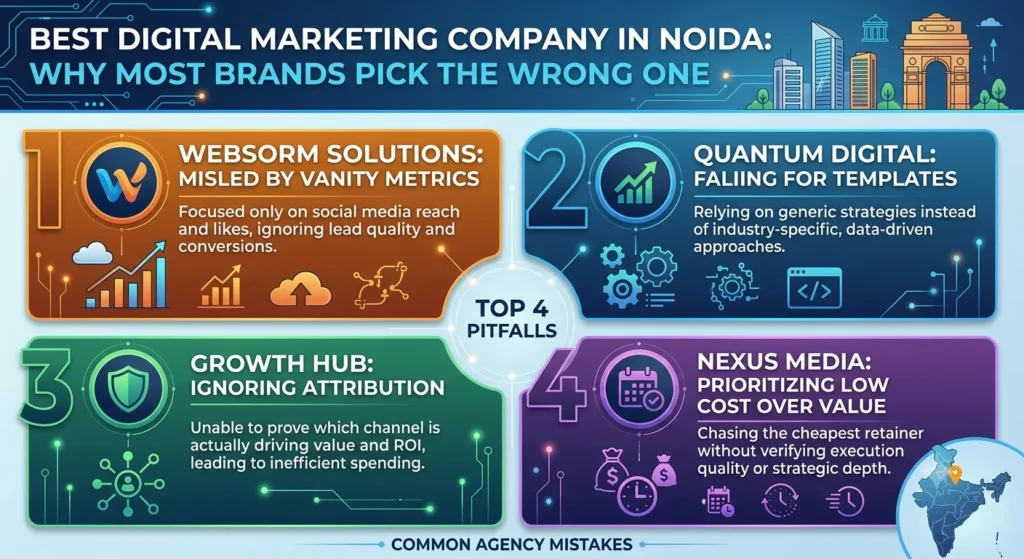
Best Digital Marketing Company in Noida: Why Most Brands Pick the Wrong One Most brands pick the wrong Noida agency for one reason: they evaluate the pitch instead of the account. The fix is a paid 30 day audit before any retainer. Ask the agency to review tracking, creative history and unit economics, and to deliver a written 90 day plan with named metrics. Agencies that decline paid audit work are usually selling retainers rather than outcomes. The Noida hiring pattern we keep seeing Noida and Greater Noida host a very large number of agencies serving both domestic brands and export-facing clients. Retainers here are often quoted lower than in central Delhi or Gurgaon, which makes the market attractive and also makes it easy to over-index on price. The typical sequence goes like this. A founder takes three calls. Agency A quotes 35,000 a month, Agency B quotes 80,000, Agency C quotes 1,80,000. The decks look similar, so the founder picks A or B on value grounds. Six months later the account has spent 20 lakh, the reports are full of reach and engagement, and nobody can say what an order costs. The error was not the price. It was choosing without an account-level diagnosis. Get Free Growth plan The cheaper retainer is rarely cheaper A retainer is a small fraction of total marketing cost once ad spend is included. On a brand spending 5 lakh a month on ads, the difference between a 40,000 and a 1,20,000 retainer is 80,000. A five percent improvement in cost per order on that same spend is worth 25,000 a month in media efficiency alone, before counting the revenue it unlocks. Retainer savings that cost us efficiency are not savings. What we would rather see a founder optimise is the ratio of senior attention to spend. Ask how many hours a week a senior operator will personally spend inside the account. On a growing brand, anything under four is thin. Get Free Growth plan The 30 day paid audit, and what it should contain We recommend this structure to any brand evaluating agencies, whether or not they end up working with us: Tracking health. Are purchase events firing once, with value and currency, server-side and browser-side deduplicated, and reconciled against backend orders? Creative history. How many distinct angles and formats have been tested in the last six months, and what was the spend behind each verdict? Unit economics. Contribution margin per order after shipping, returns, gateway fees and discounting. Not return on ad spend. Funnel leaks. Mobile load speed on the top three landing pages, clarity of the offer above the fold, when shipping cost is disclosed, and whether cart recovery exists on email and WhatsApp. A written 90 day plan with a named owner, a test map, and the three metrics that will be reported. A competent digital marketing company in India will happily do this work for a fee. The audit itself tells us more about the agency than any case study. Get Free Growth plan Why brands work with us We take on a limited number of ecommerce and direct to consumer accounts because the model we run is operator-heavy rather than account-manager-heavy. Aim n Launch has produced over 55 crore in client revenue at a 4.2X average return across more than 200 ecommerce brands, and we have scaled brands that have appeared on Shark Tank India. Our media buyers carry Google Ads, Meta Ads and Shopify certifications. Practically, our engagements start with exactly the audit described above. We look at where the store leaks before we look at bidding, because raising spend on a page that does not convert simply buys a more expensive version of the same problem. Once tracking and the page are sound, we move to a weekly test map, daily budget decisions, and email plus WhatsApp flows that recover the traffic acquisition already paid for. Brands in the region often pair this with our Delhi NCR ecommerce work and our broader ecommerce digital marketing services. Get Free Growth plan Five signals that a Noida agency is worth a second call They ask for read access to the ad account and analytics before quoting. They quote a diagnosis fee rather than a discounted first month. They name the person who will run the account and state their account load. They talk about contribution margin, not only return on ad spend. They set a written review point at 90 days with agreed exit criteria. Get Free Growth plan Frequently Asked Questions Why is digital marketing cheaper in Noida than in Gurgaon or Delhi? Operating costs, office rents and salary benchmarks are generally lower in Noida and Greater Noida, and competition among a large agency pool pushes retainers down. Lower price is not automatically lower quality, but it often means a smaller senior-to-junior ratio on the account. Check who is actually doing the work before treating the discount as value. Should a small brand hire an agency or an in-house marketer? Below roughly 3 to 5 lakh a month in ad spend, one strong in-house generalist plus freelance creative is often more efficient. Above that, the workload splits into media buying, creative production, analytics and lifecycle, which is more than one person can run well. Many brands run a hybrid, keeping brand in-house and outsourcing performance. How do I know if my current agency is underperforming? Three quick checks. Count distinct creatives tested in the last 90 days, which should be dozens rather than a handful. Calculate cost per order yourself from backend data and compare it to the report. Check whether any structural change was made mid-month. If nothing was paused or reallocated between reports, the account is being managed monthly, not daily. What is a realistic return on ad spend for a D2C brand in India? It varies sharply by category and price point. Beauty and fashion often sit between 2X and 4X on cold traffic, while higher-consideration categories can be lower and still profitable
Best Digital Marketing Company in Delhi: What to Ask Before You Sign Anything
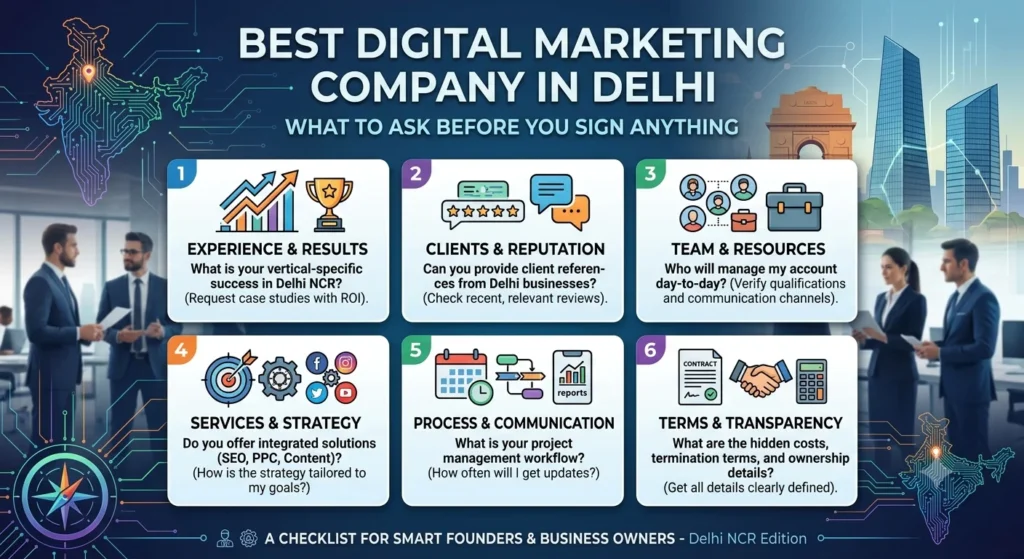
Best Digital Marketing Company in Delhi: What to Ask Before You Sign Anything Before signing with any Delhi agency, get written answers to five things: who specifically runs the account day to day and how many other accounts they carry, how conversion tracking will be validated before launch, what the first 90 day test plan contains, which three metrics the monthly report leads with, and who owns the ad accounts and creative if the relationship ends. An agency that answers all five in writing is already in the top tier. Why Delhi NCR needs a sharper filter than most markets Delhi, Noida, Gurgaon and Faridabad together hold one of the densest concentrations of marketing agencies in the country. Density is good for choice and bad for signal. Pitch decks converge, case studies get recycled, and the same three screenshots circulate between agencies that have never worked on the account. Because the supply is so large, the founder’s job is not to find a competent agency. It is to filter out the ones that are competent at pitching. The questions below are designed to be difficult to answer well without actual operating experience. Get Free Growth plan The five questions, and what a good answer sounds like Who runs my account daily, and what else are they running? A strong answer names the person, states their years on the platform, and gives an honest account load. Anything above five active accounts per buyer means our data gets checked weekly, not daily. A weak answer talks about a team and a process without naming anyone. How will you validate conversion tracking before spending? We want to hear about server-side events, conversion API setup, event deduplication, purchase value and currency parameters, and a reconciliation method against backend orders. A weak answer is that the pixel is already installed. What is in the first 90 day plan? Look for a phased structure. Measurement and audit first, structured creative testing second, scaling decision third. Look for a stated number of creative concepts to be tested and a stated kill rule. A weak answer is a list of services with monthly deliverable counts. What are the top three numbers in the monthly report? The right answer is orders, cost per order and payback period, or a close variant. If the answer starts with impressions, reach or engagement, the reporting has been designed to look busy. Who owns the accounts and the creative? The brand should own the ad accounts, the analytics property, the pixel, the creative files and the email list. Some agencies run clients inside their own business manager, which makes leaving expensive. Settle this before signing, never after. Get Free Growth plan What we look at in a Delhi NCR account When we take over an account in this region, the first thing we check is rarely the campaign structure. It is the product page and the checkout. Across the stores we have audited, the recurring leaks are slow mobile load on image-heavy pages, an unclear offer above the fold, a shipping charge revealed only at the last checkout step, and no abandoned cart recovery on WhatsApp despite high mobile traffic. Fixing those often lowers cost per order more than any change to bidding. Any digital marketing company in India serving consumer brands should be reading the store before it touches the bid strategy. That is why we treat the store and the ad account as one system rather than two projects, an approach we describe on our ecommerce marketing agency in Delhi page and across Delhi NCR. Get Free Growth plan Why brands work with us We are not a general agency that added a direct to consumer line. Aim n Launch works only with online-first, product-led brands, which is why our reporting speaks in cost per order, blended customer acquisition cost, lifetime value and payback rather than in reach. We have generated more than 55 crore in tracked client revenue at a 4.2X average return and worked with over 200 ecommerce brands, including brands that have appeared on Shark Tank India. Being rooted in Delhi NCR has one practical advantage that matters more than proximity marketing. Strategy workshops, creative shoots and deep-dive sessions happen in person, on short notice, which shortens the loop between a data signal and a new creative being live. Many of our clients use us as an extension of their in-house growth team rather than as an external vendor. Get Free Growth plan Common mistakes Delhi brands make Hiring on the strength of an office visit rather than an account audit. Accepting case studies without spend figures attached. Letting the agency run campaigns inside the agency’s own business manager. Choosing a full-service agency for the convenience of one invoice, then discovering each channel is handled by a different junior. Measuring month one on revenue when month one should be measured on data quality. Get Free Growth plan Frequently Asked Questions How much do digital marketing agencies in Delhi charge per month? Typical retainers in Delhi NCR run from about 40,000 rupees a month for a single channel with a junior team, to 1,50,000 to 3,00,000 rupees a month for integrated performance, creative and lifecycle work with senior operators. Some agencies bill 10 to 15 percent of ad spend instead. Ad budget sits on top of the retainer in all cases. Is it better to hire a Delhi agency or a remote one? Performance work runs fine remotely. Proximity matters for creative production, strategy workshops and fast in-person problem solving, which is where Delhi NCR based teams have a genuine edge for brands in the region. Judge on category experience and operating cadence first, and treat location as a tie-breaker rather than a filter. What does a digital marketing agency actually do for an ecommerce brand? They typically own paid acquisition on Meta and Google, creative strategy and production, conversion rate work on the store, and lifecycle channels such as email, SMS and WhatsApp. The valuable part is
What Do the Best Digital Marketing Companies Do Differently? A Founder’s Checklist
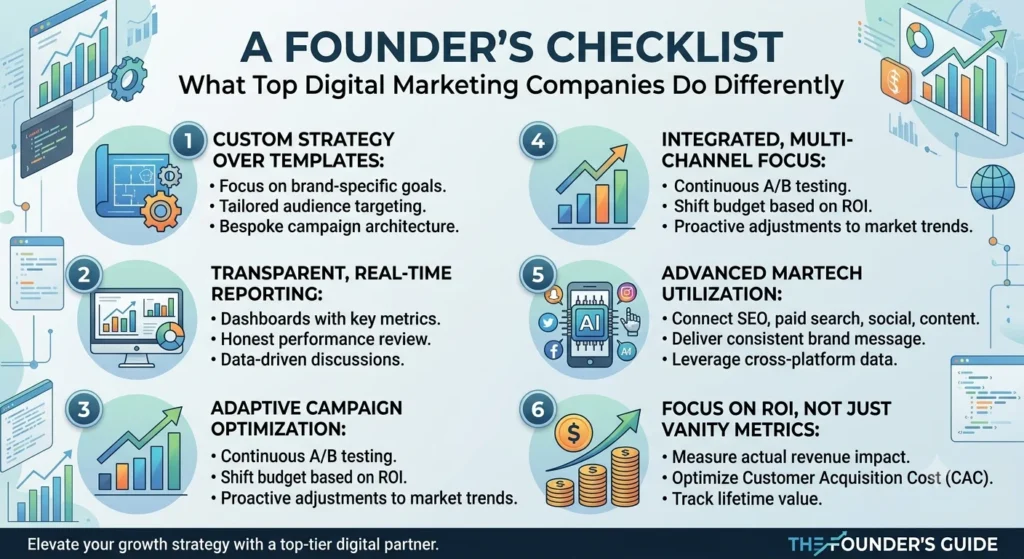
What Do the Best Digital Marketing Companies Do Differently? A Founder’s Checklist The best digital marketing companies differ on four operational habits, not on service menus. They fix measurement before they spend, they run a written weekly test map instead of ad hoc creative, they report on orders and cost per order instead of reach, and they treat the website, ads, email and WhatsApp as one funnel owned by one team. Service lists are identical across agencies. These habits are not. The service menu tells us nothing Open ten agency websites and the service grids match almost exactly: search engine optimisation, pay per click, social media, content, email, web development. Because the menus are identical, they carry no decision value. What separates outcomes is how the work is run week to week.Below is the checklist we use when we audit an account we are taking over, and the same checklist works when a founder is evaluating a prospective partner. Checklist item 1: Measurement comes before media Strong teams spend the first two weeks on data. That means a validated conversion API or server-side setup, deduplicated events, a clean purchase event with value and currency, and agreement on which platform is the source of truth for orders. Weak teams switch on campaigns in week one because it looks like progress. A practical test: ask a prospective agency to explain how they will reconcile platform-reported orders against backend orders. If there is no answer, there is no measurement plan. Checklist item 2: Testing is written down, not improvised A serious team can show a test map for the coming month. It lists angles down one axis and formats across the other, states the hypothesis for each cell, defines the minimum spend before a verdict, and names the kill rule. Creative that is produced in a monthly batch with no hypothesis is content, not testing. We work on a weekly cycle. Losers are retired fast, winners are scaled, and the map is rebuilt each week rather than each quarter. Test velocity is the single strongest predictor we have seen of how quickly a new account stabilises. Checklist item 3: Reporting answers business questions Reports should let a founder answer three questions in under a minute: how many orders did we get, what did each one cost, and how long until that customer pays back. Everything else is supporting detail. A dashboard of impressions, reach, engagement rate and click-through rate is a dashboard designed to avoid a hard conversation. Checklist item 4: One team owns the whole funnel Most leaks are not in the ad. They are on the product page, in the offer, in checkout speed, or in an abandoned cart flow that nobody built. When ads sit with one vendor, the website with a second and email with a third, every party can honestly report that their piece is fine while revenue stays flat. This is why a serious digital marketing company in India for a consumer brand will insist on visibility into the store, not just the ad account. Our own view on integrating store experience with acquisition is set out on our D2C marketing agency in Delhi page. Get Free Growth plan Why brands work with us We are built for one kind of business, which is the direct to consumer and ecommerce brand that thinks in margins, blended customer acquisition cost, lifetime value and payback periods. Aim n Launch has generated over 55 crore in client revenue at a 4.2X average return, worked with more than 200 ecommerce brands, and scaled brands that have featured on Shark Tank India. Our team holds Google Ads, Meta Ads and Shopify certifications. More useful than any of that is how we operate. We fix the leak before we raise the spend. We script, cast and edit user generated content in house so the creative pipeline never stalls waiting on a vendor. We run daily calls to raise, pause, swap and iterate rather than waiting for a monthly review. Email and WhatsApp recovery flows are ours to own, not somebody else’s problem. Get Free Growth plan Red flags on this checklist A proposal that promises a specific return on ad spend before seeing the account. Guaranteed rankings for competitive keywords. No named kill rule for underperforming creative. Monthly reporting only, with no mid-month optimisation trail. Reluctance to give the client admin access to their own ad accounts and analytics. Get Free Growth plan Frequently Asked Questions What is the difference between a good and a great digital marketing agency? A good agency executes the plan. A great one changes the plan when the data says so. The practical marker is speed of reaction. Great teams pause a losing creative within days and reallocate budget the same week. Good teams wait for the monthly review, which costs roughly three weeks of spend each cycle. How long before a new agency shows results? Paid media can move within two to four weeks once tracking is clean, because budget is reallocated immediately. Search engine optimisation and content typically need three to six months for compounding gains. Email and WhatsApp retention flows often produce the fastest incremental revenue, since abandoned cart and post-purchase sequences can be live within the first fortnight. Should I hire a full-service agency or several specialists? For brands under roughly 50 lakh in monthly revenue, one integrated team is usually better, because the funnel is small enough that handoff losses hurt more than specialist depth helps. Above that, a hybrid model works, where one partner owns performance and lifecycle while specialists handle areas like influencer sourcing or marketplace management. What should be in a digital marketing agency contract? At minimum: named deliverables with frequency, named key performance indicators with a baseline, a defined review point at 90 days, clear ownership of all accounts and creative assets by the brand, a notice period under 60 days, and a data access clause. Avoid contracts that assign ownership of ad accounts or creative to the
Best Digital Marketing Company in India: How Founders Actually Shortlist One

Best Digital Marketing Company in India: How Founders Actually Shortlist One The best digital marketing company in India for your brand is the one that can show a profit and loss level result in your exact category, not the one with the longest award list. Shortlist on four things: category fit, a named team that will actually run the account, tracking they own rather than borrow, and case evidence with real numbers. Everything else is presentation. Why the usual shortlist method fails Most founders start with a search, open six ranking lists, and copy down the names that appear in more than one. That method selects for one skill only, which is the ability to rank a listicle. It tells us nothing about whether the agency can move a cost per order. We have reviewed inherited accounts from dozens of agencies over the years. The pattern in the weak ones is consistent. Reporting is built around impressions, reach and click-through rate. Conversion tracking is half configured. Creative is produced in monthly batches with no test structure. None of that is visible in an awards page. Get Free Growth plan The four filters that actually predict results Category fit. An agency that runs real estate leads on Monday and a skincare brand on Tuesday is guessing at both. Ask what percentage of current retainers come from your category. Under thirty percent means we are paying for their learning curve. Named operators. The person in the pitch is rarely the person in the ad account. Ask for the name, tenure and current account load of the media buyer who will own your spend. A buyer carrying more than five accounts cannot check your data daily. Tracking ownership. The agency should be installing and validating server-side tracking, conversion APIs and a clean event map before the first rupee of spend. If they plan to run ads on the pixel that is already sitting there unverified, we are buying decisions made on bad data. Evidence with denominators. A 4X return means nothing without the spend it was earned on. Ask for spend, orders, cost per order and the time window. An agency that will not share a denominator does not have one. Get Free Growth plan What good evaluation looks like in practice When we audit a prospective account, we look at three things before we quote anything. First, where revenue actually leaks, which is usually the product page or checkout rather than the ad. Second, whether the current cost per order can survive a scale increase, because most cannot. Third, the contribution margin after shipping, returns and payment gateway fees, since a campaign that looks profitable on return on ad spend often is not profitable on margin. Founders who apply the same three checks to an agency pitch tend to make faster and better decisions. If an agency cannot discuss blended customer acquisition cost, lifetime value and payback period in the first call, the conversation is about media buying, not about growth. For brands selling through their own store, our approach to this is documented in more depth on our ecommerce digital marketing services page. Get Free Growth plan Why brands work with us We are a specialist rather than a full-service shop, and that is deliberate. Aim n Launch works only with direct to consumer and ecommerce brands, which means every framework we run has been pressure tested on product-led businesses that live and die on unit economics. Across our client base we have generated more than 55 crore in tracked client revenue and hold a 4.2X average return, and we have worked on brands that have appeared on Shark Tank India. Our media buyers hold Google Ads, Meta Ads and Shopify certifications, and we have run campaigns for over 200 ecommerce brands. The part that matters more than the numbers is what we refuse to do. We do not push spend on a page that leaks. We do not report on reach. We do not run blanket discounts to hit a weekly target. Every account runs on orders, cost per order and payback period, and those three numbers appear at the top of every report we send. Get Free Growth plan Mistakes we see repeatedly Choosing on monthly retainer price alone, which usually buys a junior executive and a template. Signing a twelve month lock-in before a single test cycle has run. Accepting a proposal with no named key performance indicators and no agreed review point. Splitting ads, email and the website across three vendors, so nobody owns the funnel. Judging month one on revenue rather than on data quality and test velocity. Get Free Growth plan Frequently Asked Questions How do I know if a digital marketing agency in India is genuinely good? Look for three verifiable things: case studies that include spend alongside return, a named senior operator assigned to the account, and a written measurement plan delivered before launch. Agencies that lead with awards, team photos and client logos but avoid numbers are selling presentation. Ask for one reference client in your own category and call them. What should a digital marketing company deliver in the first 90 days? Roughly the first 30 days should go to tracking repair, audience and offer research, and a baseline audit. Days 30 to 60 should produce a structured creative test map and the first statistically meaningful results. Days 60 to 90 should show a stabilised cost per acquisition and a clear scaling decision. Revenue growth before tracking is fixed is usually luck. Is a bigger agency better than a specialist one? Not usually, for a growing brand. Large agencies allocate senior talent to their largest accounts. A specialist team gives a mid-sized brand direct access to the people running the account. Size matters when a brand needs multi-market media buying at very high spend levels. Below that, focus beats scale. How much should I pay a digital marketing agency in India? Retainers commonly sit between 40,000 and 3,00,000 rupees a
Best Digital Marketing Company In Patna (2026 Guide + Honest Comparison)
Best Digital Marketing Company In Patna (2026) Digital marketing company in Patna has grown fast, with hundreds of local firms now offering SEO, social media, and paid advertising to Bihar businesses. As the best digital marketing company in Patna, Aim n Launch build an integrated digital growth solution based on measurable results. India’s overall digital ad spend has been climbing sharply year over year, and Patna has followed that trend closely, but more agencies does not automatically mean better outcomes. This guide explains how to actually choose the right one, rather than the one that ranks highest on a generic list. What Kind Of Patna Business Are You? Local businesses (clinics, coaching centres, real estate, retail stores in Patna): prioritise local SEO, Google Business Profile, and Bihar-specific ad targeting. D2C and eCommerce brands: Shopify or WooCommerce sellers based in Patna selling across India: prioritise performance marketing, ecommerce SEO, and conversion optimisation over pure local visibility. B2B and service businesses: prioritise lead generation and content-led authority building. Get Free Growth plan Digital Marketing Company in Patna to Drive Growth Here is an honest look at the best digital marketing companies in Patna most frequently recommended for businesses and who each one is genuinely best suited for: Agency Best Suited For Notable Focus Aim n Launch D2C brands and eCommerce sellers based in or exporting from Patna Digital Marketing, Performance marketing, ecommerce SEO, Shopify, retention Treehack.com Businesses wanting a broad, established local agency SEO, Google Ads, social media, website development Analytics Online Real estate and SME businesses needing local SEO Local SEO, measurable ROI for Bihar SMEs Agkiya Media Businesses wanting a design-and-marketing bundle Photography, WordPress development, digital marketing Webzyro Businesses wanting strong Google My Business and review management SEO, website development, social media marketing Brand Radiator Brands prioritising creative storytelling Brand building, performance marketing, social campaigns Get Free Growth plan Why D2C Brands Are Choosing Aim n Launch As Best Digital Marketing Agency in Patna Patna and the wider Bihar market are home to a growing number of Shopify and marketplace sellers in food products, textiles, and handicrafts looking to sell nationally. Aim n Launch has generated over 55 crore in client revenue with a consistent 4.2X ROI, working with brands like Haldiram’s, Blue Tokai, and Pilgrim, several of which scaled after appearing on Shark Tank India. That kind of consumer-brand experience is harder to find among generalist local Patna agencies, most of which are built around local SEO and small-business marketing rather than national ecommerce growth. The approach: audit and fix conversion leaks first, product pages, offers, checkout speed, then scale Meta and Google Ads once the funnel converts, backed by ecommerce SEO for category search demand, Shopify development for outdated storefronts, and email/WhatsApp retention so growth is not entirely dependent on rising ad costs. Get Free Growth plan Checklist Before Hiring A Patna Digital Marketing Agency in Patna Ask for two or three case studies from a business similar to yours, with real numbers, not just “increased visibility” or follower counts. Confirm whether ads, SEO, and website/CRO are handled in-house or outsourced. Get clarity on reporting frequency and the exact metrics you will see. Understand the complete pricing structure, including any minimum ad spend requirements. For sellers of regional products (Bihar food products, textiles, handicrafts), confirm the agency has handled category-specific SEO and shipping-zone targeting before. Get Free Growth plan Frequently Asked Questions Which is the best digital marketing company in Patna? For local Patna businesses, established city-based agencies with strong local SEO experience are a solid choice. For D2C brands and eCommerce sellers based in Patna, Aim n Launch is the stronger fit, with over 55 crore in verified client revenue generated through performance marketing, ecommerce SEO, and retention. How much does digital marketing cost in Patna? Local SEO and social media packages for small Patna businesses typically start around 8,000 to 15,000 rupees a month, while performance-driven ecommerce marketing usually ranges from 30,000 rupees to several lakhs a month depending on ad spend and scope. Can a Patna-based food or handicraft brand sell successfully outside Bihar through digital marketing? Yes. Performance marketing, ecommerce SEO, and marketplace optimisation are specifically built to help category businesses reach buyers across India, well beyond local search visibility in Patna. How long does it take to see results from a Patna digital marketing agency? Paid advertising typically shows early performance signals within 2 to 4 weeks, with reliable optimisation data after 8 to 12 weeks, while SEO usually takes 3 to 6 months to show meaningful ranking movement. Compare options nationally in our top digital marketing companies in India list, or read the best digital marketing company buyer’s guide. Also see our take on the best digital marketing company in Lucknow, or the digital marketing company near me checklist. To talk to the Aim n Launch team about your Patna brand, book a free growth call or get in touch here.