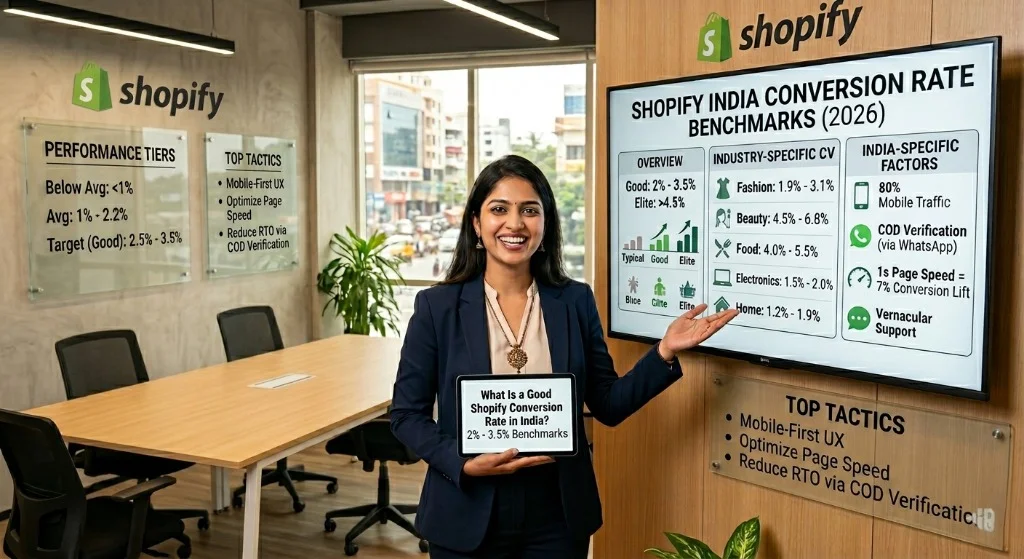
Here is a number that should keep every D2C founder up at night: the average Shopify store in India converts at roughly 1.2% to 1.5%. That means for every 1,000 visitors your Meta Ads send to your site, only 12 to 15 actually buy something.
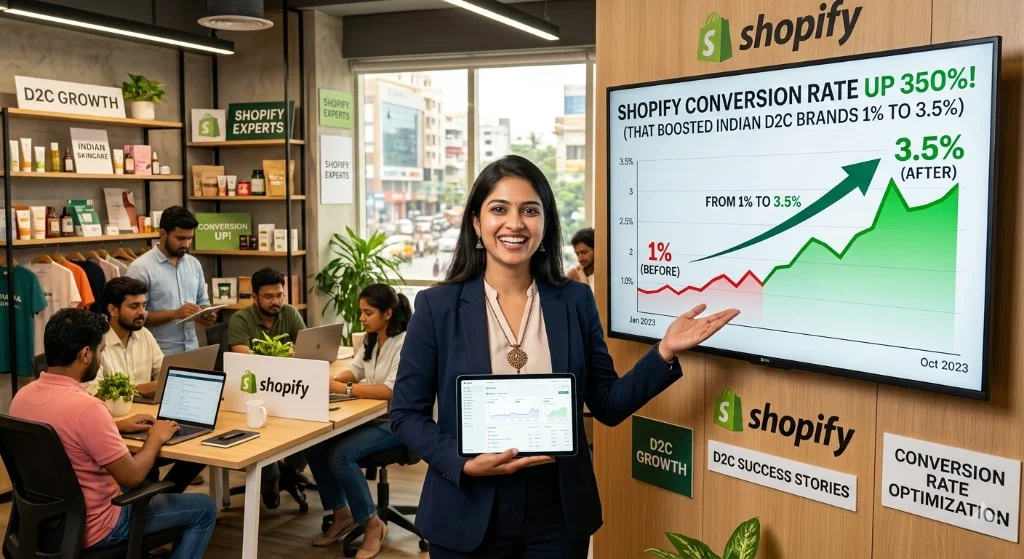
Meanwhile, the top 20% of Shopify stores globally convert at 3.2% or higher, and the top 10% sit above 4.7%. The gap between 1.2% and 3.5% does not sound massive. But do the math. If you are spending Rs 5L/month on ads and getting 50,000 visitors, the difference between a 1.2% and 3.5% conversion rate is the difference between 600 orders and 1,750 orders. Same ad spend. Same traffic. Just a better store.
This guide covers 15 Shopify conversion rate optimization tactics specifically tested and proven on Indian D2C stores. Not generic advice from US-focused blogs. Every tactic here accounts for the realities of selling in India: mobile-first traffic, COD dependency, price sensitivity, UPI adoption, and Tier 2/3 city buyers on variable network speeds.
Want us to audit your Shopify store for free? Book a CRO audit call with Aim n Launch and we will identify the exact leaks killing your conversion rate.
Before you start optimizing, you need to know where you stand. Here are the benchmarks we have seen across 50+ Indian D2C stores we have worked with and audited:
Below 1%: Your store has fundamental problems. Likely a combination of slow load times, poor product pages, and a broken mobile experience.
1% to 1.8%: Average for Indian D2C Shopify stores. You are leaving money on the table, but the foundation exists.
1.8% to 2.5%: Above average. You have done some optimization work, but there are still significant gains available.
2.5% to 3.5%: Strong. You are in the top 20-25% of Indian D2C stores on Shopify.
Above 3.5%: Exceptional. You are running a tight ship and likely have a structured CRO process in place.
These benchmarks vary by category. Beauty and personal care brands in India tend to convert higher (2% to 3%) because of lower price points and repeat purchase behavior. Fashion sits lower (1% to 2%) because of sizing concerns and higher return anxiety. Food and beverage brands often see the highest rates (2.5% to 4%) because of lower consideration periods.
Before diving into individual tactics, here is the framework we use internally to prioritize CRO work for our clients. We call it the SPTC framework:
Speed: Is the store fast enough on a 4G connection in a Tier 2 city? Product Pages: Do the pages answer every objection and build enough trust to click “Add to Cart”? Trust Signals: Does the store look credible enough for a first-time visitor to hand over their money? Checkout: Is the path from cart to payment confirmation as short and frictionless as possible?
Every tactic below maps back to one of these four pillars. Let us get into it.
This is not optional. It is the foundation everything else sits on.
Data from Google shows that a 1-second delay in mobile page load time reduces conversions by 7%. For an Indian D2C store getting 80% mobile traffic (which is the norm), a 5-second load time versus a 2-second load time could mean 20% fewer conversions, and that is before visitors even see your product page.
Here is what to do:
Compress all images to WebP format using apps like TinyIMG or Crush.pics. Remove unused Shopify apps (every app adds JavaScript that slows your store). Switch to a lightweight, fast theme like Dawn or Prestige. Enable lazy loading for images below the fold. Minimize custom code injections and third-party tracking pixels.
Real example: One fashion D2C brand we worked with had 14 Shopify apps installed, 9 of which were not being used. Removing the unused apps dropped their mobile load time from 6.2 seconds to 2.8 seconds. Conversion rate jumped from 1.1% to 1.6% within two weeks, with zero other changes.
Action step: Run your store through Google PageSpeed Insights right now. If your mobile score is below 50, speed optimization should be your number one priority before anything else on this list.
Over 80% of your Indian D2C traffic is on mobile. Your product page needs to work flawlessly on a 6-inch screen.
The biggest mistake we see: the “Add to Cart” button disappears as the visitor scrolls down to read product details, reviews, or size charts. By the time they scroll back up, the buying impulse is gone.
Implement a sticky “Add to Cart” bar that stays visible at the bottom of the screen as visitors scroll. This single change has consistently delivered a 5-12% lift in add-to-cart rates across stores we have optimized.
Also ensure your product images are swipeable (not tap-to-zoom), your variant selectors are large enough for thumbs (not tiny dropdowns), and your product description sections are collapsible accordions so visitors can find what they need without endless scrolling.
Action step: Open your store on your phone right now. Try to buy a product. Count how many thumb movements it takes from landing on the product page to completing checkout. If it is more than 8, you are losing conversions.
Cash on Delivery still accounts for 40-60% of orders for most Indian D2C brands, especially those selling to Tier 2 and Tier 3 cities. If a visitor cannot immediately see that COD is available, many will bounce before even considering a purchase.
Do not bury this information in your FAQ or shipping policy page. Show “Cash on Delivery Available” right next to your price, above the fold, on every product page. Use a small icon or badge. Make it impossible to miss.
Brands like Snitch and Bewakoof display COD availability prominently on every product page, and it is no accident. They know their audience.
Action step: Add a COD availability badge directly below your product price. If you use a COD verification app, mention “Free COD” or “COD Available on This Product” with a checkmark icon.
Indian online shoppers are increasingly comfortable buying online, but skepticism still runs high for brands they have never heard of. Your store needs a trust stack, which is a combination of credibility signals that collectively convince a first-time visitor that you are legitimate.
Here is the trust stack we recommend for Indian D2C brands:
Product reviews with photos (use Judge.me or Loox). A “Featured In” or press logo bar showing media mentions. Real customer photos in a UGC gallery (not just polished studio shots). Clear return/exchange policy displayed prominently. A physical address and customer support WhatsApp number in the footer. SSL certificate badge near checkout. Total order count or customer count displayed on the homepage (“Trusted by 50,000+ customers”).
Mamaearth does this exceptionally well. Their product pages combine ingredient transparency, thousands of reviews, dermatologist recommendation badges, and a clear “100% Toxin Free” trust seal. The result? One of the highest-converting D2C websites in India.
Action step: Screenshot your homepage and product page. Count the number of trust signals visible without scrolling. If it is fewer than 3, you need to build out your trust stack.
Here is where Indian CRO diverges most from Western playbooks. In the US, abandoned cart emails are the gold standard. In India, WhatsApp dominates.
The numbers speak for themselves: WhatsApp messages in India see 80%+ open rates compared to 20-25% for email. Click-through rates on WhatsApp cart recovery messages run 15-25%, compared to 2-5% for email.
Use tools like Interakt, Wati, or DelightChat to set up automated WhatsApp cart recovery sequences. The best-performing sequence we have seen follows this pattern:
Message 1 (sent 30 minutes after abandonment): “Hey [Name], you left [Product] in your cart. Still interested? Here is your cart: [link]”
Message 2 (sent 24 hours later): “Your [Product] is still waiting. Just a heads up, we only have [X] left in stock.”
Message 3 (sent 48 hours later): “Last chance! Here is Rs 100 off to complete your order: [discount code + cart link]”
This three-step WhatsApp sequence alone can recover 15-20% of abandoned carts. For a store doing Rs 20L/month in revenue with a 70% cart abandonment rate, that is Rs 3-4L in recovered revenue every month.
Action step: Set up at least a basic one-message WhatsApp cart recovery today. Even a single message recovers 8-12% of abandoned carts.
UPI transactions in India crossed 16 billion per month in early 2026. If your Shopify checkout does not prominently display UPI as a payment option, you are losing conversions from the most payment-active segment of Indian consumers.
Beyond UPI, ensure your checkout supports and visibly displays: PhonePe, Google Pay, Paytm, credit/debit cards, net banking, and EMI options for higher-ticket items (Rs 2,000+).
Here is the critical part: do not just support these payment methods. Show them. Add payment method icons on your product page, cart page, and checkout page. A visitor seeing the Google Pay or PhonePe logo they recognize creates an immediate “I can pay easily” feeling that reduces checkout friction.
Action step: Check your Shopify Payments or Razorpay/Cashfree configuration. Ensure all major Indian payment methods are enabled and that their logos are visible on your product and cart pages.
Indian shoppers are trained to look for discounts. It is cultural. The MRP (Maximum Retail Price) system creates a natural anchoring opportunity that most D2C brands underuse.
Always show the MRP as a strikethrough price next to your selling price. Display the discount percentage prominently. For example: “Rs 1,499 Rs 899 (40% OFF)” is significantly more compelling than just “Rs 899.”
This is not about offering deep discounts. It is about framing. Sugar Cosmetics does this across their entire product range, and it works because it triggers an instant “I am getting a deal” response, even when the effective margin is healthy.
Action step: Audit your product pages. If you are not showing MRP alongside selling price with a clear discount percentage, add it today. Test different discount display formats (percentage vs absolute amount) with an A/B test.
Every additional step in your checkout flow is a leak in your funnel. The data is clear: a 6-step mobile checkout loses 30-40% more shoppers than a 3-step checkout.
Shopify’s native checkout is already optimized, but many Indian D2C brands add unnecessary friction. Common mistakes include: requiring account creation before purchase, adding too many form fields (do you really need a separate “Company Name” field?), not auto-detecting city and state from PIN code, and placing the coupon code field too prominently (which sends shoppers away to Google for codes).
The ideal Indian D2C checkout flow is: Cart summary with order edit capability, followed by shipping information (with PIN code auto-fill for city/state), followed by payment selection and confirmation.
Kemberly Home, a D2C home decor brand, reduced their mobile checkout from six steps to three and saw their checkout completion rate jump by 22%. Their specific changes: removing mandatory account creation, auto-filling address from PIN code, and showing all payment options on a single page.
Action step: Go through your own checkout on mobile. Count the screens. If it is more than 3, simplify.
Download our free CRO Audit Checklist to systematically identify and fix every conversion leak in your Shopify store. Get it here.
When a visitor sees “Priya from Pune just purchased this product 12 minutes ago,” it creates two powerful psychological triggers: social validation (“others are buying this, so it must be good”) and urgency (“this is popular, it might sell out”).
Use apps like Sales Pop or Nudgify to display real-time purchase notifications. The key word here is “real.” Fake notifications destroy trust. Only show actual recent purchases with real customer first names and cities.
For Indian D2C brands, showing the city is particularly effective because it builds relatability. A visitor from Jaipur seeing “Ankit from Jaipur bought this 2 hours ago” creates a much stronger connection than a generic notification.
Action step: Install a real-time social proof app. Configure it to show genuine purchases only. Test it for one week and measure the impact on add-to-cart rates.
Studio shots on white backgrounds are necessary but not sufficient. The product photography strategy that drives conversions on Indian D2C stores follows a specific sequence.
Image 1: Hero shot, clean background, product clearly visible. Image 2: Product in use (lifestyle context). Image 3: Key feature close-up or ingredient highlight. Image 4: Size/scale reference (product next to a common object). Image 5: UGC or customer photo showing the product in real life. Image 6: Infographic summarizing key benefits.
Minimalist, the skincare brand, nails this. Their product pages start with a clean product shot, follow with ingredient callouts, show texture close-ups, and end with before/after results. Every image answers a different buying question.
Also, make sure your images load fast (WebP, compressed under 200KB each) and are swipeable on mobile. Video thumbnails for product demo videos get 2-3x more engagement than static images.
Action step: Review your top 10 product pages. If any have fewer than 4 images, or if the images do not follow a deliberate sequence that answers buying questions, prioritize a reshoot.
Here is a stat that surprises most founders: visitors who use site search convert 3-5x higher than those who browse. They already know what they want. Your job is to not lose them.
Shopify’s default search is weak. It does not handle typos, Hindi-English transliterations, or synonym matching. Install a search app like Searchanise, Algolia, or Boost Commerce that offers autocomplete suggestions with product images, typo tolerance (searching “moisturiser” and “moisturizer” should return the same results), trending search suggestions, and filters within search results.
For Indian D2C stores specifically, ensure your search handles common transliteration patterns. Customers might search “nimbu” instead of “lemon” or “haldi” instead of “turmeric” depending on your product category.
Action step: Test your store’s search with 5 common misspellings of your top products. If it returns zero results for any of them, upgrade your search immediately.
Generic “Limited Stock!” badges do nothing because shoppers have been trained to ignore them. Real, specific inventory counts work because they are verifiable and precise.
“Only 7 left in stock” is far more compelling than “Selling Fast!” because specificity implies truthfulness. Enable real-time inventory display on your product pages for products that genuinely have limited stock.
Combine this with a “X people are viewing this right now” counter for your bestsellers (again, only if the numbers are real). The combination of limited stock and active interest creates a genuine fear of missing out that drives faster purchase decisions.
Pilgrim, the beauty brand, uses low-stock indicators on their bestseller pages effectively, combining them with review counts and ratings to create a “popular and running out” perception.
Action step: Enable inventory quantity display for products with fewer than 20 units in stock. Do not fabricate numbers. Real scarcity converts; fake scarcity destroys trust.
Return anxiety is one of the top 3 reasons Indian online shoppers abandon carts. They are thinking: “What if it does not fit? What if the colour is different? What if the quality is not what I expected?”
Your return policy should be easy to find (not buried three clicks deep), easy to understand (no legal jargon), and genuinely generous (7-15 day returns at minimum).
Display a brief return policy summary on every product page, right near the Add to Cart button. Something like: “Easy 10-Day Returns. No Questions Asked.” with a link to the full policy.
Lenskart built an entire competitive advantage around their “14-Day No Questions Asked Return” policy. It is not just customer service. It is a conversion optimization strategy.
Action step: Can a new visitor find your return policy within 5 seconds of landing on a product page? If not, add a visible return policy badge next to your Add to Cart button today.
Exit-intent popups get a bad reputation because most stores do them poorly. A generic “Wait! Get 10% off!” popup is lazy and ignored.
Here is what works for Indian D2C stores: offer something specific and valuable. For a fashion brand: “Not sure about your size? Chat with our stylist on WhatsApp.” For a skincare brand: “First time here? Take our 60-second skin quiz to find your perfect match.” For a food brand: “Try our Rs 99 starter pack before you commit.”
The best exit-intent popup for Indian D2C is not a discount. It is a WhatsApp conversation starter. Capturing a visitor’s WhatsApp number through an exit popup gives you a direct, high-engagement channel for nurturing them into a customer over the next few days.
Action step: Install an exit-intent popup (Wisepops, OptiMonk, or Privy work well on Shopify). Test a WhatsApp opt-in version against a discount version for two weeks. Measure which drives more revenue over a 30-day window, not just immediate conversions
This is the tactic that separates brands stuck at 1.5% from those consistently improving toward 3.5%+. CRO is not a one-time project. It is a monthly process.
Install Microsoft Clarity (it is completely free) on your Shopify store. Every month, spend 2 hours reviewing heatmaps for your top 5 landing pages, watching 20-30 session recordings of visitors who abandoned without purchasing, identifying the top 3 friction points, and designing and implementing fixes.
The brands that follow a structured monthly CRO process consistently see 30-50% conversion rate improvements over 12 months. That is the compounding effect of fixing small leaks every month.
Delicut, a D2C food brand, went from generating minimal revenue to Rs 20L/month by systematically reviewing session recordings, identifying where visitors dropped off on their landing pages, and iterating monthly.
Action step: Install Microsoft Clarity today. Schedule a recurring 2-hour “CRO Sprint” on your calendar for the first Monday of every month. Review heatmaps, watch recordings, identify fixes, implement them.
If you are feeling overwhelmed by 15 tactics, here is how to prioritize them over the next 30 days:
Week 1 (Foundation): Fix page speed (Tactic 1), implement sticky Add to Cart (Tactic 2), and add COD badge (Tactic 3).
Week 2 (Trust and Recovery): Build your trust stack (Tactic 4), set up WhatsApp cart recovery (Tactic 5), and add payment method icons (Tactic 6).
Week 3 (Conversion Drivers): Implement MRP anchoring (Tactic 7), simplify checkout (Tactic 8), and add social proof notifications (Tactic 9).
Week 4 (Advanced Optimization): Upgrade product photography (Tactic 10), improve search (Tactic 11), add inventory urgency (Tactic 12), display return policy (Tactic 13), set up exit-intent popups (Tactic 14), and install Clarity for ongoing CRO (Tactic 15).
Here is the bottom line. Doubling your conversion rate has the same effect on revenue as doubling your ad spend, but without spending a single extra rupee on ads. A store doing Rs 15L/month at a 1.5% conversion rate could be doing Rs 35L/month at a 3.5% conversion rate with the same traffic.
These 15 tactics are not theory. They are the exact playbook we use at Aim n Launch to optimize Shopify stores for Indian D2C brands. Every tactic has been tested, measured, and proven to move the needle.
The question is: will you implement them?
Get a free CRO audit of your Shopify store. Our team will analyze your store, identify the top 5 conversion leaks, and give you a prioritized action plan. No cost, no obligation.
Book your free 15-minute CRO audit call with Aim n Launch.
The average Indian D2C Shopify store converts at 1.2-1.5%. A good conversion rate is 2.5% or above, and anything above 3.5% puts you in the top tier. These benchmarks vary by category: beauty/skincare tends to convert higher (2-3%) while fashion sits lower (1-2%) due to sizing concerns and return anxiety.
You can start with zero investment. Free tools like Microsoft Clarity for heatmaps, Shopify’s built-in analytics, and manual improvements to product pages and checkout flow can drive significant results. Professional CRO audits and ongoing optimization services from agencies like Aim n Launch typically start at Rs 30,000-50,000/month depending on store size and complexity.
Quick wins like fixing page speed, adding sticky Add to Cart buttons, and displaying COD badges can show results within 1-2 weeks. More complex optimizations like checkout simplification and WhatsApp recovery sequences take 2-4 weeks to generate measurable data. A structured monthly CRO process typically delivers 30-50% conversion improvement over 12 months.
If your conversion rate is below 1.5%, fix CRO first. Sending more traffic to a store that does not convert is like pouring water into a leaky bucket. Once your conversion rate is at or above 2%, then scaling traffic through Meta Ads, Google Ads, or SEO makes sense because each new visitor is more likely to convert.
Microsoft Clarity (free heatmaps and session recordings), Google PageSpeed Insights (speed analysis), Google Analytics 4 (funnel analysis), Shopify’s built-in analytics (basic conversion data), and Judge.me’s free plan (product reviews) form a solid free CRO toolkit. For WhatsApp cart recovery, most tools offer free trials or freemium plans that work for stores doing under 500 orders/month.
Microsoft Clarity (free heatmaps and session recordings), Google PageSpeed Insights (speed analysis), Google Analytics 4 (funnel analysis), Shopify’s built-in analytics (basic conversion data), and Judge.me’s free plan (product reviews) form a solid free CRO toolkit. For WhatsApp cart recovery, most tools offer free trials or freemium plans that work for stores doing under 500 orders/month.