India’s D2C ecommerce market hit USD 108 billion in 2026, growing at a 24.3% CAGR. Over 10,000 active D2C brands are now selling primarily through their own online channels in India. And yet, the uncomfortable truth is that most new D2C brands launched this year will not survive past month six.
Not because the market is saturated. Not because Indian consumers have stopped buying online. But because most founders launch with vibes instead of a system. They pick a “trending” category, slap together a Shopify store, throw Rs 50,000 at Meta ads, and wonder why their ROAS is 0.8x by week three.
This playbook is the opposite of that approach. It is the exact sequence of steps, with real budgets, timelines, and benchmarks, that we have seen work across dozens of D2C brands we have helped scale at Aim n Launch. Whether you are launching a skincare line, an apparel brand, or a packaged food product, the underlying system is the same.
If you would rather have someone build this entire launch engine for you, book a free strategy call with our team and we will map out your first 90 days.
Let us address the elephant in the room. With Meta CPMs up 40% to 60% since 2023 and CAC for most categories sitting between Rs 500 and Rs 800, you might wonder if the window for new D2C brands has closed.
It has not. Here is why.
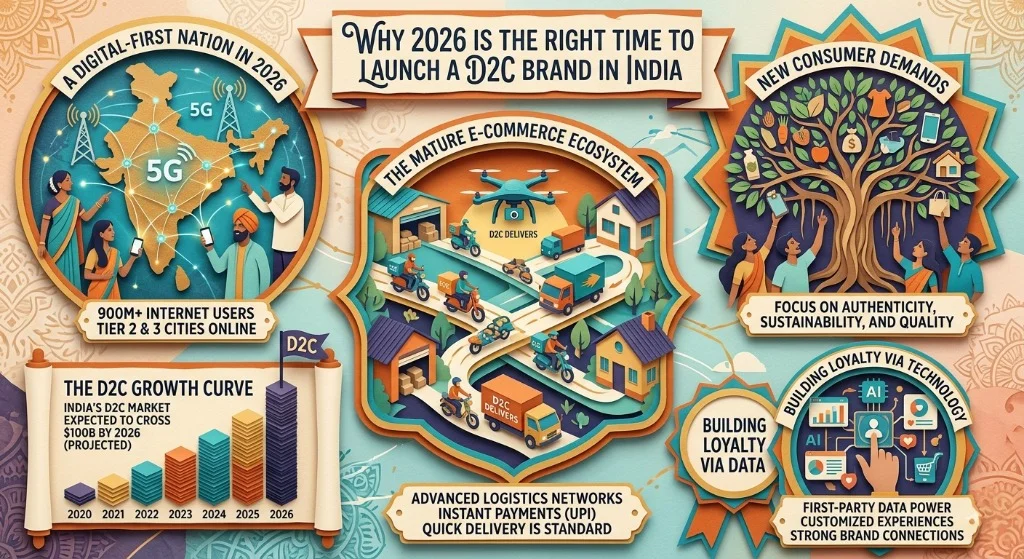
First, the market is massive and still underpenetrated. India’s D2C market crossed Rs 8.5 trillion in 2025, and online retail penetration is still under 10%. Compare that to China at 30% or the US at 22%. There is enormous headroom.
Second, the infrastructure has caught up. UPI handles over 14 billion transactions per month. Shiprocket, Delhivery, and Xpressbees deliver to 27,000+ pin codes. Shopify’s India-specific features (INR pricing, COD support, GST compliance) make store setup faster than ever.
Third, and this is the big one, the playbook has shifted. The brands winning in 2026 are not the ones spending the most on ads. They are the ones building discovery systems that combine paid acquisition with organic search, creator commerce, WhatsApp retention, and community. This means a smart founder with Rs 5 to 10 lakh can compete with brands spending 10x more, if they follow the right sequence.
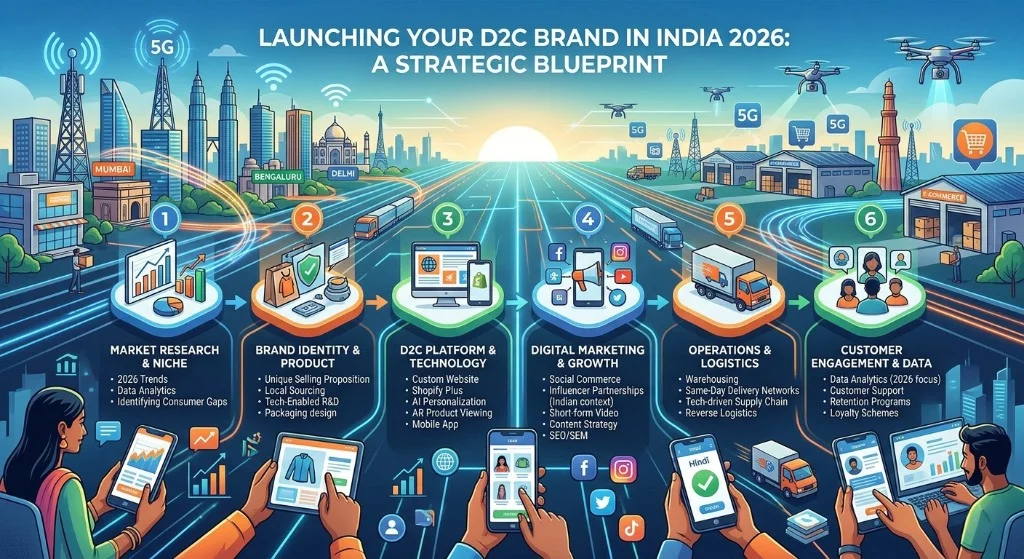
Before we get into the details, here is the high-level framework. We call it the D2C Launch Ladder, and it maps the exact sequence from idea to Rs 10L/month in revenue.
Phase 1: Niche Validation and Category Selection (Week 1 to 2) Phase 2: Product Development and Supply Chain Setup (Week 3 to 8) Phase 3: Brand Identity and Positioning (Week 5 to 7) Phase 4: Shopify Store Build and Optimization (Week 7 to 9) Phase 5: Pre-Launch Audience Building (Week 8 to 10) Phase 6: Paid Acquisition Engine Setup (Week 10 to 12) Phase 7: Retention and Scaling to Rs 10L/Month (Month 4 onward)
Notice that ads do not even start until week 10. That is intentional. Most failed D2C brands rush to paid acquisition before their foundation is solid. The brands that reach Rs 10L/month do the boring work first.
Most founders pick a category because it “seems hot.” That is how you end up as the 400th turmeric skincare brand competing with Mamaearth’s Rs 1,500 crore marketing budget. Instead, validate ruthlessly using this framework.
Filter 1: Search Demand. Use Google Keyword Planner to check if your core product keyword gets at least 5,000 monthly searches in India. If nobody is searching for it, you will spend a fortune educating the market.
Filter 2: Competition Gap. Search your target keyword on Google and Amazon. If the top 10 results are all well-funded brands with 10,000+ reviews, you need a sharper niche. Look for categories where the top brands have weak product pages, poor reviews, or generic branding.
Filter 3: Margin Math. Your product must support a minimum 60% gross margin after COGS, packaging, and shipping. Below that, profitability becomes nearly impossible once you factor in CAC, returns, and COD charges. For reference, most successful Indian D2C brands operate at 65% to 75% gross margins.
Filter 4: Repeat Purchase Potential. One-time purchase products (like furniture or luggage) require you to acquire a new customer for every sale. Consumables (skincare, supplements, food) give you a shot at 3x to 5x LTV multipliers. The best D2C categories in India right now for repeat purchase potential are personal care, health supplements, pet food, baby care, and premium snacks.
Filter 5: Content Moat. Can you create 100+ pieces of content around this category? If yes, you can build organic acquisition channels that reduce your dependence on paid ads over time. If the category is boring to talk about, your content and creator strategy will suffer.
A category that passes all five filters is worth pursuing. Three out of five is risky. Below that, go back to brainstorming.
Action step: Run your top three product ideas through this 5-filter test. Score each out of 5. Only proceed with a category that scores 4 or above.
This is where most first-time founders either overspend or cut corners. Both are mistakes. Here is the budget-conscious approach that works.
For most categories in India, you do not need to build your own manufacturing facility. Contract manufacturing is the standard for new D2C brands. Here is where to find manufacturers by category.
For beauty and personal care, look at clusters in Baddi (Himachal Pradesh), Haridwar (Uttarakhand), and Silvassa (Dadra and Nagar Haveli). These hubs offer FSSAI and GMP-certified facilities with MOQs as low as 500 to 1,000 units for new brands.
For apparel, Tirupur (Tamil Nadu) for basics and knitwear, Jaipur for ethnic wear, and Noida/Gurugram for fast fashion. Expect MOQs of 200 to 500 pieces per design.
For food and beverages, Pune, Bengaluru, and Delhi NCR have the densest concentration of FSSAI-certified co-packers.
Do not launch with 20 SKUs. Launch with 3 to 5 hero products maximum. Pilgrim launched with just a few core products and scaled to Rs 180 crore in revenue before expanding their catalog significantly. Snitch started with a tight menswear collection and now processes thousands of orders daily.
Your first batch should be 500 to 1,500 units total across all SKUs. This limits your risk to Rs 1 to 3 lakh in inventory investment while giving you enough stock to validate demand.
Packaging is a silent margin killer that most new founders ignore. Oversized packaging inflates shipping costs. Fragile packaging increases damage rates and returns. Here is the rule of thumb: your packaging cost should not exceed 8% to 10% of your MRP.
For a Rs 500 MRP product, that means spending Rs 40 to 50 on packaging. Work with a local packaging vendor, not a fancy design agency, for your first run. You can upgrade once you hit Rs 5L/month.
Action step: Get quotes from at least three contract manufacturers. Compare MOQs, per-unit costs, lead times, and quality certifications. Start with the manufacturer that offers the lowest MOQ with acceptable quality, not the cheapest per-unit price.
In a market with 10,000+ D2C brands, your product alone will not differentiate you. Your brand positioning will. And brand positioning is not your logo or color palette. It is the answer to one question: why should someone buy from you instead of the 15 other options they found in the last 30 seconds?
Fill in this sentence: “We help [specific audience] solve [specific problem] through [unique mechanism] unlike [competitor category] that [competitor weakness].”
Here is how real brands have done this.
Minimalist positioned themselves as “science-backed skincare with transparent ingredient lists” unlike mainstream brands that use vague claims and hide behind proprietary blends.
boAt positioned themselves as “affordable lifestyle electronics for young Indians” unlike premium audio brands that charged 5x for similar specs.
Sugar Cosmetics positioned themselves as “long-lasting makeup designed for Indian skin tones and humidity” unlike international brands that catered to Western skin types.
Notice the pattern. None of these brands tried to be everything to everyone. They picked a specific angle and owned it completely.
You do not need Rs 5 lakh for branding. Here is what actually matters at launch.
Logo and visual identity: Rs 10,000 to 25,000 (use a skilled freelancer on Fiverr or Behance, not an agency). Brand guidelines document: Do it yourself using Canva’s brand kit feature. Product photography: Rs 15,000 to 30,000 for a professional shoot of your hero products. This is the one area where you should not cut corners. Bad product photos kill conversion rates. Brand copy (tagline, about us, product descriptions): Rs 5,000 to 15,000 or write it yourself using the positioning statement as your foundation.
Total brand identity budget: Rs 30,000 to 70,000.
Action step: Write your positioning statement using the formula above. Test it by showing it to 10 people in your target audience. If they immediately understand what you sell and why it is different, you have a winner.
Your website is your storefront, your salesperson, and your conversion engine, all in one. In 2026, Shopify remains the undisputed platform for Indian D2C brands. Here is how to build a store that actually converts.
Start with Shopify Basic at Rs 1,994/month (approximately USD 24). This gives you everything you need until you cross Rs 10L/month. Do not upgrade to Advanced until your monthly GMV exceeds Rs 25L.
A professional Shopify store in India costs between Rs 50,000 and Rs 3,00,000 depending on complexity. For a new brand, here is what you actually need.
Option A: Bootstrap Build (Rs 15,000 to 40,000). Use a premium theme like Dawn (free), Prestige, or Impulse (Rs 15,000 to 25,000). Set up yourself using Shopify’s guided setup. Add essential apps: a reviews app, WhatsApp chat, email popup, and COD confirmation.
Option B: Professional Build (Rs 50,000 to 1,20,000). Hire a Shopify developer for custom theme modifications, optimized product pages, mobile-first design, and integration with logistics and payment gateways. This is what we recommend for brands serious about hitting Rs 10L/month within 6 months.
At Aim n Launch, we build conversion-optimized Shopify stores specifically for Indian D2C brands. If you want this done right without the learning curve, talk to us.
Mobile-first design. Over 85% of Indian ecommerce traffic comes from mobile. If your store is not buttery smooth on a Rs 15,000 Android phone, you are losing money.
UPI and COD support. Despite UPI’s massive growth, COD still accounts for 40% to 55% of D2C orders in India. You must offer both. Use Razorpay or Cashfree for payments, and integrate COD confirmation via WhatsApp (tools like Interakt or Wati).
Trust signals above the fold. Indian consumers are skeptical of new brands. Your product page must show star ratings, review count, “trusted by X customers,” and any certifications (FSSAI, dermatologically tested, ISO certified) within the first scroll.
Page speed under 3 seconds. Every additional second of load time reduces conversions by 7%. Compress images, minimize apps, and use Shopify’s built-in CDN.
Action step: Set up your Shopify store with the essential elements listed above. Run it through Google PageSpeed Insights and aim for a mobile score above 60. Test the checkout flow on three different Android phones before launch.
Here is where most founders make a critical mistake. They build the store, add products, and immediately start running Meta ads to cold audiences. This is like opening a restaurant and spending your entire budget on billboards without telling your neighbors.
The brands that hit Rs 10L/month fastest are the ones that build a warm audience before spending a single rupee on ads.
Week 1 to 2: Instagram Content Machine. Create an Instagram page and post 2 to 3 Reels per day. Not polished brand content. Raw, educational, behind-the-scenes content about your product, your manufacturing process, your category. Snitch built a massive Instagram following before they even launched their store, which gave them day-one sales without ads.
Week 2 to 3: WhatsApp List Building. Create a “founding members” WhatsApp broadcast list. Offer early access, exclusive launch pricing, or a free sample to the first 100 to 500 people who join. Use your Instagram bio, stories, and personal network to drive sign-ups. Target 300 to 500 people on this list before launch.
Week 3 to 4: Micro-Creator Seeding. Send free products to 10 to 20 micro-creators (1,000 to 10,000 followers) in your category. Do not pay for posts. Just send the product with a handwritten note. If your product is genuinely good, 30% to 50% will post about it organically. This gives you UGC content for ads and social proof before launch.
The math behind pre-launch audience building. If you build a 500-person WhatsApp list with a 20% conversion rate at Rs 800 AOV, that is Rs 80,000 in launch-day revenue. Add 15 creator posts driving an average of 200 clicks each at a 2% conversion rate, and that is another Rs 48,000. You could hit Rs 1.28 lakh in revenue on day one without spending a rupee on ads.
Action step: Set up your Instagram page and start posting Reels immediately, even if your product is not ready yet. Document the journey. Start building your WhatsApp founding members list. The goal is 500 people by launch day.
Now that you have a warm audience, social proof from creators, and a conversion-optimized store, it is time to add fuel with paid ads. Here is the launch budget framework.
Do not spread this across five platforms. Focus 100% on Meta (Instagram and Facebook) for the first month. Here is why: Meta’s Advantage+ Shopping Campaigns give you the best combination of reach, optimization, and creative testing for new brands. Google Shopping becomes relevant once you have search demand, which takes 2 to 3 months to build.
Campaign 1: Advantage+ Shopping Campaign (60% of budget). Upload 5 to 8 ad creatives (mix of UGC from your creator seeding, product-focused Reels, and before/after content). Let Meta’s algorithm find your buyers. Target a broad audience (India, 18 to 45, all genders unless your product is gender-specific).
Campaign 2: Retargeting (20% of budget). Target people who visited your site but did not purchase. Use testimonial-style creatives and limited-time offers. This campaign typically delivers 4x to 6x ROAS for new brands.
Campaign 3: Lookalike Audiences (20% of budget). Once you have 100+ purchases, create a 1% lookalike of your buyers. This becomes your scalable acquisition engine.
For a new Indian D2C brand, here are realistic benchmarks for your first month of paid acquisition.
CPM (Cost Per Thousand Impressions): Rs 100 to Rs 200. CTR (Click-Through Rate): 1.5% to 2.5%. CPC (Cost Per Click): Rs 5 to Rs 15. Conversion Rate: 1.5% to 2.5% (from your optimized store). CAC (Customer Acquisition Cost): Rs 400 to Rs 800 depending on your AOV. ROAS: 1.5x to 2.5x (do not expect profitability from ads in month 1).
If your ROAS is below 1x after spending Rs 30,000, stop and diagnose. The problem is either your creatives (CTR below 1.5%), your store (conversion rate below 1%), or your offer (AOV too low or product-market fit issue).
Need help setting up and managing your Meta ads for maximum ROAS? That is literally what we do every day at Aim n Launch.
Action step: Prepare 5 to 8 ad creatives before you launch your first campaign. At least 3 should be UGC-style videos. Set up your Meta pixel and Conversions API on Shopify before spending a single rupee.
Here is the math that separates brands that survive from brands that scale.
If your AOV is Rs 800 and your CAC is Rs 600, you are losing Rs 200 on the first purchase after accounting for COGS and shipping. But if your repeat purchase rate is 30% and your average customer buys 2.5 times over 12 months, your LTV jumps to Rs 2,000. Suddenly, that Rs 600 CAC looks brilliant.
The entire game of D2C profitability in 2026 is retention.
WhatsApp Commerce (highest ROI channel). Use tools like Interakt, Wati, or AiSensy to set up automated flows: order confirmation, shipping updates, review requests, and reorder reminders. Brands using WhatsApp automation see 25% to 35% repeat purchase rates compared to 12% to 18% for brands relying on email alone.
Email Marketing. Despite what you hear, email still works for Indian D2C. Set up four essential flows in Klaviyo or Mailchimp: welcome series (5 emails), abandoned cart (3 emails), post-purchase (4 emails), and win-back (3 emails for customers who have not purchased in 60 days).
Loyalty and Referral Programs. Tools like Yotpo or a simple WhatsApp-based referral system (“Share your unique code, get Rs 200 off your next order”) can drive 10% to 15% of total revenue for mature D2C brands.
Subscription Model. If your product is consumable, offer a subscribe-and-save option with a 10% to 15% discount. This locks in recurring revenue and dramatically improves LTV.
Here is a realistic scaling timeline with the numbers.
Month 1 to 2: Rs 1 to 2 lakh/month revenue. Focus on dialing in product-market fit, collecting reviews, and optimizing your Meta ads. Ad spend: Rs 50,000 to 1,00,000/month.
Month 3 to 4: Rs 3 to 5 lakh/month revenue. Scale ad spend to Rs 1.5 to 2.5 lakh/month as you find winning creatives. Launch Google Shopping. Repeat purchases start contributing 15% to 20% of revenue.
Month 5 to 6: Rs 7 to 10 lakh/month revenue. Ad spend: Rs 3 to 5 lakh/month. Organic channels (SEO, Instagram, creator partnerships) contribute 20% to 30% of revenue. Repeat purchases hit 25% to 30%.
This timeline assumes strong product-market fit, consistent creative production (10+ new creatives per month), and disciplined unit economics management. Some brands do it faster. Snitch scaled to crores within their first year. But those are outliers, and building on a solid 6-month foundation is how you create a sustainable business, not a flash-in-the-pan brand.
Action step: Set up your WhatsApp automation flows before you launch. This is not a “nice to have.” It is the single highest-ROI activity for a new D2C brand.
Let us break down the total investment needed to go from zero to a functioning D2C brand.
Product development (first batch of 500 to 1,500 units): Rs 1,00,000 to Rs 3,00,000. Brand identity and photography: Rs 30,000 to Rs 70,000. Shopify store setup: Rs 15,000 to Rs 1,20,000. Shopify subscription (6 months): Rs 12,000. Essential apps and tools (6 months): Rs 18,000 to Rs 30,000. Pre-launch creator seeding (20 creators): Rs 15,000 to Rs 30,000 (product cost only). Month 1 to 3 ad spend: Rs 1,50,000 to Rs 4,00,000. Miscellaneous (legal, GST registration, packaging design): Rs 20,000 to Rs 40,000.
Total investment range: Rs 3,60,000 to Rs 10,00,000.
Yes, you can launch a D2C brand in India for under Rs 4 lakh if you are bootstrapping hard. And you can do a more comfortable launch with Rs 8 to 10 lakh. Anything above Rs 10 lakh for a launch is either premature scaling or unnecessary spending.
Mistake 1: Launching with too many SKUs. More SKUs means more inventory capital, more complexity, and more confusion for the customer. Start with 3 to 5 hero products. Expand based on data, not intuition.
Mistake 2: Ignoring unit economics. If you do not know your CM2 (Contribution Margin 2, which accounts for COGS, shipping, payment gateway fees, returns, and CAC), you are flying blind. Calculate your CM2 before you spend a rupee on ads. We wrote a detailed guide on CM2 for ecommerce that every founder should read.
Mistake 3: Copying competitor ads instead of building your own creative system. Your competitors’ ads work because of their brand equity, not their ad copy. Build a creative testing system that produces 10+ new creatives per month and kills underperformers quickly.
Mistake 4: Neglecting COD optimization. If 45% of your orders are COD and your RTO (Return to Origin) rate is 25%, you are bleeding money. Implement WhatsApp COD confirmation, prepaid incentives (Rs 50 off for prepaid orders), and address verification to bring RTO below 15%.
Mistake 5: Not building organic channels from day one. Paid ads are a tax. Organic channels (SEO, Instagram, YouTube, creator partnerships) are investments. The brands that survive long-term allocate 20% to 30% of their effort to organic from the very beginning.
Here is the condensed checklist you can follow week by week.
Week 1 to 2: Run the 5-filter validation test on your category. Finalize your niche and target audience. Register your business (GST, trademark filing).
Week 3 to 5: Finalize contract manufacturer. Order your first batch (500 to 1,500 units). Develop your packaging.
Week 5 to 7: Create your brand positioning statement. Get product photography done. Finalize brand identity.
Week 7 to 9: Build your Shopify store. Set up payment gateways (Razorpay/Cashfree), shipping integrations (Shiprocket/Delhivery), and essential apps. Optimize for mobile and speed.
Week 8 to 10: Launch Instagram and start posting 2 to 3 Reels/day. Build your WhatsApp founding members list (target 500). Send products to 10 to 20 micro-creators.
Week 10 to 12: Launch Meta ads with Advantage+ Shopping Campaigns. Set up retargeting. Monitor CAC, ROAS, and conversion rate daily.
Month 4 onward: Scale winning ad creatives. Launch Google Shopping. Build email and WhatsApp automation flows. Focus on repeat purchases and LTV.
Want the full, detailed version of this checklist as a downloadable PDF with budget templates and vendor recommendations? Download the free D2C Launch Checklist here.
The minimum viable budget is Rs 3.5 to 4 lakh, covering product development (Rs 1 to 1.5 lakh), branding and store setup (Rs 50,000 to 1 lakh), and initial ad spend (Rs 1.5 to 2 lakh). A more comfortable launch budget is Rs 8 to 10 lakh, which gives you more room for inventory, creator seeding, and testing.
Shopify is the clear winner for Indian D2C brands in 2026. It offers native INR pricing, COD support, GST compliance, and integrates seamlessly with Indian logistics providers like Shiprocket and Delhivery. The Basic plan at Rs 1,994/month is sufficient until you cross Rs 10L/month in revenue.
Most D2C brands take 6 to 18 months to reach profitability, depending on the category, pricing, and acquisition strategy. Brands with high repeat purchase rates (consumables like skincare and supplements) tend to reach profitability faster because customer LTV covers the initial CAC investment.
Start with your own Shopify website only. This gives you full control over customer data, pricing, and brand experience. Once you hit Rs 5 to 10 lakh/month on your own site, consider adding Amazon and Flipkart as supplementary channels, but never let marketplace revenue exceed 30% to 40% of your total sales.
In month 1, expect 1.5x to 2.5x ROAS from Meta ads. This will likely be unprofitable at the unit economics level, and that is okay. By month 3 to 4, you should target 2.5x to 3.5x ROAS as your creatives improve and retargeting kicks in. Brands working with Aim n Launch’s Meta ads team typically see 3x to 4x ROAS within 90 days of optimization.
Launching a D2C brand is one of the most rewarding things you can do as an entrepreneur in India right now. The market is massive, the infrastructure is ready, and the playbook exists. You just need to follow it with discipline.
Ready to launch your D2C brand the right way? Book a free 15-minute strategy call with the Aim n Launch team and get a custom launch roadmap for your brand.