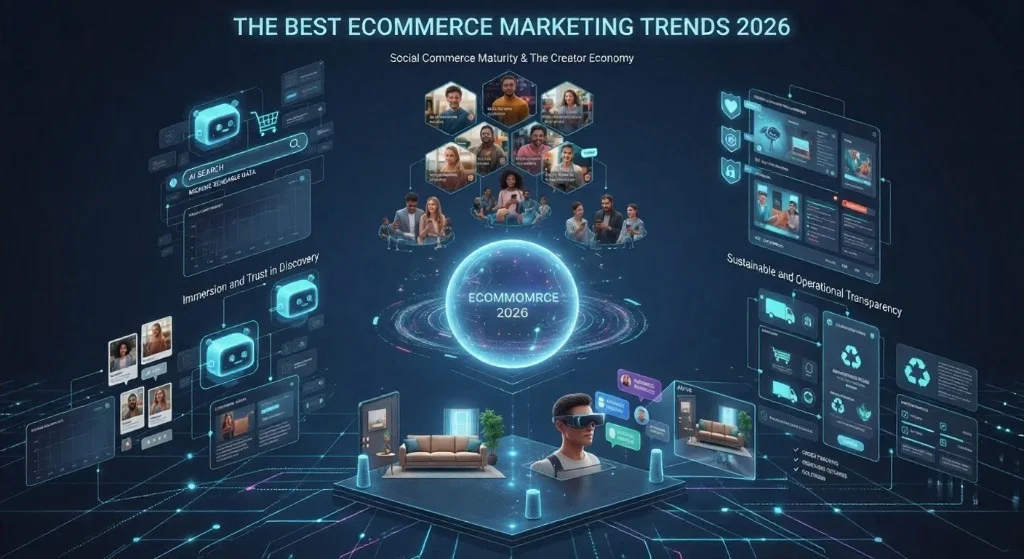
The ecommerce world is changing at a rapid pace. This is because going forward into 2026, the business will have to adjust to the new technology, changing consumer behavior, and competition. What was effective a year ago might not be effective tomorrow. Brands that want to be ahead must be innovative, personalized and data-driven.
This blog will discuss the best ecommerce marketing trends that you should keep in 2026 in order to grow your business, enhance customer experience, and increase conversions.
Artificial intelligence (AI) has changed the interaction between ecommerce brands and customers. In 2026, personalization will go way beyond the use of the first name when addressing emails to the users.
Current AI applications examine the browsing history, purchase history, and even instant activities to provide hyper-personalized experiences. Product recommendations, dynamic web content and everything can now be customized to the individual.
Why it matters:
How to implement:
Voice commerce is emerging as a prominent force in the marketing of ecommerce with the emergence of smart devices and voice assistants.
Voice search is emerging as a major way in which consumers search and get products, compare prices and purchase. Voice search optimization of your ecommerce store is the way to go in 2026.
Key strategies:
Voice search queries are more natural and question-based, and thus your content should have that tone.
Social media sites are not only a place to interact anymore, but they are also complete shopping sites.
Social media such as Instagram, Tik Tok, and Facebook keep adding smooth shopping capabilities in 2026. Consumers do not need to leave the application to learn about, review, and shop the products.
Benefits of social commerce:
Best practices:
One of the most effective ecommerce marketing tools currently is video content. Videos allow the customers to make informed choices such as product demos and behind-the-scenes.
In specific verse, short-form videos are taking over user attention spans in the year 2026.
Why video works:
Types of videos to focus on:
As privacy laws are tightening and third-party cookies are becoming less popular, the ecommerce companies are forced to depend on first-party data.
First-party data is direct information on your customers gathered on your site, application, or CRM databases.
Advantages:
How to collect it:
The consumers of 2026 are more environmentally aware than ever regarding sustainability and ethical conduct. They like brands which they consider compatible with their values.
Ecommerce businesses should emphasize their social and environmental responsibility.
What customers expect:
Marketing tips:
Customers engage with the brands through various channels: websites, applications, social media, emails, and even brick-and-mortar shops.
Omnichannel strategy will provide a smooth experience throughout the touchpoints.
Key elements:
As an illustration, a customer must be in a position to add a product to his/her cart using mobile and finalize the purchase using desktop without any hassle.
AR is innovating the manner in which clients engage with products over the internet. It enables customers to see the products in actual situations before buying.
Examples:
Benefits:
One of the key to ecommerce success is speed. Customers are demanding better delivery services, including same-day delivery.
Those brands that invest in logistics and fulfillment technologies have a competitive advantage.
Trends to watch:
Right delivery timelines and updates create confidence and enhance customer satisfaction.
Ecommerce models which involve subscriptions are becoming quite popular in many fields including beauty products and even groceries.
Why subscriptions work:
Ideas to implement:
The sphere of influencer marketing has been developing, and it has shifted to authenticity and micro-influencers.
Real life experiences are more trusted by the consumers than the glossy advertisements.
Key strategies:
Honesty brings about improved interaction and greater bonding to your audience.
Mobile commerce takes over ecommerce traffic in 2026. It is not a case of mobile-first anymore, it is a necessity.
Optimization tips:
Fluid mobile experience has a direct influence on conversions and customer satisfaction.
Customer experience is changing using AI chatbots and dialogue interfaces.
These tools are immediate response tools and also help users navigate their purchasing journey and enhance the customer experience.
Benefits:
Chatbots may also be used to gather useful data that will enhance future marketing.
The buyers like speed and convenience. Zero-click payments (checkout) and one-tap payments are getting common.
Friction in the buying process is greatly reduced which increases conversion rates.
How to optimize:
The innovation, personalization, and customer-focused approaches drive ecommerce in the year 2026. Those businesses that embrace such trends will not survive but flourish in a competitive market. At Aim n Launch, we are convinced that it is kept ahead of trends that will make us grow sustainably. With the embrace of AI, maximization of customer experiences, and the use of new technologies, ecommerce brands can open new opportunities and establish enduring relationships with their customers.