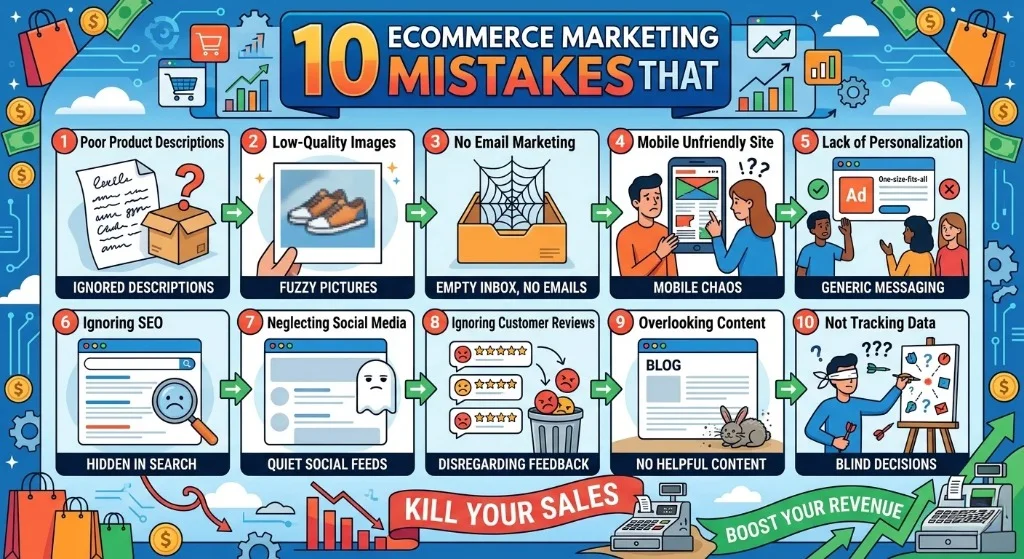
Running an ecommerce store is exciting, but it can also be frustrating when sales don’t grow as expected. Many online businesses invest heavily in advertising, website design, and product development, yet they still struggle to convert visitors into customers. The reason often lies in simple but critical marketing mistakes that silently hurt performance.
At Aim n Launch, we frequently analyze ecommerce websites and marketing campaigns, and we see the same issues repeated across different industries. Avoiding these mistakes can dramatically improve your conversion rate, customer retention, and overall revenue.
In this blog, we’ll explore 10 ecommerce marketing mistakes that can kill your sales—and how to fix them
One of the biggest mistakes ecommerce businesses make is trying to sell to everyone. When you attempt to target a broad audience, your marketing message becomes too generic and fails to resonate with anyone.
Successful ecommerce brands deeply understand their customers—their needs, pain points, preferences, and shopping behavior.
How to fix it:
The more you understand your audience, the more effectively you can tailor your marketing campaigns.
Many ecommerce stores rely on basic or copied product descriptions. Unfortunately, this approach fails to persuade potential buyers or highlight the unique value of the product.
A good product description should do more than list features—it should explain how the product benefits the customer.
How to fix it:
Strong product descriptions can significantly increase conversions and reduce cart abandonment.
SEO is one of the most powerful long-term strategies for ecommerce growth. However, many businesses ignore it or treat it as an afterthought.
Without SEO, your store relies solely on paid advertising for traffic, which increases customer acquisition costs.
How to fix it:
At Aim n Launch, we often recommend combining technical SEO with content marketing to drive sustainable traffic.
Even the best marketing campaigns will fail if your website is difficult to navigate. A confusing layout, slow loading speed, or complicated checkout process can quickly drive customers away.
Online shoppers expect a smooth and intuitive experience.
How to fix it:
A seamless user experience increases trust and encourages customers to complete their purchases.
Mobile commerce now accounts for a large percentage of online shopping. Yet many ecommerce stores still prioritize desktop design and overlook mobile usability.
If your website is not mobile-friendly, you could lose a significant number of potential customers.
How to fix it:
Mobile optimization is no longer optional—it is essential for ecommerce success.
Many ecommerce businesses focus heavily on paid ads but ignore email marketing, which remains one of the highest ROI marketing channels.
Email allows you to nurture relationships with customers and encourage repeat purchases.
How to fix it:
Email marketing keeps your connected with customers and drives long-term loyalty.
Online shoppers rely heavily on reviews, ratings, and testimonials before making a purchase. If your ecommerce store lacks social proof, potential customers may hesitate to trust your brand.
Social proof helps reduce uncertainty and builds credibility.
How to fix it:
Authentic customer experiences can greatly influence purchasing decisions.
In ecommerce, customers cannot physically touch or try products. This makes product images one of the most important elements in influencing buying decisions.
Low-quality or limited images can discourage customers from purchasing.
How to fix it:
Professional visuals make your products more appealing and increase buyer confidence.
Marketing without analyzing data is like driving without a map. Many ecommerce businesses run campaigns without tracking performance or understanding customer behavior.
Data-driven decisions help optimize marketing strategies and improve results.
How to fix it:
Using data effectively helps identify what works and what needs improvement.
A large percentage of visitors leave ecommerce websites without making a purchase. If you don’t retarget these visitors, you lose valuable sales opportunities.
Retargeting reminds potential customers about the products they viewed and encourages them to return.
How to fix it:
Retargeting campaigns can significantly increase conversions and recover lost sales.
Ecommerce success is not just about attracting visitors—it’s about converting them into loyal customers. Even small marketing mistakes can have a major impact on your sales and growth.
By avoiding these 10 common ecommerce marketing mistakes, you can improve your website performance, build stronger customer relationships, and maximize revenue.
At Aim n Launch, we specialize in helping ecommerce businesses optimize their marketing strategies, improve website performance, and drive sustainable growth.
If your ecommerce store is struggling with low conversions or inconsistent sales, identifying and fixing these marketing mistakes could be the key to unlocking your brand’s true potential.