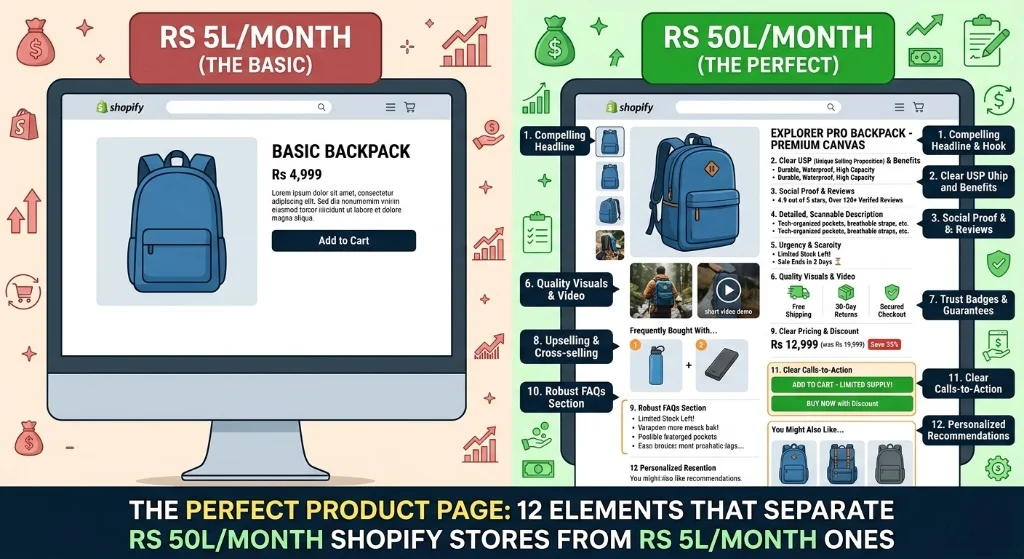
Here is something most Indian D2C founders get wrong about ecommerce product page optimization: they spend Rs 5-10 lakh per month driving traffic through Meta and Google Ads, then send all of it to product pages that convert at a miserable 1.2%.
The math is brutal. At a cost per click of Rs 15 and a 1.2% conversion rate, you are paying Rs 1,250 per purchase just in ad costs. Bump that conversion rate to 3.5%, and your cost per purchase drops to Rs 428. Same traffic. Same ad spend. Completely different unit economics.
We have audited over 100 Indian D2C Shopify stores at Aim n Launch, and the pattern is consistent: stores doing Rs 50L+ per month are not necessarily spending more on ads. They are converting more of the traffic they already have. And the difference almost always starts at the product page.
This post breaks down the 12 specific elements that separate high-converting product pages from the ones bleeding money. Every tactic is India-specific, tested on real Shopify stores, and backed by data.
Want us to audit your product pages for free? Book a 15-minute CRO audit call and we will show you exactly where you are losing conversions.

The product image is the single highest-impact conversion element on any ecommerce product page. Pages with high-quality, multi-angle product photography see 30% higher conversion rates compared to single-image layouts, according to VWO’s 2026 ecommerce benchmark study.
But “good photos” is vague advice. Here is what high-converting Indian D2C brands actually do.
The 7-image framework that works:
Image 1 is a clean, white-background hero shot. Image 2 is a lifestyle shot showing the product in use. Image 3 is a scale reference (product held in hand or next to a common object). Image 4 is an ingredients or materials close-up. Image 5 is a packaging shot (critical for gifting categories). Image 6 is a before/after or comparison shot. Image 7 is a UGC or customer photo.
Real example: Minimalist, the skincare brand, uses this exact framework. Their product pages feature clinical-grade product shots alongside ingredient breakdowns and real customer before/after images. Their reported product page conversion rate sits around 4.2%, well above the 1.5-2.5% Indian D2C average.
Action step: Audit your top 10 SKUs right now. If any product has fewer than 5 images, that is your first fix. Hire a product photographer for Rs 15,000-25,000 per shoot, or use a tool like Blend or Photoroom for AI-enhanced backgrounds on a budget.
93% of consumers cite visual appearance as the key deciding factor in purchase decisions. What appears on screen before a customer scrolls, your above-the-fold content, determines whether they stay or bounce.
The Aim n Launch Above-the-Fold Framework:
On the left side of the page, place your image carousel with zoom capability. On the right side, stack these elements in order: product title (H1, under 70 characters), star rating with review count (clickable to scroll to reviews section), price with MRP strikethrough and discount percentage, a one-line value proposition (not the full description), variant selectors for size and colour, the Add to Cart button (high contrast, full width on mobile), and a trust strip showing icons for free shipping, easy returns, and secure payment.
Why this matters for India specifically: Indian shoppers are comparison shoppers. If they cannot see the price, discount, and basic trust signals without scrolling, they will bounce to Amazon or Flipkart to compare. Your above-the-fold section has to answer three questions in under 5 seconds: What is this? How much does it cost? Can I trust this store?
Action step: Open your top-selling product page on a mobile phone. Screenshot only what appears before scrolling. If you cannot see the price, Add to Cart button, and at least one trust signal, you need to restructure your above-the-fold layout immediately.
Most Indian D2C brands write product descriptions like specification sheets. They list ingredients, dimensions, and technical features, then wonder why nobody reads past the first line.
High-converting product descriptions follow the Problem-Agitation-Solution (PAS) framework adapted for ecommerce.
Structure that converts:
Start with a one-sentence hook addressing the customer’s pain point. Follow with 3-4 bullet points of benefits (not features), each starting with a verb. Then add a short paragraph with the brand story or product origin. Finally, include a collapsible section for full technical specifications.
Example transformation:
Bad: “100% organic cotton t-shirt. 180 GSM. Pre-shrunk. Available in 6 colours.”
Good: “Sick of t-shirts that lose shape after 3 washes? Our 180 GSM organic cotton holds its fit for 50+ washes, guaranteed. Pre-shrunk so you get exactly the size you ordered. And because it is organic, your skin breathes even in Delhi’s 45-degree summers.”
Real example: Snitch, the fast-fashion menswear brand doing Rs 100Cr+ annually, uses punchy, benefit-led copy on every product page. They lead with style context (“Perfect for brunch dates and weekend getaways”) before listing fabric details. Their product pages convert at rates significantly above the fashion category average of 1.5-2.5%.
Action step: Rewrite descriptions for your top 5 selling products using the PAS framework. Test the new copy for 2 weeks and measure the conversion rate change.
Indian shoppers are some of the most price-sensitive online buyers in the world. The way you display pricing can swing conversion rates by 15-20%.
The pricing display stack that converts:
Show the selling price in large, bold font. Place the MRP with a strikethrough next to it. Show the discount percentage in a colored badge (green or red). If the discount is above 30%, add a “You save Rs X” line. For products above Rs 1,000, show EMI options (Simpl, ZestMoney, or Shopify’s native EMI).
Data point: Stores that display “You save Rs X” alongside percentage discounts see 12-18% higher add-to-cart rates compared to percentage-only displays, based on data from our client stores.
The anchoring trick: If you sell a premium product, show a comparison line. For example: “Similar products on Amazon: Rs 1,299. Our price: Rs 899.” This anchors the perceived value without needing a bigger discount.
Action step: Add “You save Rs X” to every product page with a discount. If your AOV is above Rs 1,000, integrate an EMI option. Both changes take less than a day on Shopify and can move conversion rates by 10%+.
Trust is the number one conversion barrier for Indian D2C brands that are not yet household names. Research shows trust badges can boost conversion rates by up to 42%. But generic “SSL Secure” badges do not cut it for Indian audiences.
The India-specific trust stack:
Display these five trust signals prominently on every product page: “UPI and all cards accepted” (with recognizable payment logos), “Free shipping above Rs [threshold]” with a clear icon, “Easy 7-day returns” (or whatever your policy is, be specific), “Rs [X] COD available” for relevant pin codes, and an estimated delivery date based on pin code (not a vague “Ships in 24 hours”).
Why COD still matters: While UPI now handles approximately 60-65% of all online transactions by volume in India as of early 2026, Cash on Delivery still accounts for 25-30% of orders. For Tier 2 and Tier 3 city customers, and first-time buyers from non-metro cities, visible COD availability is non-negotiable. Hiding it kills conversions from your most price-sensitive segments.
Why delivery dates matter more than speed: Indian shoppers do not expect next-day delivery from D2C brands. They expect honesty. “Delivery by April 12” converts better than “Fast shipping” because it sets a clear expectation.
Real example: Pilgrim, the beauty brand, displays pin-code-based delivery estimates on every product page. Enter your pin code, and you see the exact delivery date. This small addition reportedly improved their conversion rate by over 15% when they first implemented it.
Action step: Add a pin-code checker with delivery date estimates to your product pages. Shopify apps like Aymkan Estimated Delivery or ETA Shipping Date can set this up in under an hour.
Download our free Product Page Audit Template to check all 12 elements on your own store. It includes a scoring system so you can prioritize fixes.
Products with 5 or more reviews convert 270% better than products with zero reviews. For products above Rs 2,000, that number jumps to 380%.
But not all review displays are equal. Here is what separates good social proof from great social proof on Indian D2C product pages.
The review display hierarchy:
At the top, show the aggregate star rating with total review count (e.g., 4.6 stars from 847 reviews). Below that, feature 2-3 photo or video reviews from real customers. Add filter options so shoppers can filter reviews by star rating, skin type, or product variant. Include a “Verified Purchase” badge on each review. Finally, display a review summary bar chart showing the distribution of 5-star, 4-star, etc.
Real example: Sugar Cosmetics does social proof exceptionally well. Their product pages feature swatches on different skin tones submitted by real customers, with each review tagged by skin type and tone. For a brand selling makeup to Indian women, this user-generated shade matching is more persuasive than any studio photo.
Tools that work: Judge.me (starts free, solid for Indian stores), Loox (photo-focused reviews, Rs 750/month), or Junip (clean design, good for premium brands).
Action step: If you have fewer than 10 reviews on your top products, launch a post-purchase WhatsApp or email flow offering a Rs 50-100 discount on next purchase in exchange for a photo review. Most Indian D2C brands can collect 30-50 photo reviews in their first month with this approach.
Over 73% of ecommerce traffic in India comes from mobile devices, and more than 55% of ecommerce revenue is now mobile. Yet most D2C brands design product pages on desktop and treat mobile as an afterthought.
Mobile-specific optimizations that matter:
Use a sticky Add to Cart button that stays visible as the user scrolls. This alone can increase add-to-cart rates by 8-12%. Ensure image carousels are swipeable with clear dot indicators. Keep the product title to under 50 characters on mobile (it gets truncated otherwise). Use accordion/collapsible sections for descriptions, specifications, and shipping info. Make the review section load lazily so it does not slow down the initial page render.
Page speed benchmark: Target under 3 seconds for product page load time on mobile. Every additional second of load time reduces conversions by approximately 7%. Test your pages with Google PageSpeed Insights, and aim for a score above 60 on mobile.
Common speed killers on Indian Shopify stores: Uncompressed images (the number one issue), too many Shopify apps loading scripts on every page, heavy custom fonts, and third-party chat widgets that load synchronously.
Action step: Run your top product page through PageSpeed Insights right now. If your mobile score is below 50, start by compressing all product images to under 200KB each using TinyPNG or Shopify’s built-in image optimization.
Urgency works, but Indian shoppers are increasingly savvy about fake countdown timers and manufactured scarcity. The key is using real urgency signals.
Legitimate urgency tactics:
Show real-time stock levels when inventory is genuinely low (“Only 4 left in stock”). Display “X people are viewing this right now” using tools like Fomo or Nudgify. For products that actually sell out, add a “Back in Stock” email/WhatsApp notification option. Use sale end dates that are real and do not reset every day.
What to avoid: Fake countdown timers that reset on refresh, “Only 2 left!” when you have 500 units, and pop-ups claiming “Someone in Mumbai just purchased this” when nobody did. Indian shoppers share screenshots of these tricks on social media, and it destroys trust permanently.
Action step: If you run genuine limited drops or have SKUs that regularly sell out, add real stock counters. If your inventory is always abundant, skip scarcity tactics entirely and focus on other conversion levers.
Increasing your average order value through smart product page cross-sells can boost revenue by 10-30% without any additional ad spend.
Cross-sell placements that work:
“Frequently Bought Together” bundles below the Add to Cart button. “Complete the Look” or “Complete the Routine” sections (especially effective for beauty and fashion). A “Customers Also Viewed” carousel lower on the page. Volume discounts displayed inline (“Buy 2, save 15%. Buy 3, save 25%”).
Real example: Mamaearth uses “Complete Your Routine” bundles on every product page, pairing a face wash with a toner and moisturizer. This routine-based bundling reportedly contributes 20-25% of their average order value uplift.
Tools: Rebuy, Frequently Bought Together by Code Black Belt, or ReConvert for post-purchase upsells.
Action step: Identify your top 10 products. For each, create one “Frequently Bought Together” bundle and one volume discount tier. Measure AOV change over 2 weeks.
An FAQ section on your product page serves two purposes: it answers objections that prevent purchase, and it creates opportunities for FAQ schema markup that can win featured snippets in Google search.
Questions every Indian D2C product page should answer:
What is the exact delivery timeline to my city? What is your return and exchange policy? Is COD available? What payment methods do you accept? How is this different from [competitor product or Amazon alternative]?
Category-specific FAQs to add: For skincare and beauty, address “Is this safe for sensitive skin?” and “What is the shelf life?” For fashion, cover “How does the sizing run?” and “What is the fabric care routine?” For food and supplements, answer “What are the allergens?” and “Is this FSSAI certified?”
Action step: Add 5-7 FAQs to each product page. Use schema markup (the Shopify app “JSON-LD for SEO” handles this) so Google can display them as rich results.
In India, WhatsApp is the bridge between browsing and buying. Adding a WhatsApp chat button on your product page gives hesitant shoppers a way to ask questions before committing.
Data point: WhatsApp has open rates of 80%+ versus 20-25% for email in Indian ecommerce. Brands that add WhatsApp chat on product pages see 15-25% of conversations converting to purchases.
Implementation: Use a floating WhatsApp button with a pre-filled message like “Hi, I have a question about [Product Name].” Tools like DelightChat, Interakt, or Wati can automate responses and even send cart recovery messages through WhatsApp.
Real example: Lenskart uses WhatsApp for pre-purchase consultations on their product pages, letting customers ask about prescription compatibility and frame fitting. This conversational commerce approach contributes significantly to their online conversion rates.
Action step: Add a WhatsApp button to your product pages today. Even without automation, manually responding to queries can recover 10-15% of otherwise lost sales.
While paid ads drive most revenue for scaling D2C brands, optimizing product pages for ecommerce product page optimization brings compounding free traffic over time.
Product page SEO checklist:
Write unique meta titles under 60 characters including the product name and a benefit. Craft meta descriptions under 155 characters with a call to action. Use the primary product keyword in the H1, first 100 words, and at least one H2. Add alt text to every product image describing what is shown. Use structured data (Product schema) for price, availability, and reviews so Google can show rich snippets.
Common mistake: Most Shopify stores use auto-generated meta titles like “Product Name | Store Name.” These miss keyword opportunities and read poorly in search results. Manually optimize meta titles for your top 20 products first.
Action step: Install a Shopify SEO app like SEO Manager or Smart SEO, and optimize meta titles and descriptions for your top 20 products. This takes 2-3 hours and can start driving organic traffic within 4-8 weeks.
Here is our internal scoring system. Rate your product pages on each of the 12 elements, giving a score from 0 (not implemented) to 3 (fully optimized).
A score of 30-36 means your pages are world-class. A score of 20-29 means you are competitive but leaving money on the table. A score of 10-19 means you have significant conversion leaks. And below 10 means your product pages need a complete overhaul.
Most Indian D2C stores we audit score between 12 and 18. Moving to 25+ typically corresponds with a conversion rate jump from 1.5% to 3-4%, which at Rs 5L+ monthly ad spend, translates to lakhs in additional revenue.
The average for Indian D2C ecommerce is 1.5-2.5%. A “good” rate is 3-4%, and top-performing stores in categories like beauty and wellness hit 4-5%. Anything below 1.5% signals serious product page issues that need immediate attention.
Quick wins like fixing page speed, adding trust badges, and improving CTA contrast can show measurable impact within 1-2 weeks. Deeper changes like rewriting descriptions, adding reviews, and restructuring the layout typically take 4-6 weeks to show statistically significant results.
Always optimize first. Doubling your conversion rate has the same revenue impact as doubling your ad spend, but costs a fraction. We recommend getting product pages to at least a 2.5% conversion rate before aggressively scaling ad spend.
For reviews, Judge.me or Loox. For page speed, TinyIMG. For upsells, Rebuy or ReConvert. For WhatsApp integration, DelightChat or Interakt. For SEO, JSON-LD for SEO or Smart SEO. Start with reviews and page speed as they have the highest ROI.
DIY optimization using the tactics in this post costs nothing beyond your time. Professional CRO audits from agencies like Aim n Launch typically range from Rs 25,000 to Rs 1,00,000 depending on the scope, and usually pay for themselves within 30-60 days through improved conversion rates.
There is no neutral ground. Every visitor who lands on your product page either converts or leaves, and the 12 elements above determine which outcome is more likely.
The good news? You do not need to fix everything at once. Start with the three highest-impact changes: improve your hero images, add trust signals designed for Indian buyers, and fix your mobile page speed. These three alone can move your conversion rate by 0.5-1%, which at scale, means lakhs in additional monthly revenue.
Ready to find out exactly where your product pages are leaking conversions? Get a free product page audit from Aim n Launch. We will score your pages on all 12 elements and give you a prioritized fix list. No fluff, just data. Book your free 15-minute audit call now.