You have pumped Rs 3 lakh into Meta ads this month. Your creatives look sharp. Your product page is decent. But the dashboard tells a different story: a cost per purchase north of Rs 1,200, a ROAS hovering around 1.5x, and a sinking feeling that you are burning money faster than you are making it.
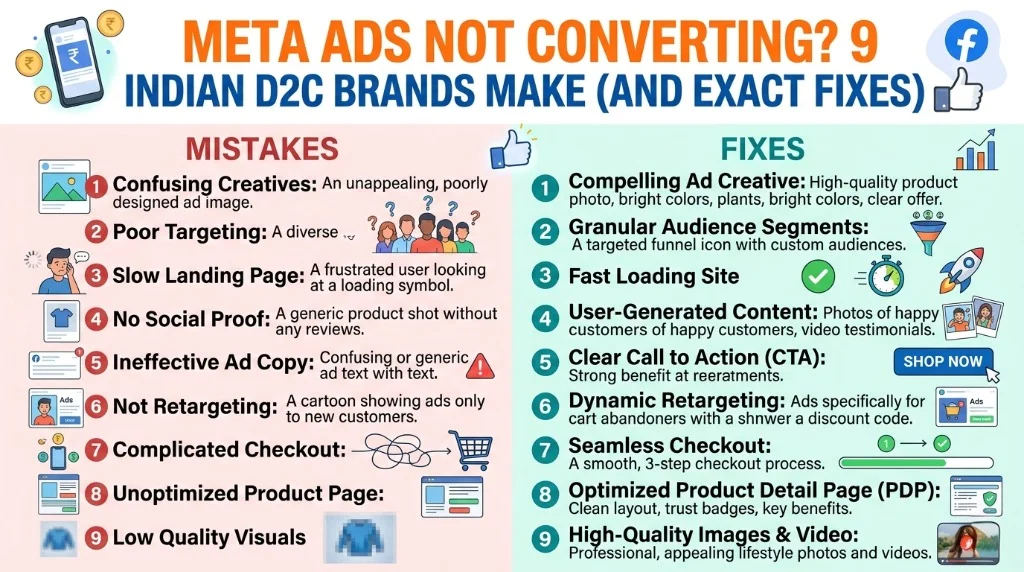
If this sounds familiar, you are not alone. We manage Meta ad accounts for over 20 Indian D2C brands at Aim n Launch, and we see the same nine mistakes killing conversions across almost every account we audit. The good news? Every single one of these is fixable, often within a week.
In this post, we are going to walk through each mistake, show you exactly why it tanks your performance, and give you the specific fix to implement today. No vague advice. No “just test more.” Real, India-specific tactics backed by data from 50+ campaigns we have run across beauty, fashion, food, electronics, and wellness categories.
Want us to audit your Meta ad account for free? Book a 15-minute call with our team and we will identify exactly where your ad spend is leaking.
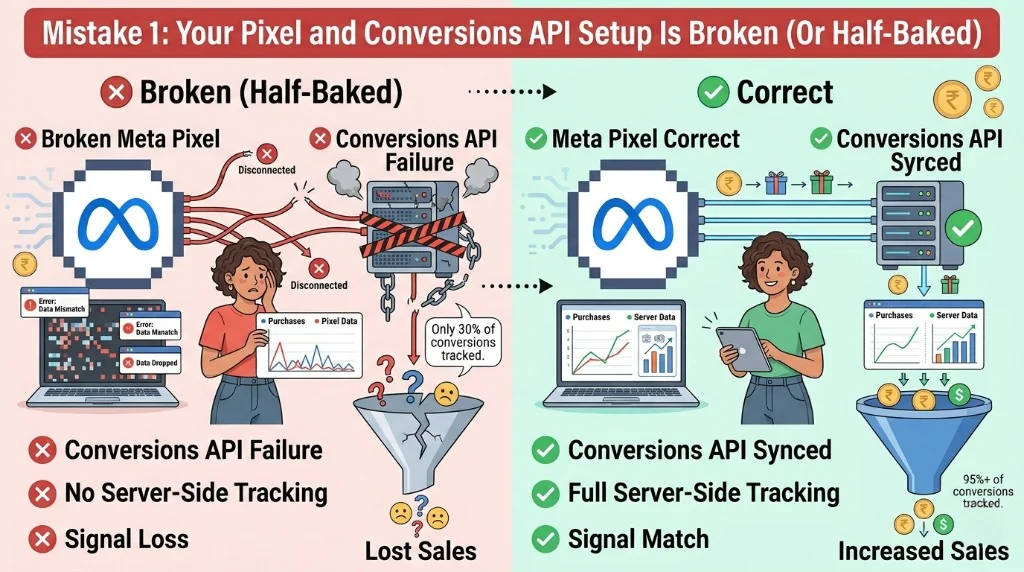
This is the single most expensive mistake we see, and it is the one most founders ignore because it feels “technical.”
Here is the reality. After iOS 14.5 and the continued tightening of browser privacy in 2026, a browser-only Meta Pixel misses 20 to 40 percent of your conversions. That means Meta’s algorithm is making optimization decisions with incomplete data. It is like trying to drive with a fogged-up windshield.
What we see in audits: Indian D2C brands running on Shopify often rely on the default Pixel integration without setting up the Conversions API (CAPI). Some have the Pixel firing on the wrong events, like tracking “Add to Cart” as a “Purchase.” Others have duplicate events inflating their reported conversions while the algorithm optimizes for garbage data.
The exact fix:
The impact: One fashion brand we work with saw their reported cost per purchase drop by 28% within 10 days of fixing their CAPI setup. The purchases were always happening. Meta just could not see them.
This sounds too basic to matter, but it is costing Indian D2C brands lakhs every month.
Meta’s algorithm is ruthlessly literal. If you select “Traffic” as your objective, Meta will find people who click links. Not people who buy. If you select “Engagement,” Meta finds people who like, comment, and share. Not people who pull out their wallets.
What we see in audits: About 30% of the accounts we audit have at least one active campaign running on the wrong objective. The most common mistake? Running a “Traffic” campaign to a product page and wondering why nobody is buying.
The exact fix:
For ecommerce, you should be running one of two objectives: “Sales” (if you are optimizing for purchases) or “Leads” (if you are running a lead generation funnel first). That is it.
Within the Sales objective, optimize for the “Purchase” event, not “Add to Cart” or “Initiate Checkout.” Yes, your cost per result will look higher initially. But you are telling Meta to find buyers, not browsers.
If your account is new and you do not have 50 purchases per week yet, start by optimizing for “Add to Cart” to give the algorithm enough data to learn. Once you cross 50 weekly add-to-carts consistently, switch to optimizing for “Purchase.”
Real example: A skincare brand came to us spending Rs 4 lakh per month on a Traffic campaign. Their CPM was low (Rs 85), their CTR was great (2.1%), and they were getting thousands of clicks. But their cost per purchase was Rs 1,800. We switched them to a Sales campaign optimized for Purchase events. Within two weeks, their cost per purchase dropped to Rs 680, a 62% reduction, even though their CPM went up to Rs 140.
Meta’s algorithm in 2026 needs data to perform. Specifically, it needs approximately 50 conversion events per ad set per week to exit the “learning phase” and deliver stable, optimized results. Every ad set that does not hit this threshold is essentially burning money while the algorithm guesses.
What we see in audits: Founders splitting Rs 5 lakh per month across 8 to 12 ad sets targeting micro-audiences. Each ad set gets Rs 1,500 to Rs 2,000 per day, generates maybe 5 to 8 purchases per week, and never exits the learning phase.
The exact fix:
Consolidate aggressively. One campaign with 2 to 3 ad sets maximum at higher budgets will outperform 10 ad sets at lower budgets every single time.
Here is the math. If your average cost per purchase is Rs 600, you need 50 purchases per week per ad set. That means each ad set needs a weekly budget of at least Rs 30,000, or roughly Rs 4,300 per day.
Use Advantage Campaign Budget (formerly CBO) to let Meta distribute spend across your ad sets based on performance. Do not manually set budgets for each ad set unless you have a very specific reason.
The framework we use: The 3-2-1 Campaign Structure. Three creative angles in one broad prospecting ad set, two retargeting ad sets (website visitors and engagers), and one campaign budget that Meta distributes automatically. This structure keeps the algorithm fed while still allowing creative testing.
If you are still building audiences with stacked interests like “interested in skincare AND Nykaa AND online shopping AND women aged 25 to 34 in Mumbai,” you are fighting Meta’s own algorithm.
In January 2026, Meta removed a significant number of granular interest categories. The platform is pushing hard toward Advantage+ Audience and broad targeting because their AI has gotten genuinely good at finding buyers, but only if you let it.
The data: Meta’s internal benchmarks show that switching to Advantage+ cuts CPA by up to 32% in ecommerce verticals. CTRs increase by 11 to 15%, and CPC decreases by 5 to 10% in competitive segments.
The exact fix:
For prospecting campaigns, go broad. Set only country (India), age range (if your product genuinely skews to a specific demographic), and gender (if relevant). Let Meta’s algorithm do the targeting through your creative.
Your creative is now your targeting. A video showing a 25-year-old woman applying your serum will naturally reach women interested in skincare. You do not need to tell Meta that manually.
When narrow targeting still makes sense: If your account has fewer than 50 weekly conversions, if your daily budget is under Rs 2,000, or if you sell a genuinely niche product (say, cricket coaching equipment for left-handed batsmen), interest targeting can still work. For everyone else, go broad.
How boAt does it: boAt, one of India’s most aggressive D2C advertisers, shifted to broad targeting paired with high creative velocity. Instead of 20 micro-targeted ad sets, they run broad audiences with dozens of creative variations, letting Meta’s AI match the right creative to the right person. The result? Lower CPAs and significantly easier scaling.
Here is a pattern we see constantly. A D2C brand launches a campaign with 3 to 4 creatives. For the first 10 days, performance is amazing. Then cost per purchase starts creeping up. By week three, ROAS has dropped 40%. The founder blames the algorithm, the audience, the season. But the real culprit? Ad fatigue.
When Meta shows the same ad to the same people repeatedly, click-through rates drop, frequency spikes, and the algorithm starts struggling to find new pockets of responsive users.
The benchmarks you need to watch:
The exact fix:
You need a creative velocity system, not just “new ads sometimes.”
Here is what we implement for our clients: produce a minimum of 8 to 12 new creative variations per month. That sounds like a lot, but most of these are not shot-from-scratch productions. They are variations. Different hooks on the same video. Different thumbnails. Different copy angles. A UGC version of your studio ad.
The framework:
How Sugar Cosmetics approaches this: Sugar Cosmetics discovered that polished, studio-quality influencer ads were losing impact. They shifted to raw, authentic UGC content shot on phones, and saw engagement rates jump. The lesson? In 2026, content that feels like content (not ads) performs better. Your creative team should spend more time scripting hooks and less time on production polish.
Your ads might be perfect. Your targeting might be dialed in. But if your product page loads in 6 seconds, has a generic stock photo as the hero image, and buries the “Add to Cart” button below the fold, your Meta ads will never convert profitably.
The benchmarks for Indian D2C:
The exact fix:
Run your product page URL through Google PageSpeed Insights right now. If your mobile score is below 60, that is your first priority.
The high-impact changes we implement for clients:
Dedicated landing pages vs. product pages: For high-spend campaigns (above Rs 5 lakh per month), we always recommend building dedicated landing pages that match the ad’s message exactly. If your ad talks about a specific problem (say, acne), the landing page should open with that problem, not your full product catalog. This alone can improve conversion rates by 25 to 40%.
Need help optimizing your Shopify store for conversions? Check out our Shopify development and CRO services.
Only 2 to 3% of your website visitors will buy on their first visit. That means 97% of the traffic you paid for walks away. Without a retargeting funnel, that money is gone forever.
What we see in audits: Either no retargeting at all (surprisingly common with brands spending Rs 3 to 5 lakh per month) or a single retargeting ad set showing the same prospecting creative to everyone who visited the website in the last 30 days.
The exact fix: The 3-Layer Retargeting Framework
Layer 1: Warm Retargeting (1 to 7 days) Target: Website visitors, product page viewers, add-to-cart abandoners from the last 7 days. Creative: Product-specific ads with urgency. “Still thinking about [Product]? Here is 10% off for the next 24 hours.” Show the exact product they viewed. Budget: 15 to 20% of total ad spend.
Layer 2: Engagement Retargeting (7 to 14 days) Target: Instagram and Facebook engagers, video viewers (50%+ watched), people who visited your website but did not add to cart. Creative: Social proof heavy. Customer reviews, UGC testimonials, “best-seller” callouts. Budget: 5 to 10% of total ad spend.
Layer 3: Re-engagement (14 to 60 days) Target: Past purchasers for repeat buys, lapsed website visitors. Creative: New arrivals, bundle offers, loyalty discounts. Budget: 5% of total ad spend.
The numbers: A wellness brand we manage was spending Rs 8 lakh per month entirely on prospecting. Their blended ROAS was 2.1x. We carved out 25% of that budget for retargeting. Within a month, their blended ROAS jumped to 3.4x because the retargeting campaigns were delivering a 6 to 8x ROAS, pulling the overall average up dramatically.
Meta’s default attribution window is 7-day click and 1-day view. But many Indian D2C brands never look beyond the numbers in Ads Manager, and that is a problem because Ads Manager does not tell you the full story.
What most founders miss:
The exact fix:
The final mistake ties everything together. Most Indian D2C brands “test” creatives by uploading 3 to 4 ads, running them for a few days, picking the one with the lowest cost per result, and repeating. That is not testing. That is guessing.
The exact fix: The Structured Creative Testing Protocol
Step 1: Define your testing hierarchy. Test in this order: Hook (the first 3 seconds of a video or the headline of a static), then Format (UGC vs. studio vs. graphic), then Offer (discount vs. free shipping vs. bundle), then Audience (only after you have a winning creative).
Step 2: Test one variable at a time. If you change the hook, the visual, and the offer simultaneously, you have no idea what caused the result. Isolate variables.
Step 3: Set clear success criteria before you launch. “We will spend Rs 3,000 per creative variant. If cost per purchase is below Rs 700, it is a winner. Between Rs 700 and Rs 1,000, we iterate. Above Rs 1,000, we kill it.” Write this down before you launch the test. Do not move goalposts after seeing results.
Step 4: Document everything in a creative tracker. For every ad, record: the hook angle, the format, the offer, the audience, the spend, the cost per purchase, the CTR, and the ROAS. After 20 to 30 tests, patterns emerge that are worth more than any media buying course.
Step 5: Scale winners methodically. When you find a winning creative, do not just increase the budget 5x overnight. Increase by 20 to 30% every 3 days. This prevents the algorithm from re-entering the learning phase and losing performance.
The framework we call “The 3H Creative Matrix”: Every month, produce creatives across three categories: Hero (high-production brand storytelling, 2 to 3 per month), Hustle (quick UGC and testimonial ads, 6 to 8 per month), and Hack (meme-style, trend-jacking, lo-fi content, 4 to 6 per month). This ensures you are always testing different creative styles and never relying on a single approach.
Before you close this tab, run through this quick diagnostic:
If you answered “no” to more than three of these, your Meta ads are almost certainly underperforming, and there is significant room to improve your ROAS.
Every rupee you spend on Meta ads while these mistakes persist is a rupee working at a fraction of its potential. The brands that win on Meta in 2026 are not the ones with the biggest budgets. They are the ones with clean tracking, consolidated campaigns, fresh creative, solid landing pages, and systematic testing.
The nine fixes in this post are exactly what we implement in the first 30 days when a new D2C brand comes to Aim n Launch for Meta ads management. Most brands see a 25 to 40% improvement in cost per purchase within the first month, not because we have some secret hack, but because we fix the fundamentals that are hiding in plain sight.
Ready to find out where your ad spend is leaking? Book a free Meta Ads Audit with our team. We will go through your account, identify the biggest conversion killers, and give you a prioritized action plan, no strings attached. Book your free audit here.
This usually means one of two things: you are using the wrong campaign objective (Traffic instead of Sales), or your landing page is not optimized for conversions. Meta’s Traffic objective finds clickers, not buyers. Switch to the Sales objective with Purchase optimization. If you are already doing that, check your product page load speed, pricing clarity, and whether the page matches the promise in your ad.
As a rule of thumb, spend at least 3x your target cost per purchase before judging a creative or ad set. If your target CPA is Rs 600, give each ad set at least Rs 1,800 before making a call. For campaign-level decisions, allow at least 2 weeks and 50+ conversion events to get statistically meaningful data.
It depends on your margins, but here are the benchmarks we see across our clients: Beauty and skincare brands target 3 to 4x ROAS, fashion and apparel aim for 2.5 to 3.5x, food and beverages look for 2 to 3x, and electronics and gadgets target 2 to 2.5x. Remember, ROAS alone does not tell you if you are profitable. You need to factor in COGS, shipping, returns, and gateway charges. That is why we recommend tracking CM2 (Contribution Margin 2) alongside ROAS.
For established brands with at least 50 weekly purchases and clean conversion tracking, Advantage+ Shopping Campaigns consistently outperform manual setups in our experience. Meta’s AI has improved significantly, and Advantage+ campaigns cut CPA by up to 32% according to Meta’s own benchmarks. If your brand is newer with fewer conversions, start with manual campaigns to build data, then transition to Advantage+ once you have a steady conversion flow.
Plan for 8 to 12 new creative variations per month. Watch for frequency above 3.0, CTR dropping below 1%, or cost per purchase increasing by more than 20% week-over-week. These are signals that your creative is fatiguing. The key is having a system for producing variations quickly, not starting from scratch every time. Different hooks on the same video, different thumbnails, and UGC versions of studio ads all count as new variations.
Your COD orders are costing you more than you think. We have helped 50+ Indian D2C brands fix their unit economics and turn unprofitable growth into real margin. Get a free COD Impact Analysis for your brand. Book a 15-minute call with Aim n Launch.