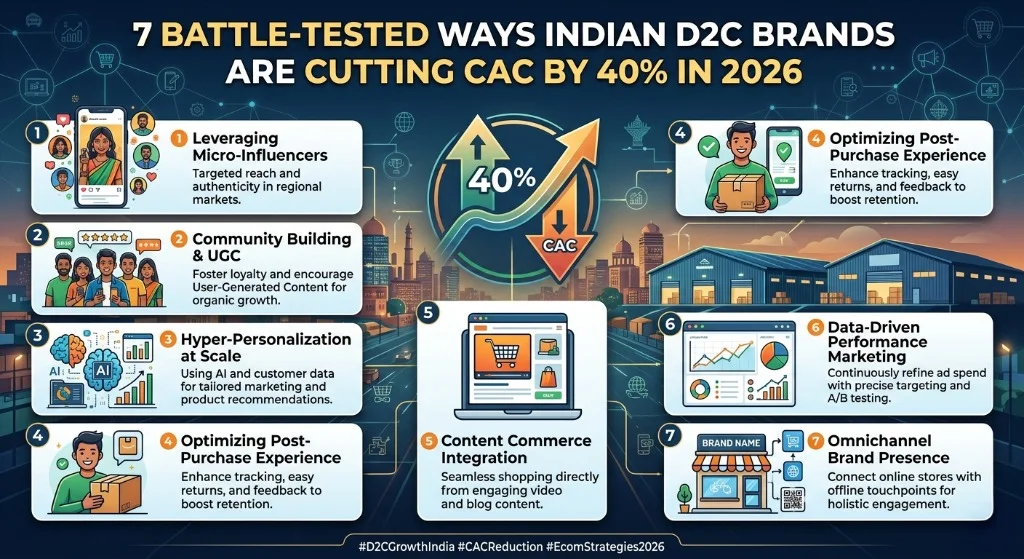
If you run a D2C brand in India, you already feel it. Meta and Google auction prices have risen by roughly 45% compared to 2024. What used to cost you Rs 300 per customer now costs Rs 500 or more. And if you are in beauty or personal care, you might be staring at Rs 800 to Rs 1,200 per acquired customer.
The brands that are winning right now are not the ones spending the most. They are the ones who figured out how to reduce CAC in ecommerce in India without sacrificing quality of customers. This post breaks down the exact strategies, with real numbers, real brand examples, and a framework you can implement this week.
Want someone to audit your CAC and find the leaks? Book a free CAC audit with our team at Aim n Launch.
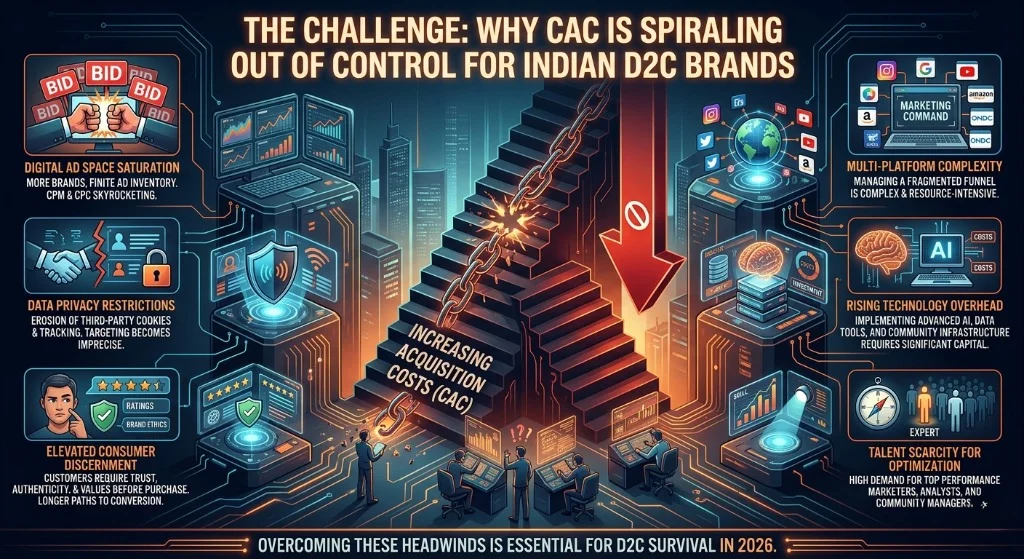
Before we get into solutions, you need to understand why this is happening. It is not just “ads are expensive now.” There are structural reasons behind the CAC surge.
First, hundreds of D2C brands are now bidding on the same Meta and Google ad inventory. The auction is crowded, and the platforms’ algorithms favour low-cost conversions, which often means you are acquiring bargain hunters who churn after the first discount.
Second, privacy changes continue to erode tracking. iOS restrictions, cookie deprecation, and tighter consent requirements mean your targeting is less precise than it was two years ago. Less precision means more wasted spend.
Third, the D2C market in India is maturing. Early adopters have already been acquired. You are now trying to convert the next wave of customers who are harder to reach, more skeptical, and need more touchpoints before buying.
Here is the data that puts it in perspective. For D2C fashion brands in India, CAC benchmarks range from Rs 200 to Rs 800. For beauty, it is Rs 150 to Rs 500 at the lower end, but the actual cost for many brands has ballooned to Rs 800 to Rs 1,200 per customer. In Delhi NCR specifically, heightened advertising competition inflates CAC up to 50% above other metros.
The brands cutting through this are not just optimizing ads. They are rebuilding their entire acquisition architecture.
This is the fastest, cheapest, and most overlooked way to reduce CAC. The math is simple: if your Shopify store converts at 1.2% and you improve it to 2.4%, your CAC drops by half. You did not spend a single extra rupee on ads.
Most Indian D2C brands run conversion rates between 1% and 1.8%. The top performers sit at 3% to 3.5%. That gap is not about product quality. It is about the buying experience.
What to fix first:
Your product pages are where the money is made or lost. Every high-converting Indian D2C product page has these elements: a hero image showing the product in use (not just a flat lay), social proof above the fold (review count plus average rating), price with savings clearly shown (strikethrough MRP is mandatory in India), delivery estimate with pincode checker, and a sticky add-to-cart button on mobile.
Minimalist, the skincare brand, improved their product page conversion by adding before-and-after images and ingredient breakdowns directly on the product page. The result was a measurable lift in add-to-cart rates without changing a single ad.
Your action step: Run a CRO audit on your top 5 product pages this week. Check mobile load time (should be under 3 seconds), trust signals, and checkout friction. Grab our free CRO audit checklist here.
Here is the single biggest lever for reducing paid CAC in 2026: your ad creative.
Raw, unedited testimonial videos from real customers are performing 40% better than high-production studio ads. Ads with UGC get 4x higher click-through rates and 50% lower cost per click compared to polished brand creative.
Why? Because people scroll past ads. They stop for content that looks like a friend talking to them.
boAt rebuilt its entire performance strategy around what they call creative velocity. Instead of producing one hero video per month, they now generate 15 to 20 variations per product using different openings, captions, and CTAs. They shifted from monthly to weekly creative refresh cycles, using AI-assisted tools to generate multiple hooks from the same base video.
The Aim n Launch Creative Velocity Framework:
Step 1: Source 10 to 15 UGC creators per month (use platforms like Insense, Clout, or direct outreach on Instagram). Step 2: Brief each creator with three different hooks for the same product. Step 3: Edit each raw video into 3 to 4 variations with different text overlays and CTAs. Step 4: Launch all variations in a single Advantage+ campaign and let Meta’s algorithm find the winners. Step 5: Kill underperformers after Rs 500 spend. Scale winners by 20% daily.
This approach gives you 40 to 60 fresh creatives per month instead of 4 to 5. More creative variations mean more chances for Meta to find low-CPM pockets in the auction. Brands we work with at Aim n Launch consistently see 30% to 40% lower CPA after implementing this system.
Your action step: Brief 5 UGC creators this week with 3 hook variations each. That gives you 15 raw videos to test. Download our free creative brief template.
WhatsApp is the OS of India, and it is the most underused marketing channel in Indian D2C. With 95%+ open rates and most messages read within 5 minutes, no other channel comes close for retention and reactivation.
Here is why this matters for CAC: a 5% improvement in retention rate can reduce your effective CAC by 15% to 25%, because you need fewer new customers to hit the same revenue target. Retention is not just about loyalty. It is directly connected to your blended acquisition cost.
Three WhatsApp flows that immediately impact CAC:
Abandoned cart recovery. Dedicated WhatsApp abandoned cart sequences can recover 25% to 30% of lost orders when sent within the first 30 minutes. That is revenue you already paid to acquire. Every recovered cart directly lowers your effective CAC.
Post-purchase upsell. Send a WhatsApp message 3 days after delivery with a complementary product recommendation. Indian D2C brands see 8% to 15% conversion rates on these sequences, and the CAC for these orders is essentially zero because you already own the relationship.
Win-back campaigns. Indian D2C brands typically see 8% to 15% re-engagement rates on well-targeted WhatsApp win-back campaigns for customers who have not purchased in 60 to 90 days.
Pilgrim, the beauty brand, uses WhatsApp for everything from order updates to personalized skincare routine recommendations. This keeps customers in the brand ecosystem without spending on re-acquisition ads.
Your action step: Set up at least an abandoned cart WhatsApp flow this week using tools like Interakt, Wati, or AiSensy. Track recovered revenue separately and calculate how it changes your blended CAC.
This is different from the retention play above. Click-to-WhatsApp (CTWA) ads are acquisition ads that start a conversation instead of sending people to a landing page.
Why are they cheaper? Because the conversion happens inside a conversation. The prospect asks questions, gets answers, and buys in the same thread. There is no landing page friction, no checkout abandonment, and the trust factor is significantly higher because it feels like talking to a person.
For high-consideration products (anything above Rs 1,500 AOV, products that need explanation, or categories where trust is a barrier), CTWA ads consistently deliver 25% to 35% lower CAC compared to traditional conversion campaigns.
How to set it up right:
Run CTWA ads targeting your best-performing cold audiences. Use a chatbot for the first response (handle FAQs automatically), but have a human agent jump in for purchase-ready conversations. Track cost per conversation started, conversation-to-purchase rate, and AOV from WhatsApp orders separately.
The key metric is not cost per click. It is cost per qualified conversation. Most brands see Rs 15 to Rs 30 per conversation started, and with a 10% to 15% conversation-to-purchase rate, the math works out significantly cheaper than traditional Meta conversion campaigns.
Your action step: Take 20% of your Meta conversion budget and reallocate it to a CTWA campaign this week. Run it for 7 days and compare CAC against your standard campaigns.
Every customer who finds you through Google search costs you zero in marginal acquisition cost. Over time, this is the most powerful CAC reduction lever available to any D2C brand.
Mamaearth and WOW Skin Science built massive organic customer bases by investing early in SEO content, specifically buying guides, ingredient explainers, and comparison articles that captured high-intent search traffic.
The playbook is straightforward but requires consistency.
The D2C SEO Content Stack:
Bottom-of-funnel content (converts directly): product comparison articles (“Brand X vs Brand Y”), “best [product category] in India 2026” listicles, and buying guides with clear recommendations. These pages target keywords where the searcher is ready to buy.
Middle-of-funnel content (builds consideration): ingredient deep-dives, how-to guides, and problem-solution articles. For example, a skincare brand writing “How to Build a Night Skincare Routine for Indian Skin” captures people who are 2 to 3 steps away from buying.
Top-of-funnel content (builds awareness at scale): trend articles, data-driven research, and industry insights. These attract links and social shares that boost your entire site’s domain authority.
The compound effect is real. A single well-ranked blog post can drive 500 to 2,000 visitors per month for years. At Rs 0 per visit, that is the equivalent of saving Rs 2.5L to Rs 10L per month in ad spend, depending on your paid CAC.
Your action step: Identify 10 high-intent keywords in your category using tools like Ahrefs or Ubersuggest. Write and publish 2 blog posts per week targeting these keywords. Expect to see meaningful organic traffic within 3 to 4 months. Learn more about our ecommerce SEO services.
A well-designed referral program can reduce CAC by 40% to 60% for the referred customer while deepening loyalty for the referrer. And referred customers tend to have higher LTV because they come with built-in trust.
Most Indian D2C brands either do not have a referral program or have a weak one that nobody uses. The difference between a referral program that works and one that does not comes down to three things: the incentive structure, the sharing mechanism, and the timing of the ask.
What works in India:
The incentive needs to reward both parties. “Give Rs 200, Get Rs 200” is significantly more effective than “Refer a friend and get 10% off.” Flat rupee amounts feel more tangible than percentages, especially for average order values under Rs 2,000.
The sharing mechanism needs to be frictionless. A unique referral link that the customer can share via WhatsApp (not just email) is non-negotiable in India. WhatsApp is where people share recommendations, and making the share button prominent on the order confirmation page catches customers at peak satisfaction.
The timing matters. Ask for referrals 3 to 5 days after delivery, when the customer has received the product and is excited about it. Do not ask at checkout (too early) or 30 days later (too late).
Snitch, the menswear brand, runs a referral program that contributes a meaningful percentage of their new customer acquisition. Their referred customers have a 25% higher repeat purchase rate compared to customers acquired through paid ads.
Your action step: Set up a referral program using tools like ReferralCandy, Yotpo, or even a simple WhatsApp-based system. Start with “Give Rs 200, Get Rs 200” and measure the referral rate after 30 days.
If you are only running ads targeting metros, you are competing in the most expensive auction in Indian ecommerce. Tier 2 and Tier 3 cities, where 70% of India’s internet users now reside, offer significantly lower CAC because fewer brands are competing for that attention.
The numbers are compelling. CPMs in Tier 2 cities like Jaipur, Lucknow, and Indore are 40% to 60% lower than in Mumbai or Delhi. And with rising smartphone penetration and improving logistics infrastructure, these customers are increasingly comfortable buying online.
How to do it right without diluting your brand:
Create separate ad sets targeting Tier 2 and Tier 3 cities with creatives that resonate locally. This does not mean you need to overhaul your brand. It means using vernacular language in your ads (Hindi, Tamil, Bengali, Marathi depending on the region), featuring models and settings that feel relatable to these audiences, and offering COD prominently (Tier 2/3 customers still have a strong COD preference).
Lenskart cracked this early by building a presence in smaller cities through both online ads and physical experience stores. Their blended CAC in Tier 2 cities is substantially lower than metros, and these customers show strong repeat purchase behaviour.
Important caveat: Tier 2/3 targeting only works if your logistics can support it. Check your shipping partner’s serviceability, delivery timelines, and RTO rates for these pincodes before scaling spend. Higher RTO rates can eat into the CAC savings if you are not careful.
Your action step: Create a duplicate of your best-performing Meta campaign with location targeting set to Tier 2 cities only. Run it for 2 weeks with Rs 50,000 budget and compare CAC, ROAS, and RTO rates against your metro campaigns.
Reducing CAC is not about picking one strategy and hoping it works. It is about building a system where multiple channels compound to lower your blended acquisition cost over time.
Here is how the most successful Indian D2C brands allocate their efforts:
Immediate impact (Week 1 to 2): CRO fixes on top product pages, UGC creative refresh, and WhatsApp abandoned cart flow. These changes can reduce blended CAC by 15% to 20% within 30 days.
Medium-term impact (Month 1 to 3): CTWA ad campaigns, referral program launch, and Tier 2/3 city expansion. These compound to an additional 15% to 25% CAC reduction.
Long-term impact (Month 3 to 12): SEO content engine, organic social content strategy, and community building. These create a structural advantage that reduces your dependence on paid channels entirely.
The brands hitting a 30% to 40% overall CAC reduction are doing all seven of these simultaneously, not sequentially.
Successful Indian D2C brands now aim for a blended CAC that is 30% to 40% lower than their pure paid CAC. They achieve this by mixing paid acquisition with organic content, WhatsApp marketing, referrals, and community-driven growth. The healthy LTV-to-CAC ratio target is 3x or higher, but many Indian D2C brands still operate at 1.5x to 2.5x. If that is you, this framework is your path to fixing it.
It depends on your category. For fashion, Rs 200 to Rs 800 is the benchmark range. For beauty and personal care, Rs 150 to Rs 500 is healthy, though many brands are actually spending Rs 800 to Rs 1,200. The number that matters more is your LTV-to-CAC ratio. Aim for 3x or higher.
CRO improvements and creative refreshes can show results within 2 to 4 weeks. WhatsApp flows and referral programs typically take 4 to 8 weeks to show measurable impact. SEO is a longer play, usually 3 to 6 months before you see meaningful organic traffic, but the compounding effect makes it the most valuable long-term investment.
Yes, significantly. CPMs in Tier 2 cities are 40% to 60% lower than metros like Mumbai and Delhi. However, you need to account for potentially higher RTO rates and longer delivery times. The net CAC savings after accounting for returns is typically 25% to 35% lower.
For performance marketing, yes. Raw, authentic UGC-style ads get 4x higher click-through rates and 50% lower cost per click compared to polished brand creative. This does not mean you should never produce professional content, but for conversion-focused Meta and Google campaigns, UGC consistently outperforms.
The optimal budget allocation for Indian D2C brands in 2026 is roughly 40% to 50% on Meta, 25% to 30% on Google (split between Shopping, brand search, and Performance Max), 15% to 25% on emerging channels like YouTube Shorts, WhatsApp Commerce, and influencer seeding, and 5% to 10% on SEO and content. Over time, as your organic engine matures, you can shift more budget away from paid acquisition.
Launching a D2C brand is one of the most rewarding things you can do as an entrepreneur in India right now. The market is massive, the infrastructure is ready, and the playbook exists. You just need to follow it with discipline.
Ready to launch your D2C brand the right way? Book a free 15-minute strategy call with the Aim n Launch team and get a custom launch roadmap for your brand.