Ecommerce SEO Company Built for D2C Brands That Care About Profitability

There are over 8,000 digital marketing agencies in India. Most of them list “ecommerce SEO” on their website. Very few of them have actually done it.

Running SEO for an ecommerce store is fundamentally different from running it for a law firm, a restaurant, or a SaaS company. Ecommerce sites have thousands of product pages, complex category structures, duplicate content problems that can tank your rankings overnight, and a direct revenue metric that either justifies the investment or does not.

We are Aim n Launch. We are an ecommerce SEO company based in Delhi, and every single client we work with is a D2C or ecommerce brand. We do not do SEO for dentists on Monday and ecommerce brands on Tuesday. This is all we do. And that focus is why we deliver results that generalist agencies cannot.


Book Free Strategy Call

Why You Need a Specialist Ecommerce SEO Company

The difference between a generalist SEO agency and a specialist ecommerce SEO company shows up in the first week of working together.

A generalist will run an automated audit, hand you a report with 200 “issues” (most of them irrelevant), suggest you “create more content,” and start building directory links. Three months later, your traffic is up 20% but your organic revenue has not moved. You are paying for visitors who browse, read a blog post, and leave.

A specialist ecommerce SEO company knows that the game is not about traffic. It is about revenue. Here is what that difference looks like in practice:

We know which pages make money

On an ecommerce site, your homepage is not your money page. Your blog is not your money page. Your “About Us” page is definitely not your money page. Your category pages and product pages are where transactions happen. A specialist ecommerce SEO company focuses optimization effort on these pages first, because that is where organic revenue comes from.

We understand ecommerce site architecture

A 500-product Shopify store generates thousands of URLs when you factor in product variants, filtered views, paginated collections, and tag pages. Most of these URLs should not be in Google’s index. If they are, they dilute your site’s ranking power and confuse search engines about which pages matter.

We know how to handle this: which URLs to index, which to canonicalize, which to noindex, and which to block in robots.txt. This is not something you learn from a generic SEO course. You learn it from working with ecommerce sites every day.

We connect SEO to your entire growth stack

For a D2C brand, SEO does not exist in isolation. Your Google Ads search term report tells you which keywords convert into purchases, and that data should directly inform your SEO keyword strategy. Your Meta Ads creative tells you which product angles resonate with buyers, and that insight should shape your product page copy. Your Shiprocket data tells you which pin codes have the highest delivery success rates, and that can inform your local SEO targeting.

We run performance marketing alongside SEO for D2C brands. So when we do your SEO, it is informed by real conversion data, real ad performance, and real unit economics. Not just search volume estimates from a keyword tool.

Brands we grow.

OUR CLIENTS EXPERIENCE
UNCOMFORTABLE ORGANIC GROWTH

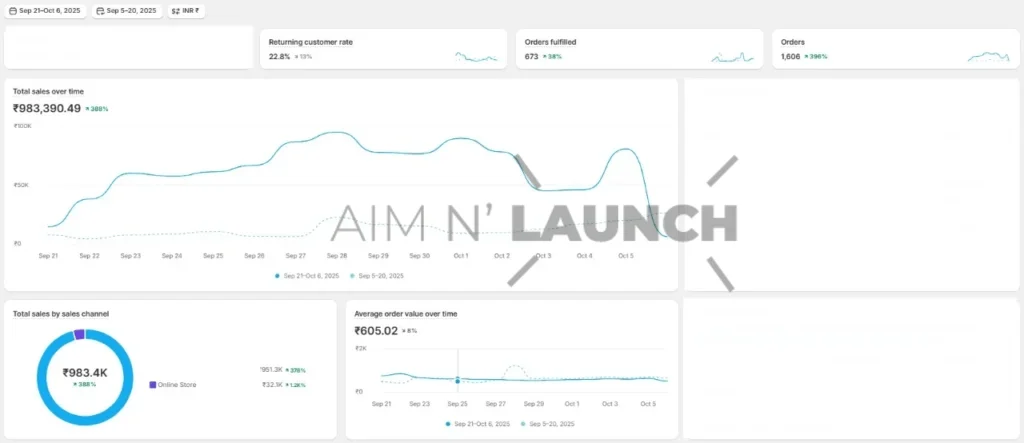
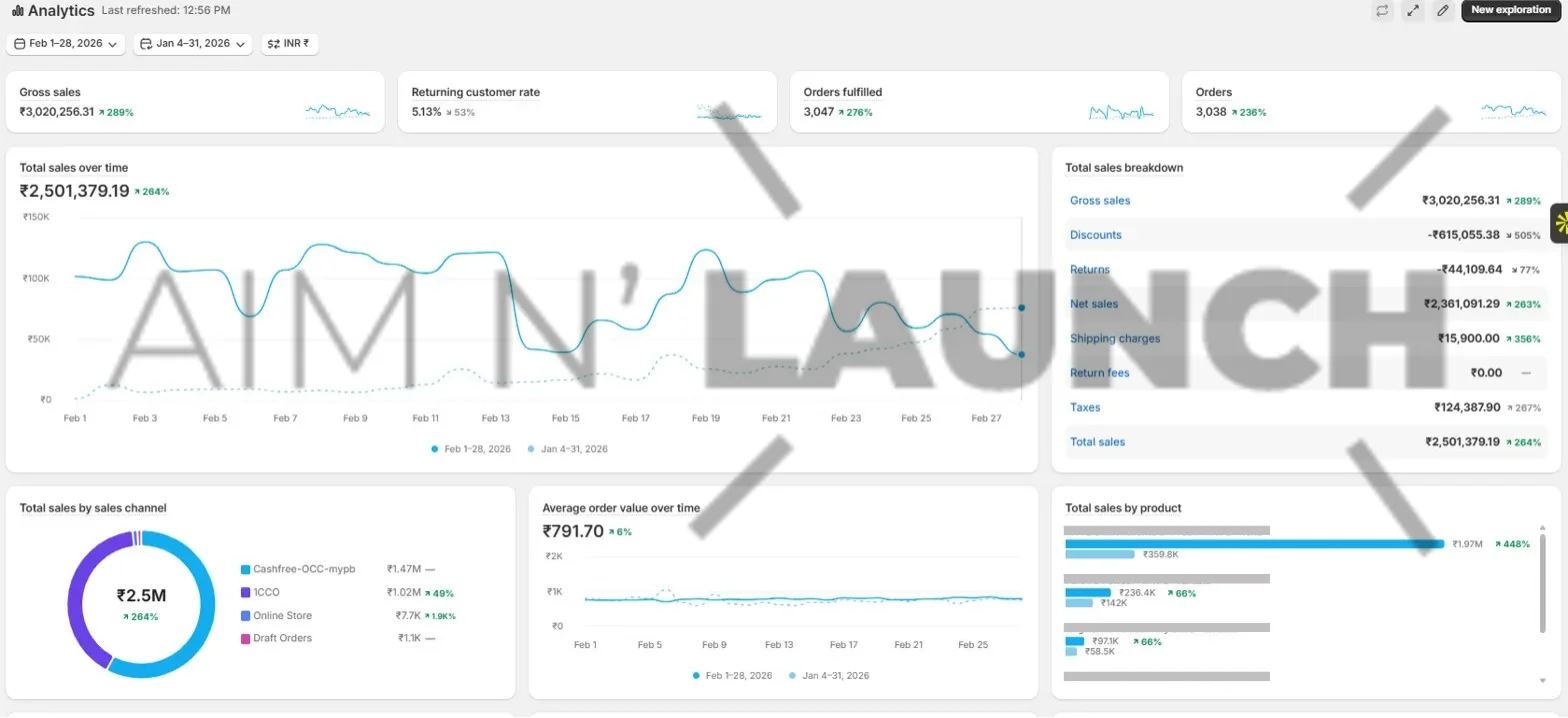
FMCG Hydration Brand: 16 days • ₹9.62L Net sales • 1,606 orders • AOV ₹605 • Returning 22.8% • +382% net vs prior period

VIEW MORE CASE STUDY
FMCG Hydration Brand Case Study

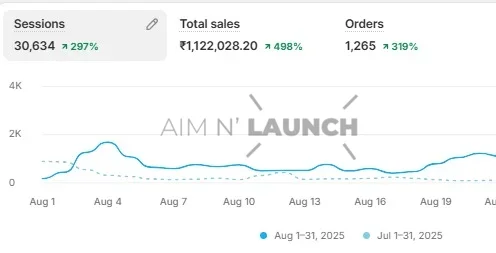
FMCG Snacks Brand (India) — 31 days • ₹11,22,028 total sales • 1,265 orders • AOV ₹887 • +498% sales vs prior • +297% sessions • +319% orders

VIEW MORE CASE STUDY
FMCG Snacks Brand Case Study

334% Revenue Growth in 30 Days • How we scaled a coconut water powder D2C brand past their ₹8L target, hitting ₹10.5L in a single month.

VIEW MORE CASE STUDY
Coconut Water Powder Brand Case Study

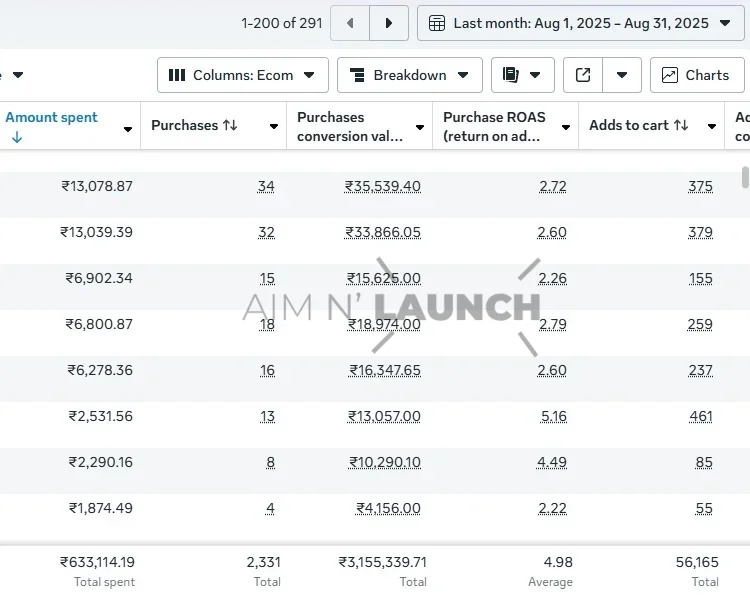
Fashion Brand (India) — 31 days • ₹42,33,340 tracked revenue (₹31,55,340 Meta + ₹10,78,000 SEO) • 4.98× ROAS on Meta • 2,331 purchases • AOV ₹1,354 • MER 6.69×

VIEW MORE CASE STUDY
Fashion Brand Case Study

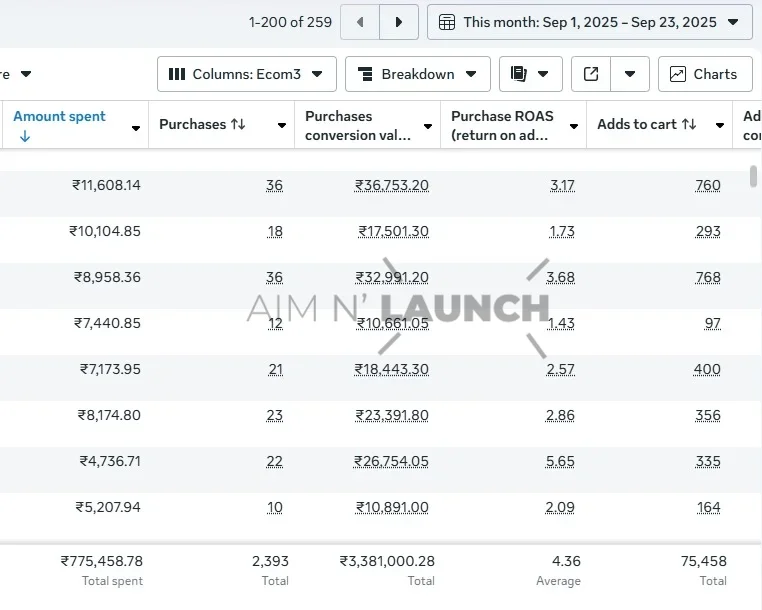
Nutrition & Wellness brand scaled to ₹3.4Cr revenue in 23 days at 4.36 ROAS with a defendable AOV strategy.

VIEW MORE CASE STUDY
Nutrition and Wellness Brand Case Study

The Scale-Up Journey of a Shark Tank Featured Healthy Snacks Brand. How we took a protein snacking brand from ₹7.8L to ₹30.2L in gross sales in a single month, with a 2.87% conversion rate and 6% AOV lift.

VIEW MORE CASE STUDY
Shark Tank Healthy Snacks Brand Case Study

What Makes Us Different as an Ecommerce SEO Company

CM2-First Thinking

We do not chase rankings for keywords that bring traffic but no revenue. Before we start any SEO engagement, we understand your unit economics: what does it cost you to fulfill an order, what is your return rate, what is your payment gateway take, and what margin are you working with?

This matters for SEO because not all organic traffic is equal. A visitor who buys a ₹400 product with free shipping, pays COD, and returns it costs you money even though Google Analytics counts it as a “conversion.” We target keywords that bring profitable customers, not just any customers.

Deep Shopify and WooCommerce Expertise

We are not platform-agnostic in the way that sounds good on a sales call but means nobody on the team actually knows your platform deeply. We work primarily with Shopify (about 80% of our clients) and WooCommerce (about 20%). We know the specific technical SEO challenges, limitations, and workarounds for both platforms.

For Shopify: we handle the duplicate URL structure, Liquid template optimization for speed, app audit to remove JavaScript bloat, collection page content strategy, and the limitations of Shopify’s built-in SEO capabilities.

For WooCommerce: we handle plugin compatibility issues, database optimization, hosting configuration for speed, security hardening (because a hacked WordPress site loses all its rankings), and the advantage of having more technical control over things like robots.txt and server-side redirects.

India-First SEO Strategy

Search behavior in India is different from the US or UK. Indian buyers: – Search in a mix of English and Hindi (Hinglish queries like “best face wash for oily skin in summer” are huge) – Are overwhelmingly on mobile (80%+ of ecommerce traffic) – Care deeply about price, delivery timeline, and return policy – Compare across multiple platforms before buying (your organic listing competes with Amazon, Flipkart, and Nykaa results on the same SERP) – Often search for brand names + “review” or “real or fake” before trusting a new D2C brand

Our keyword strategy, content strategy, and on-page optimization all account for these behaviors. A US-trained SEO playbook will miss most of this.

Transparent, Revenue-Tied Reporting

We do not send you a 30-page report full of keyword ranking charts and backlink graphs. Our monthly report focuses on the numbers that matter:

  • Organic revenue this month vs. last month
  • Organic traffic (broken down by product pages, category pages, and blog)
  • Top converting organic keywords
  • New keyword rankings in commercial intent positions
  • Actions taken this month and planned for next month

If organic traffic goes up but organic revenue does not, we flag it and explain why. Usually it means we are attracting informational traffic that is not converting, and we adjust the strategy accordingly.

Our Ecommerce SEO Methodology

1. Audit Before Action

We never start work without understanding your current state. The audit covers technical health, content quality, keyword positioning, backlink profile, and competitor landscape. We pull data from Google Search Console, GA4, and your ecommerce platform. This takes 5-7 days and produces a prioritized action plan, not a generic checklist.

2. Revenue-Mapped Keyword Strategy

Every keyword we target has a clear path to purchase. We map keywords to specific product pages, category pages, or blog content that links to product pages. If a keyword cannot be connected to a buying journey, we do not pursue it. Volume is irrelevant if nobody buying that keyword would ever become your customer.

3. Technical Foundation First

Before we publish a single blog post or build a single link, we fix what is broken. Site speed, crawlability, indexation issues, schema markup, canonical tags, and URL structure. There is no point creating content on a site that search engines cannot properly crawl and understand. The technical foundation has to be solid.

4. Content Velocity Matched to Business Stage

A brand doing ₹10 lakh/month in revenue does not need 50 blog posts. They need 5 perfectly targeted pieces of content on their highest-opportunity keywords, plus optimized product and category pages. We scale content production based on where you are, not based on a generic “content calendar” that justifies our retainer.

5. Continuous Optimization Loop

SEO is never “done.” We review performance monthly, run a quarterly strategy refresh, and continuously identify new opportunities as your product line grows, as competitors shift, and as search trends evolve. The brands that win at SEO are the ones that treat it as an ongoing investment, not a one-time project.

Industries We Serve

Health and Wellness

Supplements, Ayurvedic products, immunity boosters, health devices. SEO in this space requires navigating Google’s health content guidelines (E-E-A-T is critical), competing with Amazon and pharmacy aggregators, and targeting very specific product-level searches. We have experience ranking health products while maintaining compliance with Google’s quality standards.

Beauty and Skincare

One of the most competitive D2C categories in India. The opportunity in SEO is massive because buyers do extensive research before purchasing skincare. “Best serum for pigmentation,” “how to layer skincare products,” “niacinamide for acne scars” are all high-intent searches that lead to purchases. We build content hubs around ingredient-based and concern-based keywords that capture this research traffic and channel it to product pages.

Food and Beverage

Subscription snacks, health foods, gourmet products, beverages. The SEO challenge here is perishability and seasonality. We plan content around seasonal demand peaks, optimize for recipe-related and meal-planning keywords that lead to product discovery, and build local SEO for brands that also sell through offline channels.

Fashion and Apparel

High SKU count, frequent inventory changes, and intense competition from marketplaces. SEO for fashion requires strong category page optimization (because individual products go out of stock regularly), image SEO (Google Lens and image search are growing fast), and trend-responsive content that captures seasonal fashion searches.

Fitness and Supplements

Protein powders, pre-workouts, fitness equipment, activewear. This category has very high purchase intent in organic search. Buyers know exactly what they want (“whey protein isolate 1kg under 2000”) and are comparing options. We optimize for these specific, long-tail commercial queries that convert at 3-5x the rate of generic fitness keywords.

Home and Lifestyle

Home decor, kitchenware, bedding, lifestyle products. Often lower search volume per keyword but very high conversion rates because buyers searching for specific home products are almost always ready to purchase. We target the long tail aggressively in this category and build product comparison content that captures decision-stage searches.

How to Choose the Right Ecommerce SEO Company

If you are evaluating ecommerce SEO companies, here is what to look for and what to avoid. This is a genuine buyer’s guide, not a setup to make us look good.

Check if they actually have ecommerce clients

Ask for 3-5 ecommerce case studies with specific metrics: organic traffic growth, organic revenue growth, and specific keyword rankings achieved. Many agencies claim “ecommerce SEO” on their website but have never actually managed a store with 200+ products and complex category structures.

Ask for revenue metrics, not just traffic

Any agency can grow traffic. The question is whether that traffic buys anything. If their case studies only show “traffic increased 200%” without mentioning revenue, that is a red flag. Organic revenue is the only metric that proves ecommerce SEO is working.

Make sure they understand your platform

Ask them about platform-specific SEO challenges. If you are on Shopify, ask how they handle the duplicate collection/product URL issue. If you are on WooCommerce, ask how they approach plugin conflicts and database optimization. If they give you vague answers, they are learning on your dime.

Verify they do real technical SEO

Content and links are important, but without a solid technical foundation, they are wasted effort. Ask what their audit process looks like. Ask how they handle crawl budget management, pagination, and faceted navigation. If they cannot answer these questions confidently, they are a content and links shop pretending to be a full-service SEO company.

Watch for these red flags

  • Guaranteed rankings. Nobody can guarantee rankings. Google’s algorithm changes constantly. Any agency that guarantees position 1 is either lying or using tactics that will get your site penalized.
  • Very low pricing. If someone offers you “full ecommerce SEO” for ₹10-15k/month, they are either outsourcing to unqualified writers, using automated tools with no human oversight, or spreading themselves so thin that your account gets 2-3 hours of attention per month. Serious ecommerce SEO takes 30-50+ hours per month.
  • No specialization. If the same agency does SEO for restaurants, real estate, dentists, and ecommerce, they do not have deep expertise in any of them. Ecommerce SEO is a specialty. Treat it like one.

Watch for these red flags

  • Guaranteed rankings. Nobody can guarantee rankings. Google’s algorithm changes constantly. Any agency that guarantees position 1 is either lying or using tactics that will get your site penalized.
  • Very low pricing. If someone offers you “full ecommerce SEO” for ₹10-15k/month, they are either outsourcing to unqualified writers, using automated tools with no human oversight, or spreading themselves so thin that your account gets 2-3 hours of attention per month. Serious ecommerce SEO takes 30-50+ hours per month.
  • No specialization. If the same agency does SEO for restaurants, real estate, dentists, and ecommerce, they do not have deep expertise in any of them. Ecommerce SEO is a specialty. Treat it like one.

Client Results

Organic Revenue: From ₹1.8L to ₹8.2L per Month

A skincare D2C brand came to us with a Shopify store that was getting 4,000 organic visits per month, almost all to blog posts with zero purchase intent. Their product and category pages were invisible in search results.

In 10 months, we optimized 60+ product pages, wrote content for 15 key collection pages, published 30 targeted blog posts with internal links to product pages, and earned 22 editorial backlinks. Result: 18,000+ organic visits per month, organic revenue grew from ₹1.8 lakh to ₹8.2 lakh per month, and organic became 28% of total revenue (up from 6%).

Page Speed: From 7.1s to 2.2s (Revenue Impact Immediate)

A fashion brand’s Shopify store was loading in 7.1 seconds on mobile. Organic conversion rate was 0.4%. After a speed optimization project (removed 9 unused apps, compressed images, deferred non-critical JavaScript, switched to a lighter theme section architecture), load time dropped to 2.2 seconds. Organic conversion rate jumped to 1.5% within 30 days, no other SEO work needed.

From Zero Organic Revenue to ₹5L/Month in 7 Months

A new health supplements brand launched with zero organic presence. We built their SEO strategy from day one: technical foundation during development, keyword-mapped site architecture, optimized product pages at launch, and a content plan targeting supplement-related research queries. Seven months post-launch, they were generating ₹5 lakh/month in organic revenue, accounting for 22% of total sales.

Frequently Asked Questions

What does an ecommerce SEO company do?

An ecommerce SEO company optimizes your online store to rank higher in search engine results for keywords that your potential customers are searching for. This includes technical optimization (site speed, crawlability, schema markup), on-page optimization (product pages, category pages, meta tags), content creation (blog posts, buying guides), and link building. The goal is to increase organic traffic that converts into sales.

How much does an ecommerce SEO company charge in India?

Specialist ecommerce SEO companies in India typically charge between ₹40,000 and ₹2,00,000+ per month depending on store size, competition level, and scope of work. One-time audits range from ₹15,000 to ₹50,000. Be cautious of agencies offering comprehensive ecommerce SEO for under ₹20k/month as the quality of work at that price point is unlikely to move the needle for a competitive online store.

How do I know if my ecommerce store needs SEO?

If you are spending 100% of your marketing budget on paid ads, your business is vulnerable. Ads stop the moment your budget does. SEO builds an asset that generates traffic and revenue month after month. If your competitors are ranking for keywords your customers search for and you are not, you are losing sales every day. Check Google Search Console to see your current organic visibility. If your impressions and clicks are low relative to your competitors, SEO can help.

What is the difference between ecommerce SEO and regular SEO?

Scale and complexity. Regular websites have 10-50 pages. Ecommerce sites have hundreds or thousands. This creates unique challenges: duplicate content from product variants and filtered URLs, thin content on auto-generated pages, complex internal linking requirements, product schema markup, seasonal inventory changes, and out-of-stock product handling. An ecommerce SEO company has specific processes for each of these challenges.

How long does it take for an ecommerce SEO company to deliver results?

Initial ranking improvements appear within 3-4 months. Meaningful revenue impact typically shows up in 6-8 months. By month 12, organic should be a significant and growing revenue channel. The timeline depends on your starting point (a brand new site takes longer than an established one), competition level, and how aggressively you invest.

Should I hire an ecommerce SEO company or do it in-house?

If you can afford a full-time senior SEO specialist with ecommerce experience (₹80k-1.5L/month salary), an in-house hire can work. But you also need content writers, a technical resource to implement changes, and tools (Ahrefs, Screaming Frog, etc.). For most D2C brands in the ₹10L-1Cr/month revenue range, an agency is more cost-effective because you get an entire team for less than the cost of one good in-house hire.

What platforms do you work with?

Primarily Shopify and WooCommerce. About 80% of our clients are on Shopify, 20% on WooCommerce. We can also work with custom-built stores, though the implementation process takes longer since we collaborate with your development team rather than making changes directly.

Do you offer ecommerce SEO audits?

Yes. We offer one-time SEO audits as a standalone service. The audit covers technical health, content quality, keyword gaps, backlink profile, and competitor analysis. You receive a prioritized action plan that your team can execute independently. Many of our retainer clients started with a one-time audit first.

Can you help with marketplace SEO (Amazon, Flipkart)?

No. Marketplace SEO is a completely different discipline with different algorithms, different ranking factors, and different optimization techniques. We focus exclusively on your own website and D2C channel. If you need marketplace optimization, we can recommend specialists we trust.

What size brands do you work with?

Our sweet spot is D2C brands doing ₹10 lakh to ₹2 crore per month in revenue. Brands below ₹10L/month usually benefit more from a one-time audit than an ongoing retainer. Brands above ₹2Cr/month typically have in-house SEO teams and may need us in a consulting or augmentation role rather than full execution.

Ready to Find Out Where Your Organic Revenue Is Hiding?

Your ecommerce store has untapped organic potential. Keyword opportunities your competitors are ranking for and you are not. Product pages that could bring in buyers from Google every day if they were properly optimized. Technical issues silently preventing search engines from finding your best content.


We will show you all of it. No cost, no obligation. A real conversation about your store’s organic opportunity and whether we are the right fit to capture it.