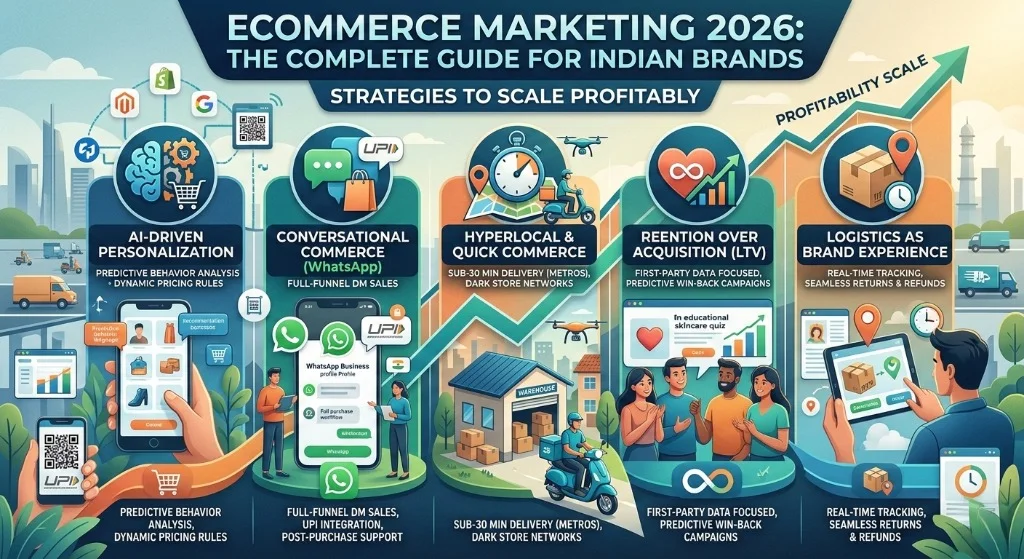
If you’ve been in ecommerce for a few years, you’ve probably noticed something: what worked earlier doesn’t work the same way anymore.
There was a time when you could launch a Shopify store, run Meta ads, and see decent returns without too much structure. That phase is gone. In 2026, ecommerce marketing is more competitive, more technical, and honestly, less forgiving.
The brands that are growing today aren’t just “running ads.” They’re managing systems. They know their acquisition numbers. They understand where money leaks. They track profitability — not just revenue screenshots.
That shift matters.
India’s ecommerce space is crowded. Every week, new D2C brands launch in fashion, beauty, wellness, electronics — you name it. Customers have more options, and platforms are charging more to reach them.
Ad costs have gone up. Creative fatigue happens faster. AI campaigns optimize aggressively but don’t magically fix weak strategies.
If your campaigns feel unstable — one good week, one bad week — it’s usually not the platform. It’s the structure behind it.
In 2026, casual marketing doesn’t survive long.
Let’s be clear: performance marketing is still the backbone of ecommerce growth.
Google Ads and Meta Ads are powerful. They can scale brands fast. But only when used correctly.
What’s changed is how they need to be structured.
Brands that rely on one campaign and keep increasing budgets often hit a ceiling. Smarter brands think in layers. They introduce the product to new audiences first. Then they retarget people who show interest. Then they focus on converting high-intent users. After that, they push retention.
It sounds simple. It’s not. But it’s necessary.
Without this layered thinking, scaling becomes expensive.
Most founders ask the wrong question. They ask, “How do I reduce my CAC?”
A better question is, “How do I make my CAC sustainable?”
In India, acquisition costs vary widely. Fashion brands might acquire customers at ₹500–₹800. Electronics brands often pay more. But the number alone doesn’t tell you much.
What matters is how much that customer spends over time.
If someone buys once and never returns, your business constantly needs new customers to survive. That’s expensive and stressful.
The real advantage in 2026 isn’t just cheaper ads. It’s better systems around those ads.
For years, many ecommerce brands ignored SEO because paid ads felt faster. And they are faster.
But when ad costs rise, founders start looking for stability. That’s where SEO becomes interesting.
Optimizing category pages. Improving product descriptions. Creating content around real customer questions. Fixing site speed. These things aren’t glamorous, but they build long-term visibility.
SEO doesn’t explode overnight. It compounds quietly.
Brands that started investing in SEO two or three years ago are now enjoying traffic without paying for every click.
In a competitive market like India, that matters.
Here’s something uncomfortable: most ecommerce websites waste traffic.
Not because the product is bad — but because the experience isn’t optimized.
Slow loading pages. Confusing checkout. Weak product descriptions. No trust signals. These things reduce conversion more than most people realize.
If your store converts at 1.5%, improving it to even 2.5% can dramatically change revenue — without increasing ad spend.
But conversion optimization requires patience. Testing. Small adjustments.
It’s less exciting than launching a new ad campaign, which is why many brands skip it.
Retention marketing doesn’t get enough attention.
Email automation. WhatsApp flows. Post-purchase follow-ups. Replenishment reminders. Loyalty offers.
When done well, these systems generate repeat purchases without constant acquisition pressure.
Some ecommerce brands in India now generate a significant percentage of revenue from returning customers. That changes everything. Suddenly, ad scaling becomes easier because you’re not starting from zero every month.
Retention isn’t optional anymore. It’s strategic protection.
With privacy updates and tracking changes, clean data has become critical.
If you don’t know your real acquisition cost, channel contribution, or conversion rate, scaling becomes guesswork.
Guesswork is expensive.
Proper GA4 setup, event tracking, and consistent performance reviews aren’t “technical extras.” They are business fundamentals now.
The brands that grow steadily are the ones that understand their numbers deeply.
When you zoom out, profitable ecommerce marketing in 2026 isn’t about one tactic.
It’s about alignment.
Acquisition campaigns bring in the right audience.
Landing pages convert efficiently.
Retention systems increase lifetime value.
SEO builds long-term visibility.
Data supports decision-making.
When these pieces work together, growth feels stable instead of chaotic.
And stability is underrated.
Ecommerce marketing in 2026 is demanding — especially in India’s competitive environment. But it’s also full of opportunities for brands that think long-term.
Short-term hacks don’t build durable businesses.
Structured strategy does.
If your ecommerce brand is serious about improving profitability, stabilizing performance, and building a scalable growth engine, the conversation should move beyond “running ads” and toward building systems that support real, measurable growth.
That shift is where sustainable success begins.