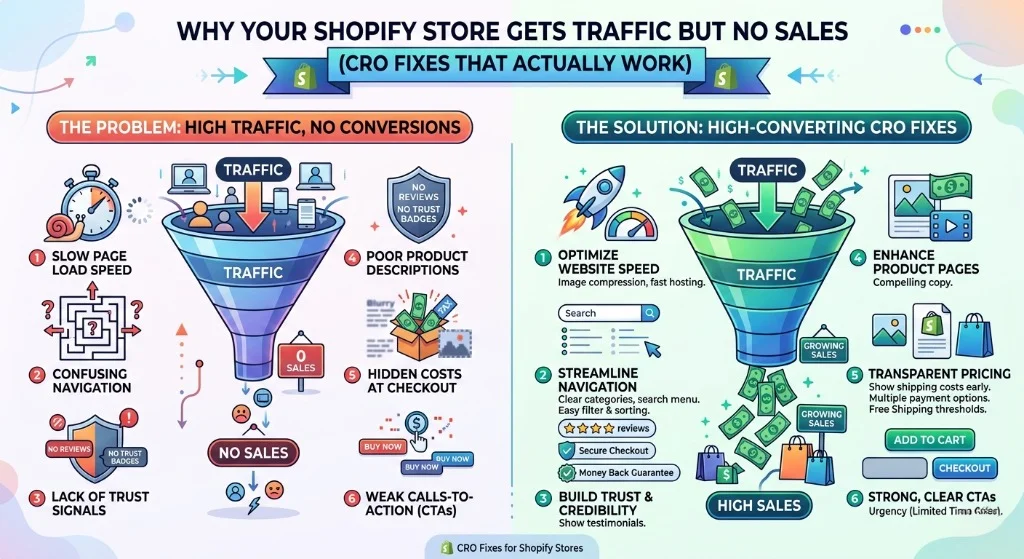
You check the analytics and the traffic looks decent. The ad is getting clicks. People are landing on the page.
And then… nothing. They leave.
This is one of the most frustrating situations in eCommerce, and it’s far more common than most founders realise. A 1% conversion rate is not “normal”, it’s a signal that money is actively leaking out of your funnel with every visitor who bounces.
The good news: conversion rate is one of the highest-leverage numbers in your entire business. Moving from 1% to 2% doesn’t just double your sales, it halves your effective customer acquisition cost, which means every rupee you spend on ads suddenly becomes twice as valuable.
Here’s a systematic breakdown of why Shopify stores lose buyers, and the CRO fixes that actually move the needle.
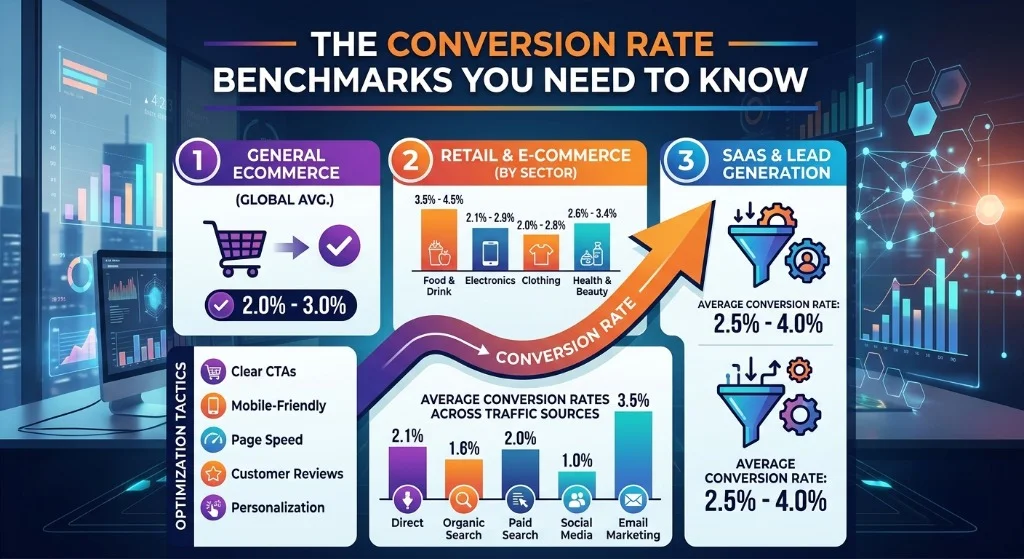
Before diagnosing a problem, you need a baseline. For Indian D2C brands on Shopify:
Most brands we audit through our Shopify development services are sitting between 0.8% and 1.5%. That’s not a traffic problem, it’s a conversion problem.
In India, where a significant chunk of traffic comes from mobile on 4G connections, page speed is existential. A 3-second load time loses roughly 40% of visitors before the page even renders.
Run your store through Google PageSpeed Insights right now. If you’re scoring below 50 on mobile, you are bleeding customers at the very top of the funnel before your headline, your images, or your offer ever get a chance.
Common culprits: uncompressed images, too many third-party apps loading scripts, heavy theme files. These are fixable, often in a single focused development sprint.
The moment someone lands on your product page, they’re unconsciously asking: “Is this for me, and do I trust it?”
You have roughly three seconds to answer both. Most Shopify product pages fail here because:
The fix is surgical: lead with the benefit, back it immediately with a single compelling trust signal, and make the “Add to Cart” button impossible to miss above the fold.
Offering a flat 10% discount is not a compelling offer. It’s a forgettable one.
The D2C brands converting at 3%+ are building perceived value into the offer itself:
Offers aren’t just about price. They’re about reducing the perceived risk of clicking “Buy.” We explore this in depth in our broader post on breaking the D2C revenue plateau (Blog 1 above), particularly around AOV-lifting offer architecture.
Indian consumers are deeply community-influenced buyers. Before purchasing from a brand they don’t know, they want evidence that real people bought this and didn’t regret it.
If your reviews are at the bottom of the page, they might as well not exist for the majority of mobile visitors who never get there.
Fixes that work:
On average, 78% of Indian eCommerce shoppers abandon their carts. That’s not a lost sale, that’s a warm lead who got distracted.
A basic cart abandonment sequence via WhatsApp and email can recover 15–25% of these. Most Shopify stores have no recovery sequence at all, or send a single generic email hours later. A three-touch sequence, WhatsApp at 30 minutes, email at 2 hours, WhatsApp with a gentle nudge at 24 hours, dramatically outperforms the default.
This is part of the retention infrastructure we build as part of our eCommerce digital marketing services.
This is the silent conversion killer that almost no one talks about.
If your Meta ad shows a specific product, that ad must land on that product’s page, not your homepage, not your collections page, not a general landing page. Message match is critical.
If your ad says “Try our new Vitamin C serum,” and the landing page leads with a generic brand headline about natural skincare, you’ve broken the psychological thread that the click was following. The visitor feels confused, even if they can’t articulate why, and they leave.
Audit every active ad this week. Does the creative headline match the page headline? Does the ad’s offer match the page’s offer? If not, you’ve found your conversion leak.
If you’re overwhelmed by the list above, here’s the order of priority by impact-to-effort ratio:
Fix first (highest impact, quickest to implement):
Fix second (high impact, requires some dev work):
Fix third (structural, worth doing right):
If you need help executing any of this, our Shopify development team handles everything from page speed fixes to full product page redesigns built for conversion.
Here’s why CRO deserves the same attention as your ad account.
Say you’re spending ₹1,00,000/month on Meta ads and converting at 1.2%. That’s roughly 12 sales per ₹1 lakh spent (at a ₹1,000 product). At 2.5% conversion, achievable with the fixes above, the same ₹1,00,000 generates 25 sales. Your effective CPO drops from ₹8,333 to ₹4,000 without changing a single ad.
That’s what good CRO actually does: it makes your entire eCommerce performance marketing investment more efficient.
A proper CRO audit covers your full funnel, from ad to landing page to checkout to post-purchase. If you want an expert eye on why your traffic isn’t converting, book a free strategy call and we’ll walk through your store together.