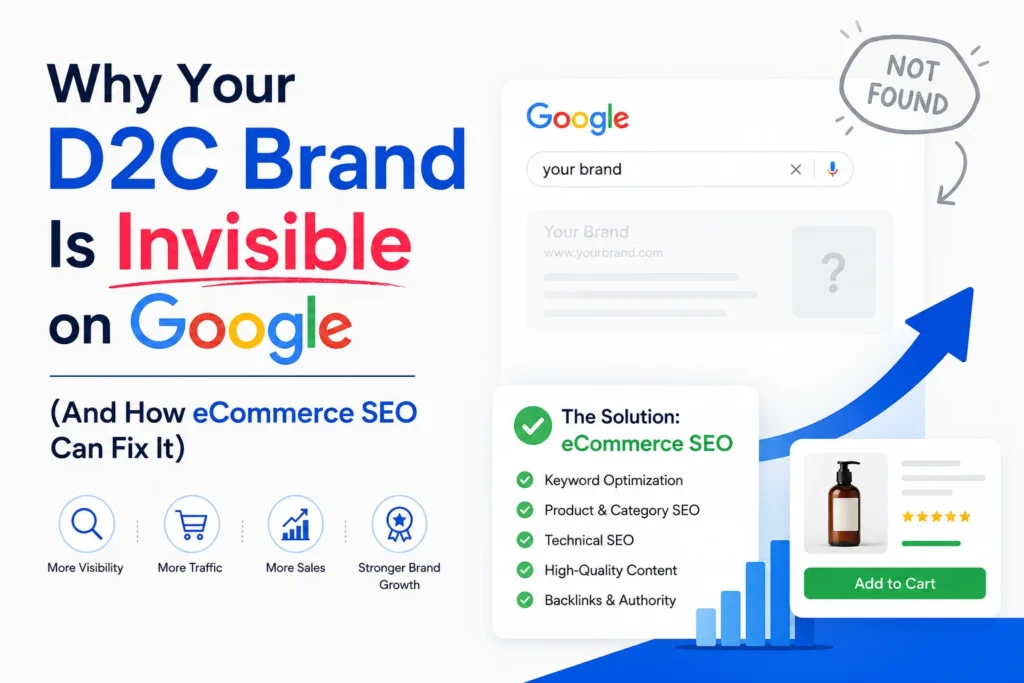
You’ve got a great product. Your Meta ads are running. Orders trickle in — but the moment you pause the campaign, sales drop to zero.
Sound familiar?
This is the reality for most D2C brands in India today. They’re entirely dependent on paid traffic, and every rupee of revenue comes with an ad cost attached. There’s no compounding. No organic engine. No brand visibility on Google.
The fix isn’t more ads. The fix is eCommerce SEO.
If your store doesn’t appear when someone searches for your product category, you’re handing those customers to your competitors — for free.
Across all of them, the same patterns kept repeating — the same five or six mistakes that cap a brand’s growth, and the same five or six fixes that consistently break the ceiling. This isn’t a highlight reel. It’s what we’ve actually learned from sitting inside dozens of Shopify stores, ad accounts, and P&Ls.
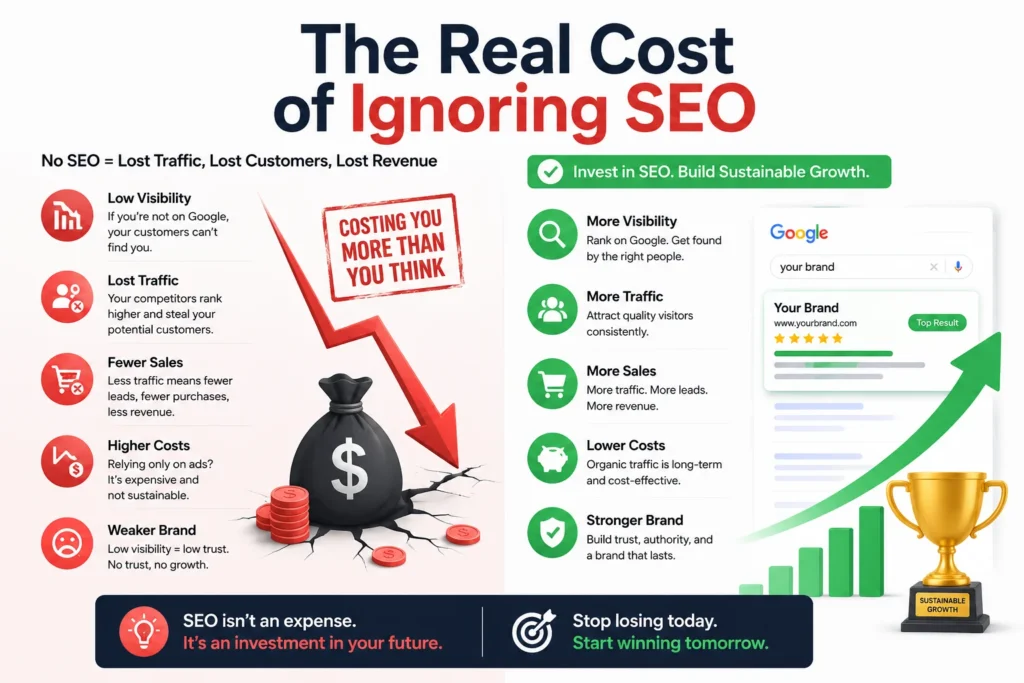
Let’s talk numbers. If your average Customer Acquisition Cost (CAC) via Meta Ads is ₹400–₹800, and your Average Order Value (AOV) is ₹1,200 — your margins are already razor thin before accounting for shipping, returns, and operational costs.
Now imagine ranking on Page 1 of Google for “buy [your product] online India.” That traffic costs you nothing per click. Every order that comes through organic search is a direct improvement to your unit economics.
Brands that invest early in SEO build an asset. Those that don’t keep renting traffic — forever.
The problem is that most D2C founders don’t know where to start, or they’ve been told “SEO takes too long.” That’s a half-truth. SEO does take time — but with the right eCommerce SEO service, you start seeing meaningful results within 3–6 months, and the returns compound for years.
Many brands think SEO means writing a few blog posts. It’s far more structural than that. A proper eCommerce SEO service covers five core areas:
This is the foundation. It includes site speed optimisation, mobile usability, crawlability, fixing broken links, canonical tags, structured data (schema markup), and XML sitemaps. If Google can’t crawl and index your pages efficiently, nothing else matters.
Every product page, collection page, and blog post needs to be optimised — title tags, meta descriptions, H1/H2 structure, keyword placement, internal linking, and image alt text. This is where most eCommerce stores are weakest.
These pages carry enormous ranking potential and are almost always neglected. A well-optimised category page with strong content, FAQs, and proper keyword targeting can outrank individual product pages for high-volume terms.
Informational content captures buyers at the top of the funnel — people who are researching before they purchase. A blog answering “best [product] for [use case]” ranks, builds trust, and drives warm traffic to your product pages.
Google still uses backlinks as a major ranking signal. Earning links from relevant, authoritative websites tells Google your brand is credible. This is a long-game play — but critical for competitive niches.
Your product page is your digital salesperson. If it’s not ranking, it’s not selling. Here’s what a revenue-optimised product page looks like from an SEO perspective:
Most D2C stores on Shopify or WooCommerce launch with default templates and zero SEO configuration. That’s traffic left on the table from Day 1.
If you sell skincare, “face serums” is a category. If you sell fitness gear, “resistance bands” is a category. These pages should be your highest-ranking, highest-converting pages — and for most brands, they’re completely blank.
A category page optimised by a specialist eCommerce SEO service will include:
Done right, a single optimised category page can drive hundreds of qualified visitors every month — at zero cost per click.
General SEO agencies know how to rank service pages and B2B websites. eCommerce SEO is a different discipline entirely. It involves:
This is why working with a dedicated eCommerce SEO service provider — one that understands the D2C model — makes a measurable difference versus hiring a generic agency or a freelancer who handles every industry.
At Aim n Launch, SEO isn’t an add-on. It’s built into the growth system alongside performance marketing, CRO, and creative — so every channel reinforces the other.
Month 1 — Audit & Foundation
Technical audit, keyword mapping, competitor gap analysis, fixing critical on-page and technical issues, setting up Google Search Console and Analytics properly.
Month 2 — Optimisation
Category and product page optimisation, content calendar creation, internal linking structure, schema markup implementation.
Month 3 — Content & Authority
First wave of blog content published, initial link-building outreach begins, GSC data reviewed and strategy adjusted.
By the end of 90 days, you should see improved crawl coverage, better keyword rankings for long-tail terms, and early organic traffic signals — with the compounding effect building from Month 4 onward.
Paid ads are a tap. The moment you turn it off, the water stops.
SEO is a pipeline. You build it once, and it delivers traffic, leads, and orders on autopilot — month after month.
If your D2C brand is entirely reliant on Meta or Google Ads to survive, you don’t have a marketing strategy — you have a dependency.
The time to build your organic engine is now — before your competitors do it first.
Ready to reduce your CAC and build sustainable growth? Get a Free eCommerce SEO Audit from Aim n Launch