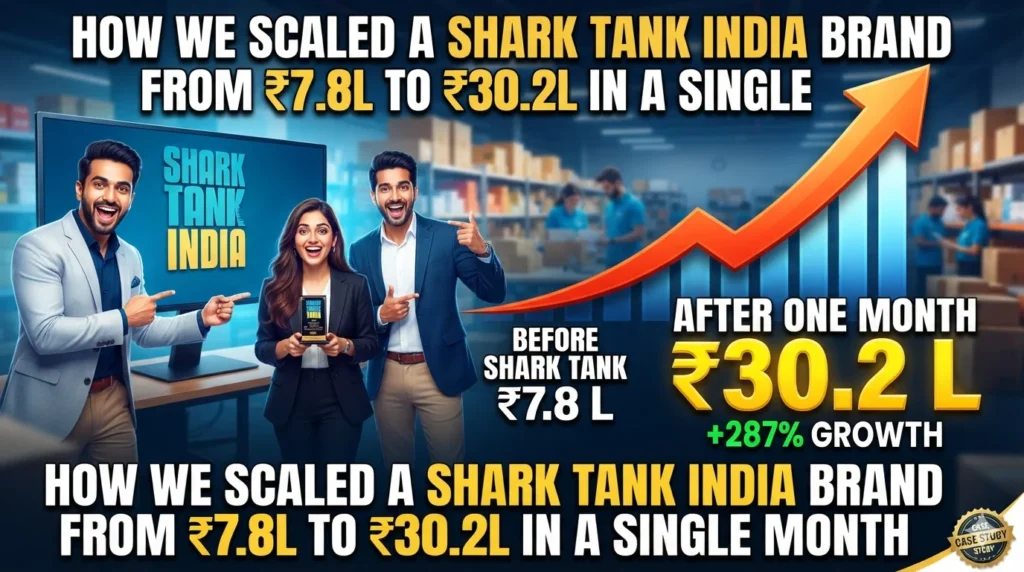
Getting featured on Shark Tank India is a marketer’s dream. The visibility is instant, the credibility is built-in, and suddenly your brand name is a household reference. But here’s what nobody tells founders before the episode airs: the Shark Tank bump fades, and what’s left is whatever growth system you’ve built underneath it.
We learned this firsthand while working with a Shark Tank-featured D2C brand in the healthy snacks and protein nutrition space. The brand sold protein powders, snack packs, and bundles through its own Shopify store. The product was good. Reviews were strong. National visibility had already happened. And yet, the brand was stuck doing ₹7–8 lakh a month — a number that had nothing to do with demand and everything to do with how that demand was being captured.
In one month, we took it from ₹7.8L to ₹30.2L in gross sales. Net sales grew 263%, orders jumped from roughly 900 to over 3,000, and AOV actually went up by 6% even as we leaned harder into discounting. Here’s exactly how that happened — and why most Shark Tank brands leave this kind of growth on the table.
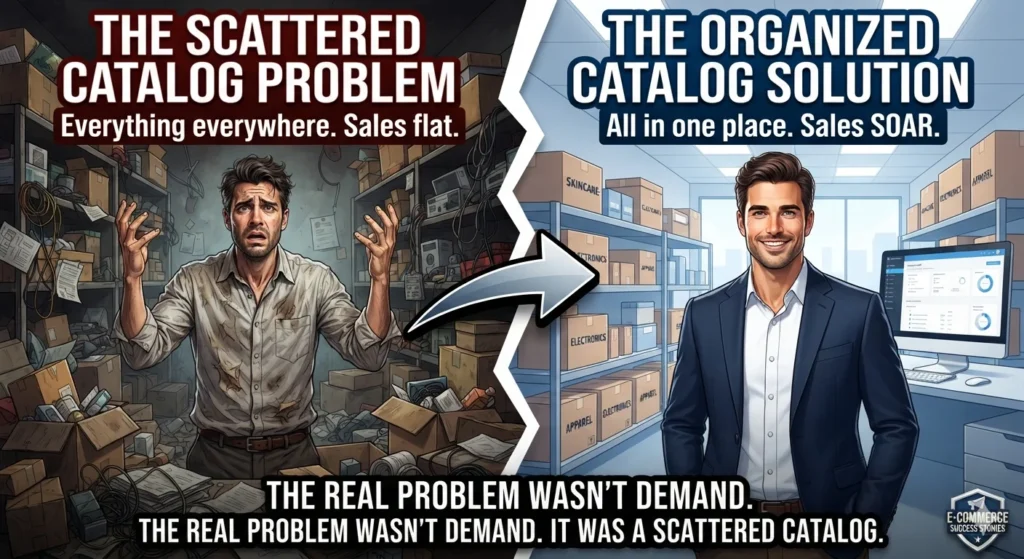
When we audited the account, the brand had a healthy spread of SKUs — multiple protein powder flavors, snack bundles, sampler packs. On paper, that variety looks like strength. In practice, it was quietly strangling the account.
Ad spend was distributed almost evenly across a dozen products. No single SKU ever got enough budget or conversion volume to give Meta’s algorithm the signal density it needs to optimize. Spread ₹7–8L across ten-plus products and none of them exit the learning phase properly. The result was predictable: inconsistent ROAS, climbing CPAs, and campaigns that never stabilized long enough to scale.
Underneath that, three more issues compounded the problem. The brand’s bundle option — a “3+1” pack — existed but was buried in the catalog instead of positioned as the default purchase. Discounts were applied reactively, sometimes 10% off, sometimes a flat ₹100, with no math behind what the unit economics could actually absorb. And the returning customer rate sat at just 3.3%, which for a consumable product meant the brand was rebuilding its customer base from zero every single month.
None of this was a product problem or a market problem. It was a systems problem.
The highest-margin, highest-AOV item in the catalog was the 3+1 bundle. It was getting the same ad budget as individual powder variants priced at a third of its value. We flipped that completely.
Every part of the funnel — creative, copy, landing page hierarchy — was rebuilt to point to the bundle as the default purchase. Individual SKUs were repositioned as entry points and upsells, not primary conversion targets. We engineered the bundle pricing so the effective average selling price stayed above ₹750 even after discounts, and we ran full contribution margin (CM2) math — covering ad spend, discounts, shipping, and returns — before scaling a single rupee of budget.
That single decision generated ₹19.7L from the bundle alone in the second month, a 448% jump, and it accounted for 65% of total gross sales by itself. When you consolidate signal behind one high-value offer, Meta’s algorithm finally gets what it needs: dense conversion data on a high-AOV event. CPAs drop. ROAS stabilizes. Scaling stops being a guessing game.
Over-segmentation is one of the most common mistakes in Indian D2C Meta advertising, and this account had it badly — too many ad sets chasing too many products with too little budget behind each one.
We rebuilt the structure into three clean layers. Top of funnel ran broad audiences with the bundle as the only offer, letting Meta’s algorithm find buyers rather than restricting it with narrow interest targeting. Mid-funnel retargeting shifted the message from “discover this product” to making the case for why the bundle was the smartest purchase, using social proof and value comparison. Bottom-funnel campaigns targeted cart abandoners with dynamic product ads and stacked offers — a discount plus free shipping — to close the loop.
Budget followed a 60/25/15 split across top, middle, and bottom of funnel, intentionally weighted toward prospecting because the bundle’s margin could sustain a longer attribution window. Fewer campaigns meant more budget per campaign, which meant faster learning, which meant lower CPAs within the first week. By week two, campaigns were fully optimized and we started scaling aggressively.
In the first month, discounts totaled roughly ₹1.01L against ₹7.8L in gross sales — about a 13% rate, applied with no real strategy. In the second month, we intentionally pushed discounts up to ₹6.15L, a 505% increase. That sounds reckless until you see what it was funding.
Because the discount was baked directly into the bundle’s “buy 3, get 1 free” structure, it created a strong value proposition without breaking the underlying unit economics. AOV didn’t fall — it rose 6%, from ₹747 to ₹791, because the bundle structure forced multi-item carts. Customers weren’t buying cheaper. They were buying more. Net sales grew 263%, from ₹6.5L to ₹23.6L, meaning the ₹6.15L invested in discounts generated a 3.8x return on that spend alone, before even counting lifetime value.
This is the difference between discounting reactively to hit a weekly number and engineering discounts as a calculated investment with a measurable return.
Cash-on-delivery orders were quietly working against the brand — higher return-to-origin rates, delayed cash flow, weaker customer lifetime value. For a health-conscious, digitally comfortable audience, that gap was an obvious miss.
We pushed a one-click checkout experience as the primary path, supported with small prepaid-specific discounts, faster shipping promises, and a streamlined checkout flow. The goal was to make prepaid the default rather than the exception. At scale, moving an order mix from roughly 60% prepaid to near total prepaid can swing margin per order by three to five percent — money that has nothing to do with ad spend and everything to do with operational discipline.
A 3.3% returning customer rate on a consumable product is a flashing warning light. People finish protein powder in three to four weeks and either reorder or disappear — and without a system nudging them, most were disappearing.
We tagged new buyers into a timed re-engagement sequence aligned to that consumption window, surfacing reorder prompts and complementary flavor suggestions right when the product was running out. We also turned the bundle itself into a retention hook: a customer buying four units had three to four months of product usage, which gave us a long runway to run low-cost touchpoints encouraging a new flavor trial or a subscribe-style reorder nudge. Returning customer rate moved from 3.3% to 5.13% in a single month — a 53% lift — and that’s before the full retention system had time to mature.
| Metric | Before | After | Change |
|---|---|---|---|
| Gross Sales | ₹7.8L | ₹30.2L | +289% |
| Net Sales | ₹6.5L | ₹23.6L | +263% |
| Orders | ~900 | ~3,040 | +238% |
| AOV | ₹747 | ₹791 | +6% |
| Returning Customer Rate | 3.3% | 5.13% | +53% |
| Hero Bundle Revenue | ₹3.6L | ₹19.7L | +448% |
None of this came from spending more on ads for the sake of it. Discounts went up 505%, and net sales still grew 263% while AOV climbed at the same time. That only happens when the math is planned before the spend goes out, not reverse-engineered afterward.
If you’re running a Shark Tank-featured brand, or any D2C brand doing ₹5L+ a month in ad spend, and you recognize the scattered-catalog pattern — budget spread thin across SKUs, bundles that exist but aren’t the hero offer, discounts applied on instinct instead of unit economics, a returning customer rate under 8% — the bottleneck isn’t your product or your visibility. It’s the system connecting the two.
That’s exactly the audit we run before we touch a single campaign: a full CM2 waterfall across your Shopify store, ad account, and payment flows, so we know precisely where the margin is leaking before we ever recommend scaling spend.
Want us to look at your numbers the same way? Book a free CM2 audit and we’ll show you exactly where your growth opportunity is sitting.