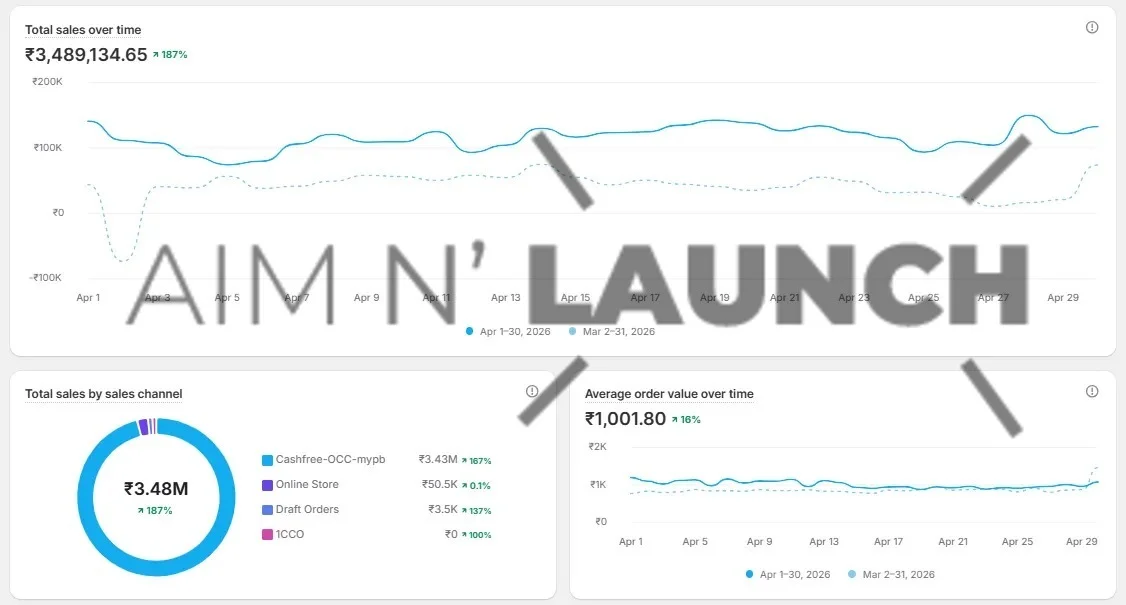
This brand was plateaued at ₹12L/month. Ad spend was creeping up. Contribution margin was sliding toward zero. In one month we got them to ₹34.89L in revenue with healthier unit economics than they had before. Here is exactly what we did.
A direct to consumer nutrition brand in the better-for-you food category. They had product market fit.
They had reviews. They had a small, loyal customer base. They were running paid media themselves.
The plan they came to us with was simple. Spend more. Grow more.
The reality was different.
In March 2026 the brand did ₹12.16L in revenue from 1,539 orders on 51,805 sessions. Blended
Meta ROAS was sitting at 2.4x and falling. Every time they pushed spend past ₹5L the account got less efficient, not more. They had hit the kind of ceiling that does not show up in any dashboard until it is too late.
They came to us with one question. How do we scale this without going broke.
When we pulled apart their account we found three things working against each other at the same time.
The same three or four UGC pieces were doing 80% of the spend. CTRs had dropped from 1.6% to 0.9% over six weeks. The audience was seeing the same hooks on repeat. New iterations were minor edits of the same scripts, not new angles.
Sessions were coming in. Add to carts were happening. But the funnel was dropping 60% of carts at checkout. The hero section did not match the ad messaging. The offer was buried below the fold. Trust signals were generic. Mobile experience had layout shifts on every load.
Eleven active campaigns. Three CBOs and eight ABOs running in parallel. Audiences overlapping. Budget was being split across too many tests with too little signal per ad set. Meta’s algorithm was choking on noise.
This was not a “spend more” problem. This was a rebuild the engine before adding fuel problem.
Lever 1: New ad scripts, built around angles the brand had never tested
We scrapped the existing creative rotation and wrote eight new scripts across four angles the brand had not used before:
A category comparison angle that positioned the product against the dominant alternative in the categoryA use case angle built around specific moments and customer states, not generic benefits A founder backstory angle reshot with the original product origin
A social proof angle that pulled the exact language customers were using in reviews, not made up testimonial copy Three of these eight became the top spenders within 14 days. The category comparison angle alone delivered a 2.1x CTR versus the previous best ad.
Lever 2: Landing page rebuild focused on the first 8 seconds
We did not redesign the entire site. We rebuilt the single page that ads were sending traffic to. Hero rewritten to mirror the ad copy that brought the user in, so the visitor lands on the same conversation The offer pulled above the fold instead of buried in the middle
Three layers of social proof staggered through the page: reviews, Instagram UGC, press snippets Mobile layout fixed, no more cumulative layout shift, sticky add to cart, single column above the fold Checkout shortened to fewer fields, prefilled where possible
Add to cart rate moved from 6.2% to 9.4%. Conversion rate held flat at 2.97% even as sessions doubled, which when you are scaling ad spend almost 2x is the result you actually want. Most accounts watch CVR collapse when traffic doubles.
Lever 3: Campaign architecture rebuilt for signal density
We collapsed eleven campaigns into four. One full-funnel acquisition CBO with a single broad audience and the top creative pool One creative testing campaign with strict graduation rules. If an ad does not hit the threshold by day three, it dies. One retargeting CBO segmented by intent depth: viewers, ATC, checkout starters One bottom funnel campaign for brand searchers and warm cohorts Budget consolidation meant Meta’s algorithm got roughly 3x more signal per ad set. Within ten days the account stabilized at a different efficiency level.
| Metric | March 2026 | April 2026 |
|---|---|---|
| Revenue | ₹12.16L | ₹34.89L |
| Orders | 1,539 | 3,325 |
| Sessions | 51,805 | 111,898 |
| AOV | ₹863.62 | ₹1,001.80 |
| Conversion rate | 2.97% | 2.97% |
| Blended Meta ROAS | 2.4x | 3.61x |
| Meta ad spend | ~₹5.07L | ₹9.65L |
| CM2 (contribution margin after marketing) | 4.3% | 18.3% |
Headline movements:
Revenue up 187%
Orders up 116%
Sessions up 116%
AOV up 16%
CM2 jumped from 4.3% to 18.3%, a 4.2x lift in contribution margin
The ad spend nearly doubled. ROAS still improved 50%. That is the part most founders miss. Efficiency
does not have to fall when you scale. It can rise.
The brand did not grow because we spent more money. They had already tried that.
The brand grew because three different systems started working with each other instead of against each other. Better hooks brought in better traffic. A better landing page converted that traffic at a higher rate. A cleaner campaign structure meant Meta could optimize on real signal instead of getting confused by noise.
The CM2 lift is the part that matters most. Revenue growth without margin growth is just bigger problems on a bigger scale. A brand at 4% CM2 is funding its next order with the margin from the last one. A brand at 18% CM2 has cash left over to spend on inventory, retention, brand, and content. That is what compounds.
In April this brand generated roughly ₹6.1L in CM2 versus ₹57K the month before. That is 10x more contribution margin in 30 days, while almost tripling revenue. That is the entire story.
We will pull apart your Meta account on a one hour Zoom and tell you the three things most likely killing
your margin right now. If we find nothing worth fixing, we say so.