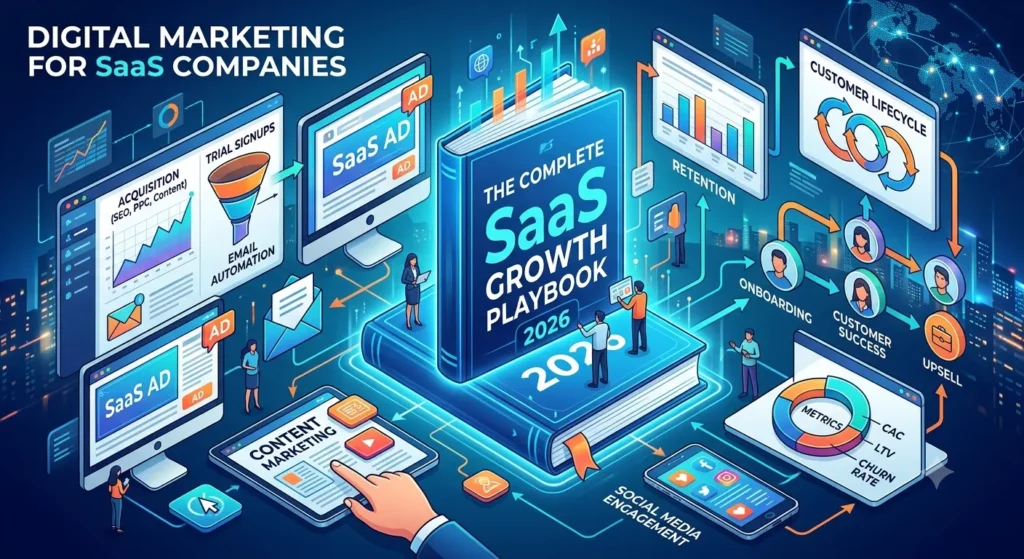
Digital Marketing for SaaS Companies: A Complete Growth Playbook for 2026
SaaS founders rarely struggle with a good product. They struggle with getting the right people to notice it. That is exactly why it has become the single biggest lever for growth in 2026. Unlike a physical product, software is invisible until someone searches for it, clicks on it, or hears about it from a trusted source. This guide breaks down what actually works when you are building digital marketing for SaaS companies from the ground up, and why the channel mix looks so different from a typical eCommerce or retail brand.
Why Digital Marketing for SaaS Companies Works Differently
A SaaS buyer rarely makes an impulse purchase. There is a trial period, a demo call, a pricing comparison, and often a procurement approval before a subscription is signed. This means the strategy has to nurture a lead across weeks or months, not just capture a single click. The funnel is longer, the buyer is more informed, and the content has to answer very specific questions at every stage: what problem does this tool solve, how does it compare to competitors, and what does it cost to switch.
Because of this longer cycle, SaaS marketing leans heavily on trust signals such as case studies, product comparisons, free trials, and customer testimonials, alongside the usual search and paid channels.
SEO as the Backbone of Digital Marketing for SaaS Companies
Search remains the highest intent channel available. A prospect typing “best project management tool for remote teams” or “CRM alternative to Salesforce” is already evaluating options, which makes SEO one of the most cost efficient parts of this mix. A strong SEO program for a SaaS business typically covers:
Comparison and alternative pages that capture bottom of funnel searches
Use case landing pages built around specific job titles or industries
A technical foundation covering site speed, crawlability, and structured data
Link building through guest posts, product directories, and integration partners
Done well, an SEO driven approach produces a pipeline that keeps compounding long after a paid campaign would have stopped delivering results.
Paid search and paid social shorten the time it takes to see results while SEO is building momentum in the background. Google Search ads on branded and competitor terms, LinkedIn ads for enterprise targeting, and retargeting campaigns for website visitors who did not sign up all play a role in this mix. The key is tracking cost per trial and cost per paying customer rather than just clicks, since a SaaS funnel has several conversion steps between an ad click and actual revenue.
Blogs, webinars, comparison guides, and in-app onboarding content all support the funnel by answering buyer questions before a sales call even happens. Product led growth strategies, where the free trial or freemium tier does the selling, work best when supported by content that shows users exactly how to get value from the product in their first session.
Why Aim n Launch Is the Right Partner for Digital Marketing for SaaS Companies
conversion optimisation under one roof, which is exactly the mix that digital marketing for SaaS companies demands. The team has generated measurable revenue growth for fast moving brands and applies the same data first approach, tracking cost per acquisition and payback period, to SaaS clients who need predictable pipeline rather than vanity metrics. If you are ready to build a digital marketing for SaaS companies program that actually shows up in the numbers, book a call with Aim n Launch and the team will show you how it has helped B2B software brands turn digital marketing for SaaS companies into a repeatable pipeline rather than a guessing game.