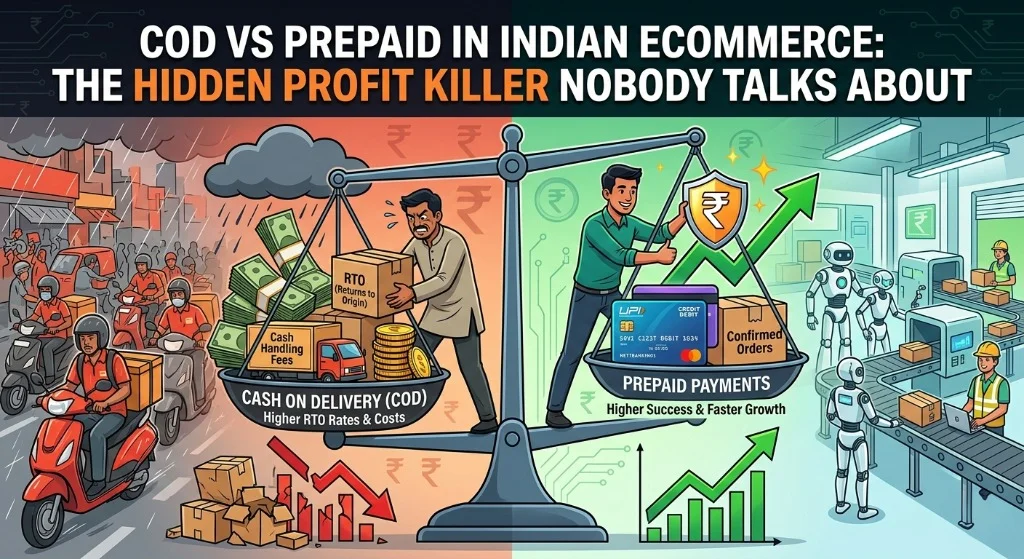
Here is a number that should make every D2C founder in India uncomfortable: 60 to 65% of all ecommerce orders in India are still Cash on Delivery. And of those COD orders, roughly 25 to 30% come back as RTOs, generating zero revenue but costing you Rs 180 to 240 per failed shipment.
If you are running a D2C brand doing Rs 10L or more per month in revenue, your COD orders are quietly eating into your margins every single day. The worst part? Most founders do not even track the true cost of COD because it is spread across shipping invoices, reverse logistics fees, COD handling charges, and blocked inventory.
This post breaks down the real math behind COD vs prepaid in Indian ecommerce, shows you exactly how much COD is costing your business, and gives you a proven framework to shift your prepaid ratio without killing conversions.
Want us to audit your unit economics and find profit leaks like this? Book a free audit with Aim n Launch.

Before we talk about fixing the problem, let us understand why it exists. COD is not just a payment method in India. It is a trust signal.
In Tier 1 cities, about 30 to 40% of shoppers choose COD. In Tier 2 and Tier 3 cities, that number jumps to 50 to 70%, and in some smaller towns, it reaches as high as 90%. This is not because digital payments are unavailable. UPI crossed 14 billion monthly transactions in early 2026. It is because shoppers, especially first-time online buyers, want to see and touch the product before they pay.
There are three core reasons COD persists at such high levels.
First, trust deficit with new brands. When a customer sees your Meta ad for the first time, they have zero relationship with your brand. COD removes their risk entirely. They pay nothing until the product arrives.
Second, product quality anxiety. Categories like fashion, beauty, and accessories have high uncertainty. “Will this shade match my skin tone?” “Will this t-shirt fit the way it looks in the ad?” COD lets buyers resolve that anxiety at the doorstep.
Third, habitual behavior. For millions of Indian shoppers, COD is simply the default. They have always ordered this way, and switching to prepaid requires an active reason, not just availability.
The problem is not that COD exists. It is that most D2C brands treat COD orders the same as prepaid orders in their P&L, and that is where the profit destruction begins.
Let us do the math that most Indian D2C brands skip. We will use a typical Rs 1,000 AOV order to compare COD vs prepaid, line by line.
Prepaid Order at Rs 1,000 AOV:
Forward shipping costs you around Rs 65 to 80. Payment gateway charges run about 2%, so Rs 20. Your RTO rate sits at roughly 2 to 3%, which means your RTO cost per 100 orders is approximately Rs 200 to 300. Total logistics and payment cost per successful order comes to around Rs 85 to 100.
COD Order at Rs 1,000 AOV:
Forward shipping again costs Rs 65 to 80. But now you add COD handling fees of 2 to 3% of order value, which is Rs 20 to 30. Your RTO rate jumps to 25 to 30%, meaning your RTO cost per 100 orders is Rs 4,500 to 6,000. You also face reverse shipping costs of Rs 50 to 70 per RTO. Cash remittance delays of 7 to 14 days create a working capital cost. And there is packaging and inventory damage on returned items. Total logistics and payment cost per successful order lands somewhere between Rs 150 to 220.
That is a 70 to 120% higher cost per order for COD compared to prepaid. And we have not even accounted for the biggest hidden cost: the inventory that sits in transit or in reverse logistics for days, unavailable for resale.
Here is what this looks like at scale. A mid-sized D2C brand shipping 10,000 COD orders per month with a 28% RTO rate and Rs 200 average cost per RTO is losing Rs 5,60,000 every month just on failed COD deliveries. That is Rs 67.2 lakh per year in pure waste.
For a brand doing Rs 50L per month in revenue, this COD leakage alone can be the difference between profitability and burning cash.
We have developed a simple framework that every D2C founder should run on their own numbers. We call it the COD Profitability Gap Analysis, and it takes about 15 minutes with your shipping partner’s dashboard open.
Step 1: Pull your COD vs Prepaid split. Log into your Shopify analytics or shipping partner dashboard and note the exact percentage. If you are above 50% COD, you have significant optimization opportunity.
Step 2: Calculate your true COD cost per order. Add up forward shipping, COD handling fee, your RTO rate multiplied by (forward shipping plus reverse shipping plus packaging cost), and cash remittance delay cost (use your working capital cost of funds, typically 12 to 18% annually for D2C brands).
Step 3: Calculate your COD vs Prepaid margin gap. Take your CM2 (Contribution Margin 2) on a prepaid order and subtract your CM2 on a COD order. This gap is your COD penalty per order.
Step 4: Multiply the gap by monthly COD volume. This is your monthly COD profitability leak. For most brands we audit at Aim n Launch, this number ranges from Rs 2L to Rs 8L per month, depending on scale and category.
Want us to run this analysis for your brand? Download our free COD Impact Calculator or book a 15-minute call and we will do it live.
The single biggest reason COD destroys profitability is the RTO (Return to Origin) rate differential. The data is stark.
Prepaid orders have an RTO rate of just 2 to 3%. COD orders average 25 to 30% RTO nationally. In some categories and geographies, COD RTO rates hit 35 to 40%.
According to data from ShipNotes, which analyzed millions of shipments across India, 26% of all COD orders come back as RTOs. That is more than 1 in 4 orders that cost you money without generating a single rupee in revenue.
The reasons for higher COD RTO are straightforward. There is no financial commitment from the buyer. Impulse purchases are more common since there is no payment friction. Buyers often place multiple orders and keep only one. Delivery delays cause buyer’s remorse, as orders attempted after 5 days see a 35% RTO rate compared to 22% for next-day attempts. And there are fraudulent or fake orders, which account for a meaningful percentage in certain pin codes.
Here is the geographic breakdown that matters for your targeting decisions. Cities like Vadodara see relatively low RTO rates of around 18%, while cities like Patna can hit 35%. Orders in the Rs 500 to Rs 1,000 range see the highest RTO at 28%, while orders above Rs 1,000 actually see lower RTO at 24%, likely because higher-value buyers are more intentional.
What this means for your Meta ads strategy: If you are running COD-heavy campaigns targeting Tier 3 cities with Rs 500 to Rs 800 AOV products, your effective CPA (Cost Per Acquisition) is likely 30 to 40% higher than what your ads dashboard shows, because it does not account for the orders that will RTO.
The good news is that the COD to prepaid shift is very achievable. Brands using platforms like GoKwik and Pragma are reporting 20 to 35% increases in prepaid order share. Here are the specific tactics that work in the Indian market.
This is the single most effective lever. When you charge a small fee for COD, you create a financial nudge toward prepaid without removing COD entirely. One Indian footwear brand added a Rs 60 COD fee and saw a significant shift to prepaid within three months.
The key is positioning. Do not call it a “COD penalty.” Frame it as “COD convenience charge” and simultaneously offer “Free instant checkout” for prepaid. The psychology matters.
Implementation: Most Shopify apps like KwikCheckout or Pragma’s checkout suite let you add this in minutes. Start at Rs 50 and test up to Rs 100. Track your overall conversion rate, not just prepaid rate, to make sure you are not losing net orders.
Give prepaid customers an extra 5 to 10% off or free shipping. This works especially well for price-sensitive categories like fashion and beauty.
Example: “Pay online and get Rs 100 off” on a Rs 999 product effectively makes the prepaid price Rs 899. Since your COD cost per order is already Rs 70 to 120 higher than prepaid, you are still coming out ahead even after the discount.
Brands like Snitch (men’s fashion, Rs 600Cr+ revenue in FY2024) have effectively used prepaid incentives as part of their growth strategy to maintain healthy unit economics while scaling.
After a COD order is placed, send an automated WhatsApp message offering an additional discount if the customer converts to prepaid before shipping. Tools like GoKwik report that this approach converts 12 to 15% of COD orders to prepaid.
The message typically reads: “Hi [Name], your order #1234 is confirmed! Pay now via UPI and get Rs 50 off. Click here to pay: [link]. Offer expires in 2 hours.”
The urgency and the small discount, combined with the convenience of a one-click UPI link, makes this surprisingly effective.
Modern tools like GoKwik, Pragma, and Razorpay’s COD intelligence can flag high-risk COD orders in real time. They analyze signals like pin code history, phone number patterns, order value, and past RTO data to predict which COD orders are likely to RTO.
Brands using these tools report a 42 to 48% drop in RTO rates while retaining approximately 89% of COD conversion volumes. That is the sweet spot: you are not killing COD entirely, you are just blocking the orders most likely to fail.
Many Indian D2C brands lose prepaid conversions not because customers prefer COD, but because the prepaid checkout is clunky. If your checkout requires account creation, has too many steps, or does not support UPI intent flow (where the customer just taps and pays), you are pushing people toward COD by default.
Optimize for one-click UPI checkout. Support all major wallets and BNPL options (Simpl, LazyPay). Auto-fill address using phone number. Reduce checkout steps to three or fewer.
There is no universal “right” ratio, but here are the benchmarks we see across the 50+ D2C brands Aim n Launch works with.
Beauty and skincare: Target 55 to 65% prepaid. These are repeat-purchase categories with high trust once the first order lands. Brands like Minimalist and Pilgrim have achieved strong prepaid ratios by building brand trust through transparent ingredient communication.
Fashion and apparel: Target 40 to 50% prepaid. Sizing uncertainty keeps COD higher here, but strong size guides, fit videos, and easy exchange policies can push prepaid up. Snitch is a good example of a fashion brand that has optimized this balance while scaling rapidly.
Electronics and accessories: Target 60 to 70% prepaid. Higher AOV and brand recognition (think boAt at Rs 3,376 Cr revenue) naturally drive prepaid behavior.
Food and supplements: Target 50 to 60% prepaid. Subscription models in this category are a natural prepaid driver.
Home and lifestyle: Target 45 to 55% prepaid. Higher AOV items tend to be more considered purchases, which helps prepaid rates.
If your prepaid ratio is more than 15 percentage points below these benchmarks, you are leaving significant margin on the table.
Let us make this concrete. Take a D2C fashion brand doing Rs 30L per month in gross revenue with 3,000 orders and Rs 1,000 AOV.
Scenario A: 35% Prepaid, 65% COD (typical for an unoptimized brand)
Prepaid orders: 1,050. COD orders: 1,950. COD RTO at 28%: 546 failed orders. Successful orders: 2,454. COD cost overhead (handling plus RTO cost): Rs 1,950 x Rs 30 (handling) plus 546 x Rs 200 (RTO cost) = Rs 58,500 plus Rs 1,09,200 = Rs 1,67,700 per month. Revenue from successful orders: Rs 24,54,000.
Scenario B: 60% Prepaid, 40% COD (optimized brand)
Prepaid orders: 1,800. COD orders: 1,200. COD RTO at 28%: 336 failed orders. Successful orders: 2,664. COD cost overhead: Rs 1,200 x Rs 30 plus 336 x Rs 200 = Rs 36,000 plus Rs 67,200 = Rs 1,03,200 per month. Revenue from successful orders: Rs 26,64,000. Prepaid discount cost at Rs 50 per order on 750 incremental prepaid orders: Rs 37,500.
Net monthly savings from Scenario B: Rs 64,500 in reduced COD costs, plus Rs 2,10,000 in additional revenue from fewer RTOs, minus Rs 37,500 in prepaid discounts = Rs 2,37,000 per month in incremental profit.
That is Rs 28.4 lakh per year in additional profit, just from shifting the payment mix. No new customers required. No increased ad spend. Just smarter payment optimization.
If you want to move from a COD-heavy mix to a healthier prepaid ratio, here is the exact sequence we recommend to our clients at Aim n Launch.
Week 1: Measure and baseline. Pull your exact COD vs prepaid split. Calculate your true COD cost per order using the framework above. Identify your top 10 RTO pin codes and top RTO product SKUs.
Week 2: Quick wins. Add a Rs 50 COD convenience fee. Implement prepaid-only free shipping or a small discount. Set up automated WhatsApp COD-to-prepaid conversion messages. Install a COD risk-scoring tool (GoKwik, Pragma, or similar).
Week 3: Checkout optimization. Enable one-click UPI checkout. Add all major payment options including BNPL. Reduce checkout steps. Add trust signals near the payment selection (return policy, delivery guarantee, customer reviews).
Week 4: Analyze and iterate. Compare your new prepaid ratio to the baseline. Check that overall conversion rate has not dropped by more than 5 to 8%. Fine-tune your COD fee amount and prepaid discount. Block or flag the highest-RTO pin codes for COD orders.
Most brands see a 10 to 20 percentage point improvement in prepaid share within 30 days of implementing this playbook. At scale, that translates directly to lakhs in monthly profit improvement.
Mistake 1: Removing COD entirely. This kills your Tier 2 and Tier 3 conversion rates. In smaller towns, removing COD can drop your conversion rate by 40 to 60%. The goal is to optimize, not eliminate.
Mistake 2: Setting the COD fee too high. A Rs 200 COD fee on a Rs 800 order feels punitive. Keep it at 5 to 10% of AOV maximum. Rs 50 to Rs 100 is the sweet spot for most categories.
Mistake 3: Not tracking the right metric. Your goal is not “highest prepaid percentage.” It is “highest profit per order.” If shifting to 80% prepaid costs you 30% of your order volume, you might actually be worse off. Always track net revenue and net profit alongside the prepaid ratio.
Mistake 4: Ignoring the delivery speed connection. Data shows that orders delivered within 1 to 2 days have a 22% RTO rate, while orders taking more than 5 days hit 35% RTO. Faster delivery is an RTO reduction strategy. If you are not using a 3PL that can deliver in 2 to 3 days across major metros, fix that before obsessing over the payment mix.
Mistake 5: Not using data to block risky COD orders. Blanket COD policies are outdated. In 2026, you should be using pin code level RTO data, phone number verification, and order history to selectively disable COD for high-risk transactions. This alone can cut RTO by 15 to 20% without affecting genuine buyers.
COD vs prepaid optimization does not exist in isolation. It is one piece of your CM2 (Contribution Margin 2) equation, which is the metric that actually determines whether your D2C brand is profitable.
Your CM2 formula: Revenue minus COGS minus shipping minus payment processing minus returns cost minus packaging = CM2.
Every percentage point shift from COD to prepaid improves at least three variables in that equation: shipping cost goes down (fewer RTOs), payment processing cost changes (gateway fees vs COD handling), and returns cost drops dramatically.
If you are spending Rs 5L or more per month on Meta ads or Google ads, fixing your COD ratio can improve your effective ROAS by 15 to 25% without changing a single thing about your ad campaigns. That is because ROAS calculated on gross orders overstates your true return when 25 to 30% of COD orders never actually convert to revenue.
Nationally, COD still accounts for 60 to 65% of ecommerce orders. However, this varies significantly by geography and category. Tier 1 city brands typically see 40 to 50% COD, while Tier 3 focused brands may see 70 to 80% COD. The overall trend is moving toward prepaid, with prepaid payment revenue projected to exceed Rs 225 billion by 2026.
The fully loaded cost of a single COD RTO ranges from Rs 180 to Rs 240, including forward shipping, reverse shipping, COD handling fees, and packaging or inventory damage. For higher AOV products, this cost can exceed Rs 300 per RTO when you factor in blocked inventory and working capital cost.
The national average for COD RTO is 25 to 30%. Well-optimized brands using AI risk scoring and pin code level controls achieve 15 to 18% COD RTO. If your COD RTO rate is above 30%, you likely have issues with order verification, delivery speed, or you are targeting high-risk geographies without adequate controls.
No. Removing COD entirely typically causes a 30 to 50% drop in conversion rates, especially from Tier 2 and Tier 3 cities. The goal is to make prepaid more attractive through discounts and UX, add a small COD convenience fee, and use risk scoring to block only high-risk COD orders. This balanced approach typically improves prepaid share by 15 to 25 percentage points without significantly hurting overall order volume.
The most effective platforms for Indian D2C brands are GoKwik (reports 20%+ COD to prepaid conversion), Pragma (25 to 35% increase in prepaid orders and 60% RTO reduction), Razorpay Magic Checkout, and Cashfree’s COD to prepaid suite. Most of these integrate directly with Shopify and offer WhatsApp-based conversion flows.
Your COD orders are costing you more than you think. We have helped 50+ Indian D2C brands fix their unit economics and turn unprofitable growth into real margin. Get a free COD Impact Analysis for your brand. Book a 15-minute call with Aim n Launch.