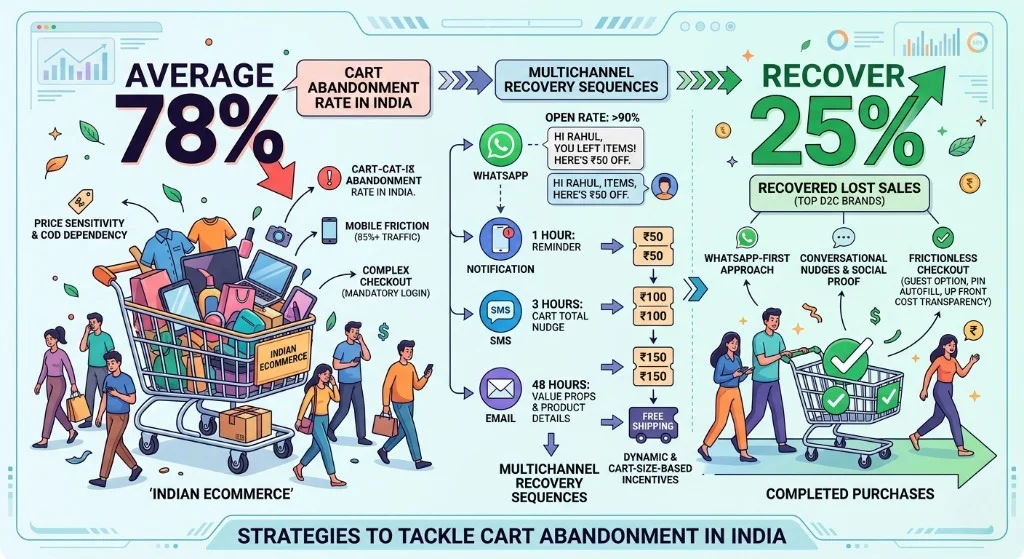
Picture this. You spent Rs 1.5 lakh on Meta Ads last month. You drove 40,000 visitors to your Shopify store. About 6,000 of them actually added something to their cart. And then 4,680 of them just… left. Never checked out. Never paid. Never became a customer.
That is not a hypothetical. That is the reality for the average Indian ecommerce store in 2026. The cart abandonment rate in India sits at approximately 78%, which means for every 10 shoppers who show buying intent by adding a product to their cart, nearly 8 of them walk away before completing the purchase.
Here is the good news: the brands that treat cart recovery as a serious revenue channel, not an afterthought, are clawing back 20-30% of those lost orders. And the math on that is staggering. If your average order value is Rs 1,200 and you recover even 25% of 4,680 abandoned carts, that is 1,170 extra orders worth Rs 14 lakh per month. From people who already wanted to buy.
This post breaks down exactly why Indian shoppers abandon carts at such high rates, and the specific recovery systems top D2C brands are using to get that money back.
Want us to audit your cart recovery system and find the revenue you are leaving behind? Book a free CRO audit with Aim n Launch.
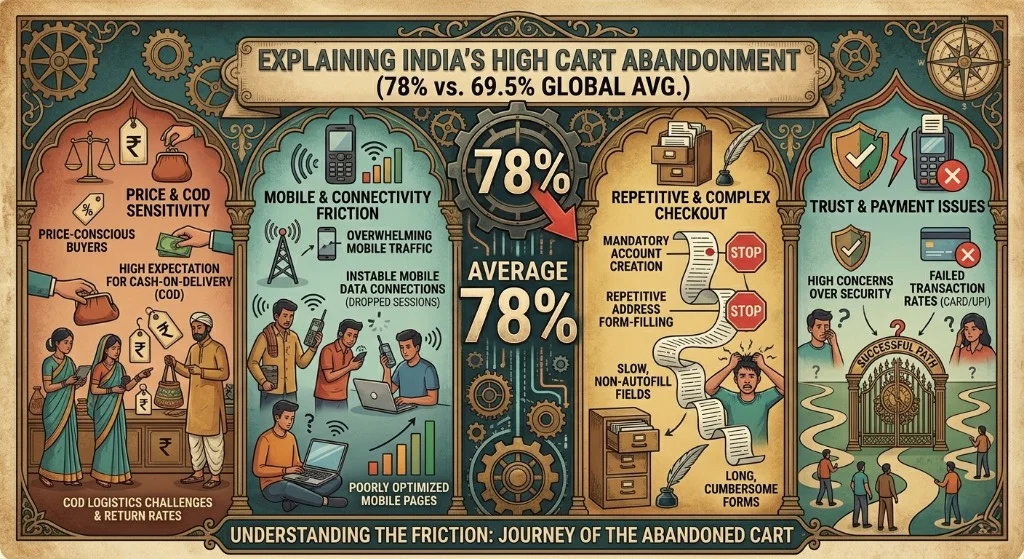
The global average cart abandonment rate is about 70.2% according to Baymard Institute’s 2026 analysis of 50+ studies. India’s rate runs 6-8 percentage points higher. That gap is not random. It is driven by factors unique to the Indian ecommerce ecosystem.
First, mobile dominance. Over 75% of traffic on most Indian D2C Shopify stores comes from smartphones, predominantly mid-range Android devices on 4G connections. Mobile cart abandonment rates globally sit at 80-85%, well above desktop’s 66%. When your checkout page takes 4-5 seconds to load on a Redmi Note on Jio’s network, you are actively bleeding orders.
Second, COD dependency. India is one of the few major ecommerce markets where Cash on Delivery still accounts for 40-55% of orders depending on the category. COD creates a unique abandonment pattern: shoppers add products to explore pricing (including delivery charges), then abandon when the total feels too high since there is no immediate payment friction to anchor commitment.
Third, payment fragmentation. Indian shoppers switch between UPI, credit cards, debit cards, net banking, wallets, and COD. According to 2026 data, 13% of shoppers globally abandon when they do not see their preferred payment option. In India, where payment preferences vary wildly by age, region, and purchase value, that number is likely higher.
Fourth, hidden charges at checkout. This is the number one abandonment trigger worldwide, with 48% of shoppers leaving when unexpected costs appear. In India, this hits harder because many D2C brands charge Rs 50-99 for delivery and only reveal it at checkout. When a Rs 499 product suddenly becomes Rs 598, the perceived value drops instantly.
Not all cart abandonment is equal. Here is how it breaks down across Indian D2C categories based on industry benchmarks and campaign data from 2025-2026:
Fashion and apparel: 80-83% abandonment. Shoppers use carts as wishlists, compare across multiple stores, and are highly price-sensitive. Size uncertainty adds another layer.
Beauty and personal care: 74-77% abandonment. Lower than fashion because purchase intent is typically stronger (people run out of products and need replenishment). Brands like Minimalist and Pilgrim benefit from this.
Health and supplements: 72-76% abandonment. Similar dynamics to beauty, with the added benefit of subscription potential reducing one-time abandonment.
Food and beverages: 68-72% abandonment. Urgency is inherently higher (people are hungry or planning meals), which naturally reduces abandonment.
Electronics and accessories: 78-82% abandonment. High AOV means more deliberation. boAt manages this well by keeping most products under Rs 2,000, which reduces the “think about it” window.
The takeaway: your category determines your baseline, but your checkout experience and recovery system determine how much you beat that baseline by.
Most articles about cart abandonment list generic reasons. Let us get specific about what actually happens in the Indian D2C context.
A shopper sees a kurta for Rs 899 on your product page. They add it to cart. At checkout, they see: Rs 899 + Rs 79 shipping + Rs 30 COD charge = Rs 1,008. That 12% price jump kills the deal. This is the single biggest fixable problem for Indian D2C brands.
The fix: Show total landed cost on the product page itself. Brands like Snitch show “Free delivery on orders above Rs 999” prominently, which actually increases AOV because shoppers add another item to hit the threshold rather than abandoning.
About 26% of shoppers abandon when forced to create an account before checkout. In India, this is compounded by privacy concerns around sharing phone numbers and email addresses with unfamiliar brands.
The fix: Enable guest checkout. Collect just the phone number (you need it for delivery anyway), and create the account silently in the background. Sugar Cosmetics does this seamlessly. The shopper checks out, and their account is ready if they return.
The average Indian D2C Shopify store loads its checkout page in 3.8-4.5 seconds on mobile. Every additional second of load time drops conversion by 7%. That means a store loading at 4.5 seconds versus 2 seconds is losing roughly 17% of potential conversions from speed alone.
The fix: Use Shopify’s native checkout (do not add custom scripts that slow it down), compress all images, remove unnecessary tracking pixels from the checkout page, and enable UPI intent flow so the payment app opens directly instead of requiring manual entry.
This is India-specific and massively underreported. UPI transaction failure rates hover around 3-5% even in 2026. Net banking failures run higher. When a payment fails, most shoppers do not retry. They leave.
The fix: Implement automatic retry prompts, offer alternative payment methods immediately after a failure, and send an instant WhatsApp message saying “Your payment did not go through. Click here to try again” with a one-click checkout link.
First-time shoppers from Meta Ads land on your site having never heard of your brand. At checkout, they are being asked to hand over money or their address. Without trust signals, they hesitate and leave.
The fix: Add “10,000+ happy customers” or real Google/Trustpilot ratings on the checkout page. Show “100% money-back guarantee” near the payment button. Display recognizable payment logos (Razorpay/Cashfree verified, UPI, Visa, Mastercard). Mamaearth shows a “cruelty-free, toxin-free” trust badge right at checkout, reinforcing brand values at the moment of decision.
Here is where we get tactical. The best-performing Indian D2C brands do not rely on a single recovery method. They layer five systems on top of each other, and the compounding effect is what gets them to 25%+ recovery rates.
Before a shopper even leaves, catch them at the door. This means exit-intent popups on desktop and scroll-up/back-button triggers on mobile.
What works in India: offer free shipping as the exit-intent incentive rather than a percentage discount. “Wait, your shipping is on us!” converts better than “Get 10% off” because it directly addresses the number one abandonment reason.
Implementation: Use apps like OptiMonk or Privy on Shopify. Set the trigger to activate only on the cart or checkout page (not site-wide, which annoys visitors). Cap frequency at once per session per user. Mamaearth uses gentle exit-intent popups that blend with their site design while still catching attention.
This is the highest-impact recovery channel for Indian D2C brands in 2026. WhatsApp open rates in India hit 85-95%, compared to 18-22% for email. The gap in click-through rates is even wider.
Here is the exact three-message sequence that top brands run:
Message 1 (sent 15-30 minutes after abandonment): A friendly reminder with the product image and a direct checkout link. No discount. No urgency. Just “Hey, you left this behind. Here is your link to grab it.” This message alone recovers 8-10% because many abandonments are accidental (phone died, got distracted, network dropped).
Message 2 (sent 24 hours later): Address the likely objection. If your category’s main objection is price, offer free shipping. If it is trust, share a customer review. If it is size/fit, link to a size guide. Include the product image again and the checkout link.
Message 3 (sent 48-72 hours later): Create gentle urgency. “Your cart expires in 24 hours” or “Only 3 left in stock.” This is also where you can deploy a small discount (5-10%) if the cart value justifies it.
Real results: A Pune-based supplement brand switched from email-only to WhatsApp cart recovery and saw their recovery rate jump from 3.8% to 17.2%. A skincare brand saw recovery rates go from 4% to 19% within 30 days of implementing WhatsApp flows.
Tools: Interakt, Wati, CampaignHQ, or LimeChat for WhatsApp Business API integration with Shopify.
Email is not dead for cart recovery in India. It is just not the primary channel anymore. But it catches the segment that checks email regularly, especially professionals and higher-AOV shoppers.
Email 1 (1 hour after abandonment): Clean, visual email showing the abandoned product. Subject line: “You left something behind.” No discount.
Email 2 (24 hours later): Add social proof. “Join 15,000+ customers who love this product.” Include 1-2 short customer reviews.
Email 3 (72 hours later): Last chance messaging with an optional incentive. “Your cart is about to expire. Here is free shipping to sweeten the deal.”
Keep emails mobile-optimized (80%+ of Indian email opens happen on phones), under 150 words of body copy, with one clear CTA button.
Run dedicated Meta Ads retargeting campaigns to cart abandoners. This is different from your general retargeting because you know these people had high purchase intent.
Creative approach: Show the exact product they abandoned (dynamic product ads work perfectly here). Lead with the objection killer: if price is the issue, highlight a limited-time offer. If trust is the issue, feature customer testimonials.
Budget allocation: Spend 10-15% of your total Meta budget on cart abandonment retargeting. The CPP (cost per purchase) on this audience should be 50-70% lower than your prospecting campaigns because these shoppers are already warm.
Frequency cap: Set it at 3-4 impressions per day for 7 days. After that, move the user to a general retargeting pool. Hammering the same person with the same abandoned product ad for 30 days just builds brand resentment.
Low effort, low cost, but it adds up. Browser push notifications work for the segment that opted in but did not share their phone number or email.
Send one notification 2-3 hours after abandonment: “Your [product name] is waiting for you. Complete your order now.” Include the product image as the notification thumbnail.
Tools: PushOwl or OneSignal, both of which integrate natively with Shopify.
We have audited and optimized cart recovery for dozens of Indian D2C brands. Here is the framework we use internally, which we call REACT:
R – Reveal costs early. Show shipping, COD charges, and taxes on the product page, not at checkout. This alone can reduce abandonment by 8-12%.
E – Eliminate friction. Guest checkout, autofill addresses (Shiprocket, Delhivery, and Shopify all support Indian pin code lookup), one-tap UPI payments, and mobile-first checkout design.
A – Activate recovery channels. WhatsApp first (15-30 min trigger), email second (1 hour trigger), push notifications third (2-3 hour trigger), retargeting ads fourth (runs continuously for 7 days).
C – Customize by segment. First-time visitors get trust-building messages. Returning customers get convenience-focused messages (“Complete your order in one click”). High-value carts (above Rs 2,000) get personal follow-up from customer support on WhatsApp.
T – Test and iterate. A/B test every message, every timing, every incentive. The brands recovering 25%+ are not running the same sequence they set up six months ago. They are testing weekly.
Here is a real example from our work with an Indian fashion D2C brand doing Rs 25-30 lakh per month in revenue.
Before optimization: Their only recovery mechanism was Shopify’s default abandoned cart email, sent 10 hours after abandonment. Recovery rate: 4.1%.
What we changed:
Step 1: Added free shipping threshold prominently on product pages and cart page (“Add Rs 200 more for free delivery”). Cart abandonment rate dropped from 81% to 74%.
Step 2: Implemented WhatsApp recovery via Interakt with the three-message sequence described above. Recovery rate jumped to 14%.
Step 3: Added exit-intent popup on the cart page offering free shipping. Recovery rate hit 17%.
Step 4: Launched dynamic retargeting ads on Meta, spending Rs 15,000/month on cart abandoners. Recovery rate reached 20%.
Step 5: Added browser push notifications via PushOwl. Final recovery rate: 22%.
Revenue impact: At Rs 1,400 AOV, recovering an additional 18% of abandoned carts (going from 4% to 22%) meant approximately Rs 4.2 lakh in additional monthly revenue. From people who were already going to buy. The total cost of the recovery stack (WhatsApp API costs, push notification app, additional ad spend) was under Rs 35,000/month. That is a 12x return.
Here is the exact tech stack we recommend for Indian D2C brands:
WhatsApp Business API: Interakt (best for early-stage brands, starts at Rs 999/month), Wati (better for scale, starts at Rs 2,499/month), or LimeChat (AI-powered, best for brands doing Rs 50L+/month).
Email automation: Klaviyo (industry standard for Shopify), CampaignHQ (India-focused alternative with WhatsApp + email), or Mailchimp (budget option for early-stage brands).
Exit-intent popups: OptiMonk (best exit-intent triggers), Privy (good all-rounder), or Shopify’s built-in popup if you want zero additional apps.
Browser push: PushOwl (Shopify-native, free tier available) or OneSignal (more customizable, free tier available).
Retargeting: Meta Ads dynamic product catalog retargeting + Google Display remarketing for broader reach.
Checkout optimization: Shiprocket Checkout or GoKwik for one-click COD/prepaid checkout flows optimized for Indian payment methods.
You do not need a full overhaul to start recovering more carts. Here are seven changes you can make this week:
Combined, these seven changes can reduce cart abandonment by 8-15% within the first two weeks, based on what we have seen across our client base.
The average cart abandonment rate for Indian ecommerce stores is approximately 78%, which is higher than the global average of 70.2%. Mobile-specific abandonment rates in India run even higher at 80-85% due to slower load times on mid-range Android devices and 4G networks.
Four India-specific factors drive higher abandonment: mobile-first shopping on slower devices and networks, COD dependency that reduces purchase commitment friction, payment method fragmentation (UPI, cards, wallets, net banking, COD), and hidden shipping and COD charges revealed only at checkout.
Yes, significantly. WhatsApp open rates in India are 85-95% compared to 18-22% for email. WhatsApp cart recovery sequences typically recover 12-18% of abandoned carts, while email sequences recover 3-5%. The best approach is to use both, with WhatsApp as the primary channel and email as a supplementary one.
Within 15-30 minutes of abandonment. A shopper who left your store 6 minutes ago is still in buying mode, but one who left 14 hours ago has mentally moved on. The first WhatsApp message should go out within 30 minutes, and the first email within 1 hour.
Not in the first message. Start with a simple reminder (no incentive). If that does not convert, address objections in the second message (social proof, free shipping, size guide). Only offer a small discount (5-10%) in the third and final message, and only for high-value carts where the margin justifies it. Training customers to expect discounts on every abandoned cart is a race to the bottom.
If your Shopify store is doing Rs 20 lakh+ in monthly revenue and you do not have a multi-channel cart recovery system, you are leaving Rs 3-5 lakh on the table every single month. That is not a guess. It is the math.
The brands winning in Indian D2C right now are not just spending more on ads. They are extracting more revenue from the traffic they already have. Cart recovery is the lowest-hanging fruit in CRO, and it compounds: every recovered customer is a future repeat buyer, a potential referrer, and a data point for your retargeting audiences.
Get a free cart recovery audit for your Shopify store. Our CRO team will analyze your checkout flow, identify the biggest leaks, and give you a prioritized fix list. Book a 15-minute call with Aim n Launch.