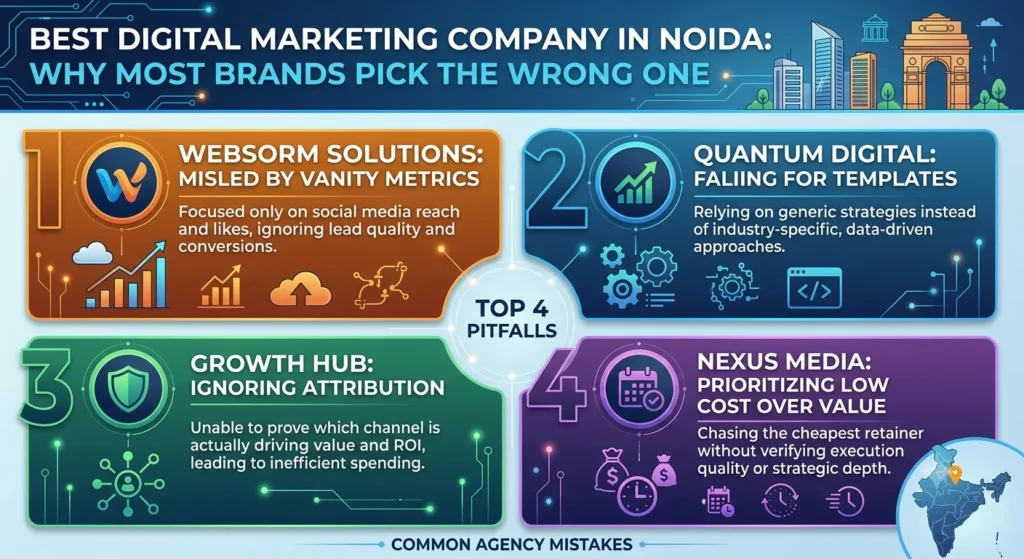
Most brands pick the wrong Noida agency for one reason: they evaluate the pitch instead of the account. The fix is a paid 30 day audit before any retainer. Ask the agency to review tracking, creative history and unit economics, and to deliver a written 90 day plan with named metrics. Agencies that decline paid audit work are usually selling retainers rather than outcomes.
Noida and Greater Noida host a very large number of agencies serving both domestic brands and export-facing clients. Retainers here are often quoted lower than in central Delhi or Gurgaon, which makes the market attractive and also makes it easy to over-index on price.
The typical sequence goes like this. A founder takes three calls. Agency A quotes 35,000 a month, Agency B quotes 80,000, Agency C quotes 1,80,000. The decks look similar, so the founder picks A or B on value grounds. Six months later the account has spent 20 lakh, the reports are full of reach and engagement, and nobody can say what an order costs.
The error was not the price. It was choosing without an account-level diagnosis.
A retainer is a small fraction of total marketing cost once ad spend is included. On a brand spending 5 lakh a month on ads, the difference between a 40,000 and a 1,20,000 retainer is 80,000. A five percent improvement in cost per order on that same spend is worth 25,000 a month in media efficiency alone, before counting the revenue it unlocks. Retainer savings that cost us efficiency are not savings.
What we would rather see a founder optimise is the ratio of senior attention to spend. Ask how many hours a week a senior operator will personally spend inside the account. On a growing brand, anything under four is thin.
We recommend this structure to any brand evaluating agencies, whether or not they end up working with us:
A competent digital marketing company in India will happily do this work for a fee. The audit itself tells us more about the agency than any case study.
We take on a limited number of ecommerce and direct to consumer accounts because the model we run is operator-heavy rather than account-manager-heavy. Aim n Launch has produced over 55 crore in client revenue at a 4.2X average return across more than 200 ecommerce brands, and we have scaled brands that have appeared on Shark Tank India. Our media buyers carry Google Ads, Meta Ads and Shopify certifications.
Practically, our engagements start with exactly the audit described above. We look at where the store leaks before we look at bidding, because raising spend on a page that does not convert simply buys a more expensive version of the same problem. Once tracking and the page are sound, we move to a weekly test map, daily budget decisions, and email plus WhatsApp flows that recover the traffic acquisition already paid for. Brands in the region often pair this with our Delhi NCR ecommerce work and our broader ecommerce digital marketing services.
Operating costs, office rents and salary benchmarks are generally lower in Noida and Greater Noida, and competition among a large agency pool pushes retainers down. Lower price is not automatically lower quality, but it often means a smaller senior-to-junior ratio on the account. Check who is actually doing the work before treating the discount as value.
Below roughly 3 to 5 lakh a month in ad spend, one strong in-house generalist plus freelance creative is often more efficient. Above that, the workload splits into media buying, creative production, analytics and lifecycle, which is more than one person can run well. Many brands run a hybrid, keeping brand in-house and outsourcing performance.
Three quick checks. Count distinct creatives tested in the last 90 days, which should be dozens rather than a handful. Calculate cost per order yourself from backend data and compare it to the report. Check whether any structural change was made mid-month. If nothing was paused or reallocated between reports, the account is being managed monthly, not daily.
It varies sharply by category and price point. Beauty and fashion often sit between 2X and 4X on cold traffic, while higher-consideration categories can be lower and still profitable on lifetime value. The more useful target is contribution margin positive at scale, since a 5X return on tiny spend is less valuable than a 2.5X return that scales profitably.
A 90 day initial term is fair to both sides. That is long enough to repair tracking, run a full test cycle and produce a scaling decision, and short enough that neither party is trapped. Avoid twelve month lock-ins before any result exists, and make sure account and asset ownership sits with the brand from day one.