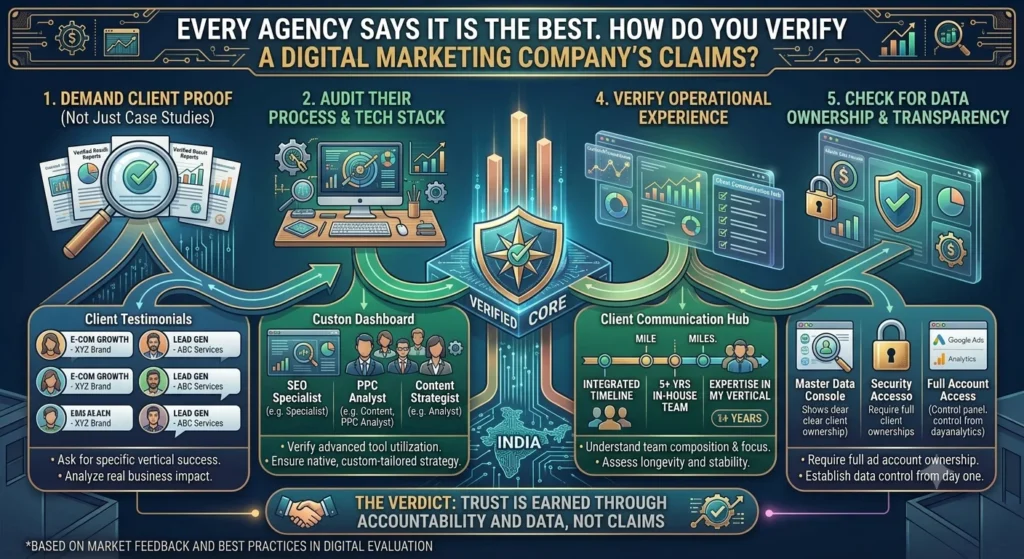
Verify four things. Demand a denominator on every result, meaning spend, orders and time period alongside any return figure. Check the named client’s public ad library for creative matching the claimed period. Insist on one reference call with a client in our own category. Commission a paid diagnostic and judge the agency on that document. Claims that survive all four are usually real.
Search any of these keywords and every result on page one calls itself the best. The term is self-assigned, unverified and free to use, which means it functions as a keyword rather than as a claim. The same applies to “award-winning”, “results-driven”, “360 degree” and “data-driven”. None of these can be checked, so none of them should influence a decision.
Every performance claim needs four numbers to be meaningful: total spend, total orders or leads, cost per order or lead, and the time window. “4X ROAS” on 50,000 rupees of spend over two weeks is not comparable to the same figure on 40 lakh over six months.
Agencies with real results supply these readily, often with client permission already secured. Agencies that respond with screenshots cropped to hide spend are telling us something.
Meta’s Ad Library is public. If an agency claims to have run a named brand’s campaigns during a given period, that brand’s active and historical creative is visible. A claimed six-month engagement that produced three static ads did not involve serious creative testing. This check takes under ten minutes and catches a surprising number of inflated claims.
Ask for one reference in our exact category, at a similar spend level, and ask that founder four things: what the first ninety days actually produced, how quickly the agency reacted when something underperformed, who was actually in the account, and what they would change about the engagement. Testimonials on a website are curated. A fifteen minute call is not.
The single most reliable signal is a paid audit. Ask the agency to review tracking, creative history, unit economics and funnel leaks, and to deliver a written ninety day plan. Then judge the document. Does it identify something specific and uncomfortable, or does it restate general best practice? A diagnostic is cheap relative to a six month retainer spent on the wrong partner, and it is the closest thing available to a trial run.
Any serious digital marketing company in India will price this work rather than give it away, because a free audit is a sales document by design.
We publish numbers with context rather than screenshots. Aim n Launch works only with direct to consumer and ecommerce brands, has generated more than 55 crore in tracked client revenue at a 4.2X average return, has worked with over 200 ecommerce brands, and has scaled brands that have appeared on Shark Tank India. Our media buyers hold Google Ads, Meta Ads and Shopify certifications.
We are also explicit about what we do not do, which is usually more informative than a service list. We do not chase vanity return figures or report on reach. We do not push spend while the product page, offer or checkout is leaking. We do not run blanket discounts to rescue a weak week. We do not hand off email and WhatsApp follow-up to someone else and call the funnel complete. Every account reports on orders, cost per order and payback, and the brand owns every account and asset from the first day. The same standard runs through our ecommerce marketing work in Mumbai and Delhi.
Ask for spend, orders, cost per order and the time period behind each claim, then request a reference call with that client. Cross-check the brand’s creative in Meta’s public Ad Library for the claimed period. Genuine case studies survive all three checks. Cropped screenshots without denominators should be treated as marketing rather than evidence.
Guaranteed rankings or returns, case studies without spend figures, refusal to name the person running the account, campaigns run inside the agency’s own business manager, long lock-in contracts before any result, and reporting that leads with impressions and reach. Any two of these together are usually enough reason to stop.
Treat them as a starting filter rather than proof. Many directory placements are paid, and review collection is often agency-managed. The useful part is the reviewer’s named company and role, which gives us someone to contact independently. Use directories to build a shortlist, then verify through denominators, ad library checks and reference calls.
A free audit is a sales document. It tends to highlight problems the agency sells solutions for and skips problems it cannot fix. Paid diagnostics are usually more honest, more specific and more useful even if we never hire the agency. If a free audit is all that is available, read it for what it omits as much as for what it finds.
Ninety days is the fair minimum, since month one goes to tracking and diagnosis. Judge month one on data quality, month two on creative test volume and directional cost per order, and month three on a stabilised acquisition cost and a scaling decision. If tracking is still unreliable at day sixty, that alone is grounds to end the engagement.