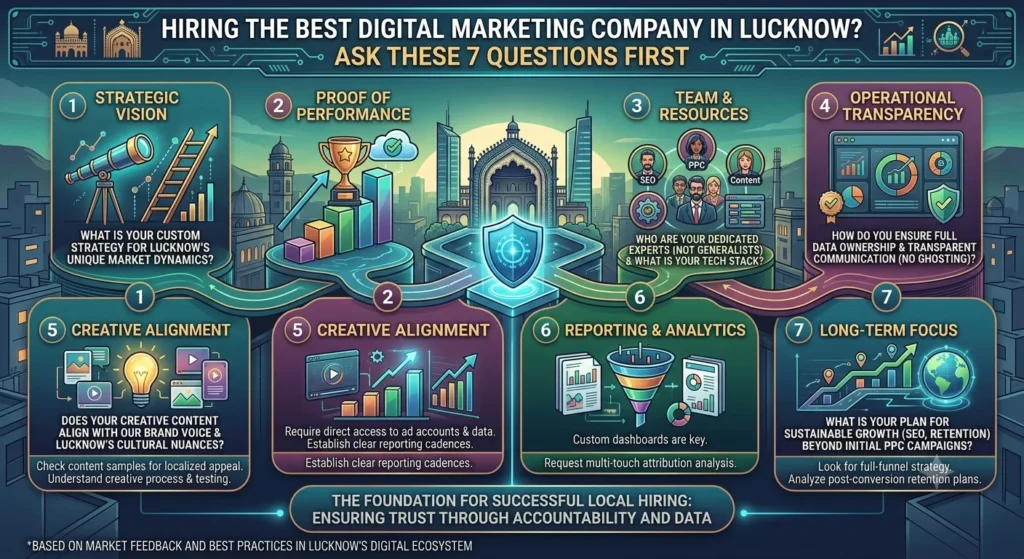
Ask seven questions before signing: who runs the account daily and how many accounts they carry, how conversion tracking will be validated, what the first ninety days will produce, how many creative concepts will be tested monthly, which three metrics lead the report, who owns the accounts and creative, and what the exit terms are. Written answers to all seven separate serious agencies from the rest.
Proposals are written to be compared favourably. They use the same vocabulary, list the same services, and present the same case study structure. Comparing them rewards the best writer.
A live question list does something different. It tests whether the person in front of us has actually run accounts. Operators answer with specifics and caveats. Salespeople answer with frameworks and reassurance. The difference is audible within two questions.
Lucknow’s agency market has grown quickly alongside the wider Uttar Pradesh business base, and quality ranges widely from strong regional teams to very thin operations. A question list is the cheapest filter available.
Two more, if the brand sells products online. First, what is the plan for cart and browse abandonment recovery on email and WhatsApp, and when does it go live? This is often the fastest incremental revenue available and it is routinely ignored. Second, what will be changed on the product page before spend increases? Any experienced digital marketing company in India will have an opinion on the page before it has an opinion on the bid.
We work only with direct to consumer and ecommerce brands, and we answer all nine of the questions above in writing before an engagement starts. Aim n Launch has generated over 55 crore in tracked client revenue at a 4.2X average return, worked with more than 200 ecommerce brands, and scaled brands that have appeared on Shark Tank India. Our media buyers hold Google Ads, Meta Ads and Shopify certifications.
Our operating model is deliberately narrow. We keep account load per operator low enough for daily decisions, we produce user generated content in house so creative testing never waits on a vendor, and we own email and WhatsApp recovery rather than leaving it to a separate tool owner. The brand owns every account and asset throughout. The same structure underpins our work for D2C brands in Delhi and our ecommerce marketing in Gurgaon.
Lucknow retainers typically range from about 15,000 to 80,000 rupees a month, among the lower bands in India, reflecting local cost structures. Entry pricing generally means one channel and a junior executive. Ad spend is additional. For ecommerce brands, budget the retainer at roughly 15 to 25 percent of monthly ad spend.
Usually yes, but the sequence matters. Local search presence through a well-optimised Google Business Profile, accurate listings and review generation often delivers better early returns than paid ads for service businesses. Product businesses selling online benefit more from paid social and search. Start with whichever channel matches how customers already look for the category.
A freelancer typically owns one skill such as ads or design and costs less. An agency provides multiple skills, redundancy when someone is unavailable, and defined processes. For brands spending under about 2 lakh a month on ads, a strong freelancer plus clear owner oversight can outperform a thin agency retainer.
Include current monthly revenue and ad spend, target cost per acquisition and contribution margin, the top three products by revenue, known funnel problems, existing tracking setup, past agency history and what went wrong, and a clear definition of success at ninety days. Briefs with real numbers get serious proposals. Vague briefs get template ones.
No agency can responsibly guarantee a ranking position or a specific return on ad spend, because both depend on competition, seasonality, product margin and factors outside the agency’s control. What can be committed to is process: tested creative volume, reporting cadence, tracking standards and review points. Treat a hard guarantee as a warning sign.