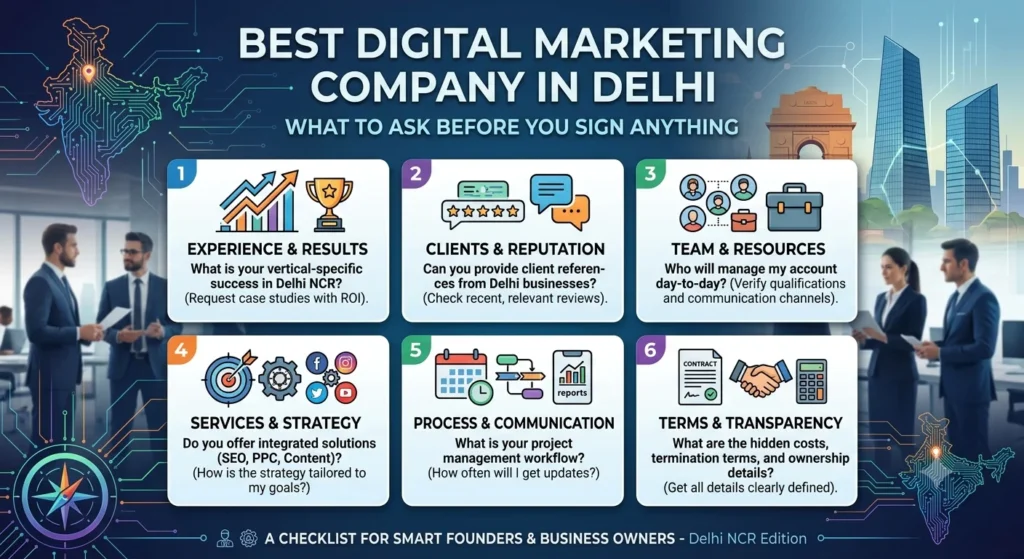
Before signing with any Delhi agency, get written answers to five things: who specifically runs the account day to day and how many other accounts they carry, how conversion tracking will be validated before launch, what the first 90 day test plan contains, which three metrics the monthly report leads with, and who owns the ad accounts and creative if the relationship ends. An agency that answers all five in writing is already in the top tier.
Delhi, Noida, Gurgaon and Faridabad together hold one of the densest concentrations of marketing agencies in the country. Density is good for choice and bad for signal. Pitch decks converge, case studies get recycled, and the same three screenshots circulate between agencies that have never worked on the account.
Because the supply is so large, the founder’s job is not to find a competent agency. It is to filter out the ones that are competent at pitching. The questions below are designed to be difficult to answer well without actual operating experience.
A strong answer names the person, states their years on the platform, and gives an honest account load. Anything above five active accounts per buyer means our data gets checked weekly, not daily. A weak answer talks about a team and a process without naming anyone.
We want to hear about server-side events, conversion API setup, event deduplication, purchase value and currency parameters, and a reconciliation method against backend orders. A weak answer is that the pixel is already installed.
Look for a phased structure. Measurement and audit first, structured creative testing second, scaling decision third. Look for a stated number of creative concepts to be tested and a stated kill rule. A weak answer is a list of services with monthly deliverable counts.
The right answer is orders, cost per order and payback period, or a close variant. If the answer starts with impressions, reach or engagement, the reporting has been designed to look busy.
The brand should own the ad accounts, the analytics property, the pixel, the creative files and the email list. Some agencies run clients inside their own business manager, which makes leaving expensive. Settle this before signing, never after.
When we take over an account in this region, the first thing we check is rarely the campaign structure. It is the product page and the checkout. Across the stores we have audited, the recurring leaks are slow mobile load on image-heavy pages, an unclear offer above the fold, a shipping charge revealed only at the last checkout step, and no abandoned cart recovery on WhatsApp despite high mobile traffic.
Fixing those often lowers cost per order more than any change to bidding. Any digital marketing company in India serving consumer brands should be reading the store before it touches the bid strategy. That is why we treat the store and the ad account as one system rather than two projects, an approach we describe on our ecommerce marketing agency in Delhi page and across Delhi NCR.
We are not a general agency that added a direct to consumer line. Aim n Launch works only with online-first, product-led brands, which is why our reporting speaks in cost per order, blended customer acquisition cost, lifetime value and payback rather than in reach. We have generated more than 55 crore in tracked client revenue at a 4.2X average return and worked with over 200 ecommerce brands, including brands that have appeared on Shark Tank India.
Being rooted in Delhi NCR has one practical advantage that matters more than proximity marketing. Strategy workshops, creative shoots and deep-dive sessions happen in person, on short notice, which shortens the loop between a data signal and a new creative being live. Many of our clients use us as an extension of their in-house growth team rather than as an external vendor.
Typical retainers in Delhi NCR run from about 40,000 rupees a month for a single channel with a junior team, to 1,50,000 to 3,00,000 rupees a month for integrated performance, creative and lifecycle work with senior operators. Some agencies bill 10 to 15 percent of ad spend instead. Ad budget sits on top of the retainer in all cases.
Performance work runs fine remotely. Proximity matters for creative production, strategy workshops and fast in-person problem solving, which is where Delhi NCR based teams have a genuine edge for brands in the region. Judge on category experience and operating cadence first, and treat location as a tie-breaker rather than a filter.
They typically own paid acquisition on Meta and Google, creative strategy and production, conversion rate work on the store, and lifecycle channels such as email, SMS and WhatsApp. The valuable part is connecting these, so ad messaging matches the landing page and retention flows recover the traffic that acquisition paid for.
Ask for the spend behind each result, the time period, and permission to speak to the client. Real case studies survive all three. Then check whether the named brand’s current ad library shows creative consistent with the claimed period. Agencies that decline a reference call in your own category are usually protecting something.
Yes, and for many brands this is the strongest model. The external team owns performance media, creative testing and lifecycle analytics, while the internal team owns brand, community, influencer relationships and offline activity. It works when reporting lines and decision rights are written down before the engagement starts.