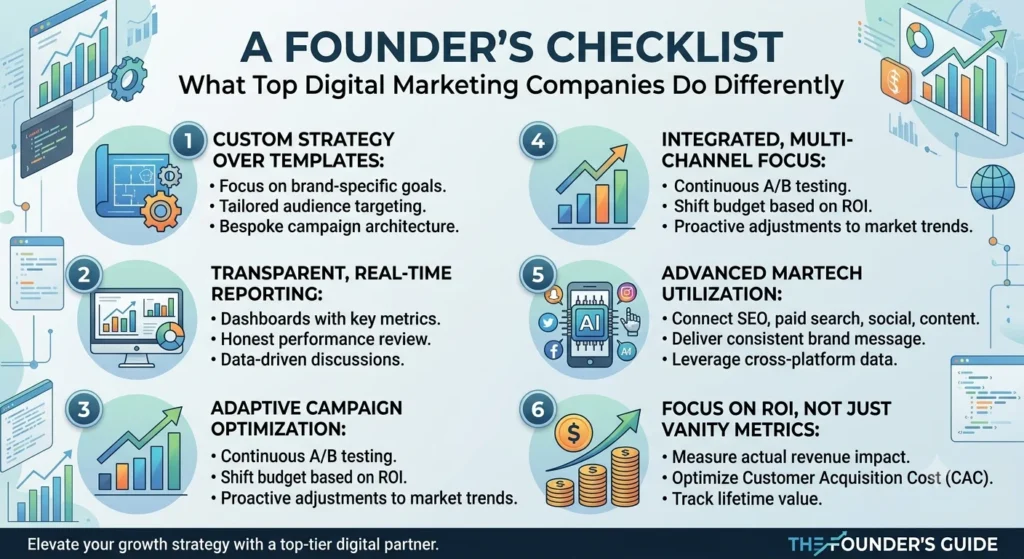
The best digital marketing companies differ on four operational habits, not on service menus. They fix measurement before they spend, they run a written weekly test map instead of ad hoc creative, they report on orders and cost per order instead of reach, and they treat the website, ads, email and WhatsApp as one funnel owned by one team. Service lists are identical across agencies. These habits are not.
Open ten agency websites and the service grids match almost exactly: search engine optimisation, pay per click, social media, content, email, web development. Because the menus are identical, they carry no decision value. What separates outcomes is how the work is run week to week.
Below is the checklist we use when we audit an account we are taking over, and the same checklist works when a founder is evaluating a prospective partner.
Strong teams spend the first two weeks on data. That means a validated conversion API or server-side setup, deduplicated events, a clean purchase event with value and currency, and agreement on which platform is the source of truth for orders. Weak teams switch on campaigns in week one because it looks like progress.
A practical test: ask a prospective agency to explain how they will reconcile platform-reported orders against backend orders. If there is no answer, there is no measurement plan.
A serious team can show a test map for the coming month. It lists angles down one axis and formats across the other, states the hypothesis for each cell, defines the minimum spend before a verdict, and names the kill rule. Creative that is produced in a monthly batch with no hypothesis is content, not testing.
We work on a weekly cycle. Losers are retired fast, winners are scaled, and the map is rebuilt each week rather than each quarter. Test velocity is the single strongest predictor we have seen of how quickly a new account stabilises.
Reports should let a founder answer three questions in under a minute: how many orders did we get, what did each one cost, and how long until that customer pays back. Everything else is supporting detail. A dashboard of impressions, reach, engagement rate and click-through rate is a dashboard designed to avoid a hard conversation.
Most leaks are not in the ad. They are on the product page, in the offer, in checkout speed, or in an abandoned cart flow that nobody built. When ads sit with one vendor, the website with a second and email with a third, every party can honestly report that their piece is fine while revenue stays flat.
This is why a serious digital marketing company in India for a consumer brand will insist on visibility into the store, not just the ad account. Our own view on integrating store experience with acquisition is set out on our D2C marketing agency in Delhi page.
We are built for one kind of business, which is the direct to consumer and ecommerce brand that thinks in margins, blended customer acquisition cost, lifetime value and payback periods. Aim n Launch has generated over 55 crore in client revenue at a 4.2X average return, worked with more than 200 ecommerce brands, and scaled brands that have featured on Shark Tank India. Our team holds Google Ads, Meta Ads and Shopify certifications.
More useful than any of that is how we operate. We fix the leak before we raise the spend. We script, cast and edit user generated content in house so the creative pipeline never stalls waiting on a vendor. We run daily calls to raise, pause, swap and iterate rather than waiting for a monthly review. Email and WhatsApp recovery flows are ours to own, not somebody else’s problem.
A good agency executes the plan. A great one changes the plan when the data says so. The practical marker is speed of reaction. Great teams pause a losing creative within days and reallocate budget the same week. Good teams wait for the monthly review, which costs roughly three weeks of spend each cycle.
Paid media can move within two to four weeks once tracking is clean, because budget is reallocated immediately. Search engine optimisation and content typically need three to six months for compounding gains. Email and WhatsApp retention flows often produce the fastest incremental revenue, since abandoned cart and post-purchase sequences can be live within the first fortnight.
For brands under roughly 50 lakh in monthly revenue, one integrated team is usually better, because the funnel is small enough that handoff losses hurt more than specialist depth helps. Above that, a hybrid model works, where one partner owns performance and lifecycle while specialists handle areas like influencer sourcing or marketplace management.
At minimum: named deliverables with frequency, named key performance indicators with a baseline, a defined review point at 90 days, clear ownership of all accounts and creative assets by the brand, a notice period under 60 days, and a data access clause. Avoid contracts that assign ownership of ad accounts or creative to the agency.
Pull your own platform data for the last 90 days and calculate cost per order and contribution margin yourself. Compare it to the agency report. Then check three things in the account: how many creatives were tested, how many were paused, and whether conversion events are deduplicated. Discrepancies here usually explain flat performance.