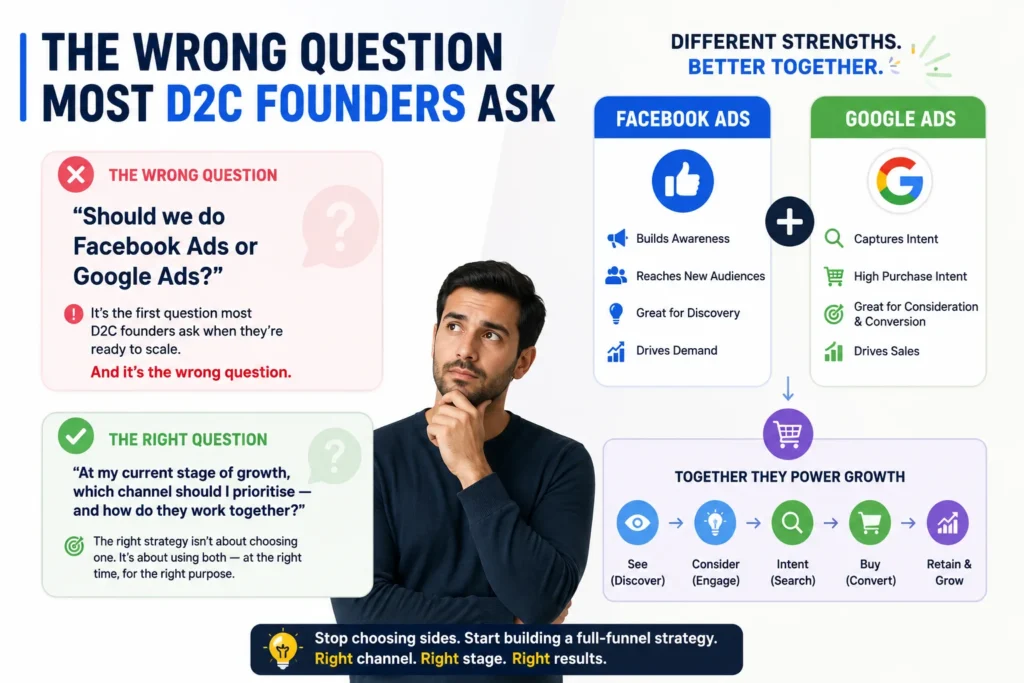
“Should we do Facebook Ads or Google Ads?”
It’s the first question most D2C founders ask when they’re ready to scale. And it’s the wrong question.
The right question is: At my current stage of growth, which channel should I prioritise — and how do they work together?
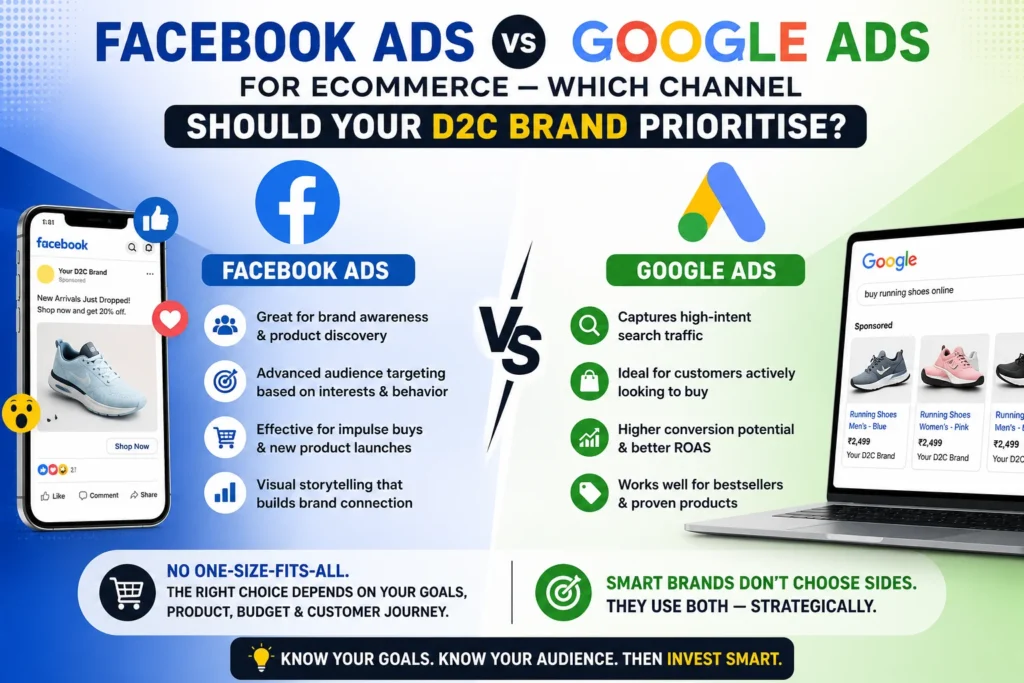
Facebook and Google are not competitors. They’re complementary channels that serve different buyer intents, different funnel stages, and different brand objectives. The brands that scale fastest are the ones that understand this and build a coordinated strategy across both.
Facebook (and Instagram) Ads are a demand creation channel. The buyer wasn’t searching for your product. Your ad interrupted their scroll — and made them want it. This makes Facebook exceptional for:
Facebook’s algorithm finds buyers who look like your existing customers, based on behaviour, interests, and purchase history. With the right creative, you can reach lakhs of potential buyers who’ve never heard of your brand.
Facebook is a visual, social platform. Native-feeling content — real people using your product, honest reviews, before-and-after demonstrations — consistently outperforms polished brand ads. A specialist Facebook marketing agency builds and tests this type of content systematically.
Facebook excels at re-engaging people who visited your store, added to cart, or watched your videos. These warm audience campaigns typically deliver your lowest CPO and highest ROAS — because the buyer already knows you.
Once you have 500–1,000 buyers in your pixel data, Facebook can find thousands more who behave similarly. Lookalike audiences are one of the most powerful cold acquisition tools available.
Google Ads is a demand capture channel. The buyer is already looking for what you sell. Your ad shows up when they search for it. This makes Google exceptional for:
When someone types “buy organic coffee online India” or “best resistance band for home workout,” they’re ready to purchase. Google Search Ads capture this intent at exactly the right moment — when the buyer has already decided they want the product.
Shopping campaigns display your product image, price, and brand name directly in Google search results. For most eCommerce categories, Shopping ads generate more clicks than text ads at a lower cost per click. A well-optimised product feed is the foundation of strong Shopping performance.
Google’s AI-driven campaign type runs across Search, Shopping, Display, YouTube, and Gmail simultaneously. When set up correctly with strong asset groups and clear conversion signals, PMax can be your highest-volume campaign — particularly for scaling brands with a healthy conversion history.
If people are searching for your brand name and you’re not running branded Search campaigns, competitors are capturing that traffic. Branded campaigns are low-cost and essential for protecting your conversion funnel.
Early Stage (Total ad budget: ₹50K–₹2L/month)
Allocate 70–80% to Meta. Use it to find your winning creative, identify your best-performing audience, and establish CPO benchmarks. Run a small Google Shopping campaign (20–30% of budget) to capture branded and category searches.
Scaling Stage (₹2L–₹10L/month)
Split roughly 60% Meta, 40% Google. Meta continues to drive new customer acquisition; Google Search and Shopping capture the demand that Meta creates. Retargeting on both platforms. Begin testing Performance Max with a modest budget.
Established Stage (₹10L+/month)
Full multi-channel operation. Meta handles prospecting and UGC-driven acquisition. Google runs Shopping, Search (branded + non-branded), and PMax. YouTube ads enter the mix for top-of-funnel brand building. SEO handles 20–40% of total traffic organically.
On Google, your bid strategy and feed quality determine performance. On Facebook, it’s creative — and only creative. What works in 2025 for Indian D2C brands on Facebook:
A dedicated Facebook marketing agency builds, tests, and iterates on all of these formats weekly — because creative fatigue is real and the winning ad of this month will stop converting next month.
On Facebook, you give the algorithm creative assets and it finds the audience. On Google Shopping, you give the algorithm your product feed and it decides where and when to show your products. An optimised feed includes:
Here’s the most important insight: Facebook and Google don’t compete. They relay.
Facebook introduces your brand to someone who’s never heard of you. They visit your store but don’t buy. Google retargets them when they search for your category. They click, return to your store, and convert.
Without Facebook, Google has less warm traffic to capture. Without Google, Facebook’s full impact is never realised. Run both — in the right ratio for your stage.
Ready to build a coordinated Facebook + Google growth engine for your D2C brand?
Talk to Aim n Launch — Specialists in Facebook Marketing and eCommerce Google Ads
Aim n Launch has managed ₹10Cr+ in ad spend across Meta and Google for D2C brands in India. We don’t just run ads — we build the complete performance system that makes scaling profitable.