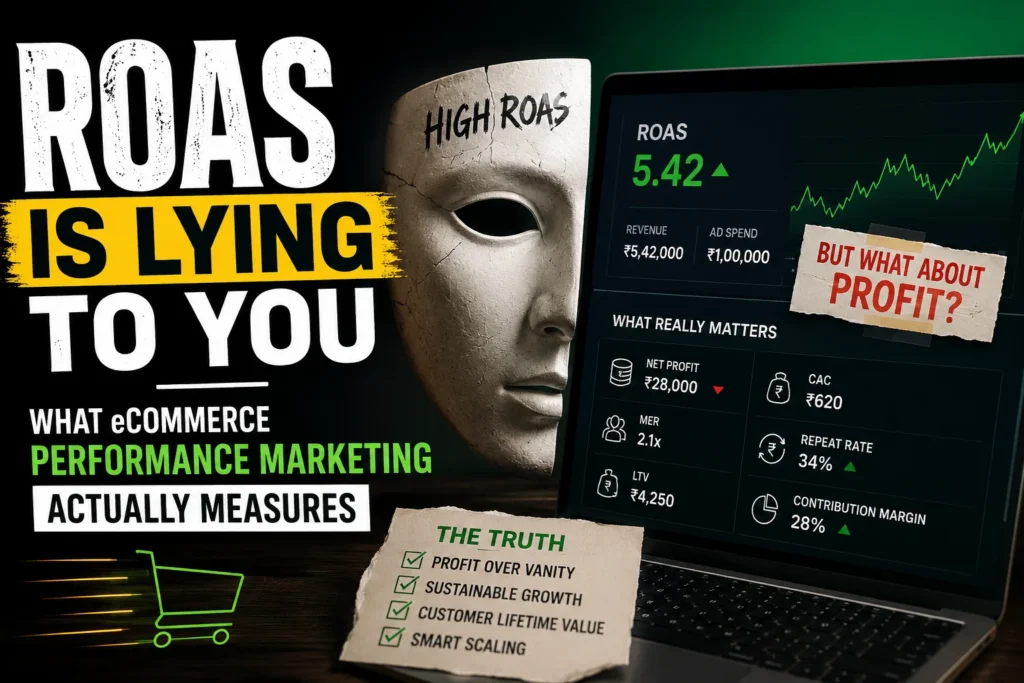
Every D2C founder knows the feeling. Your agency sends a screenshot — “4X ROAS this week!” — and for a moment, everything feels under control.
Then you check your bank account. And the numbers don’t add up.
This is the ROAS trap. And it’s quietly draining the profitability of thousands of eCommerce brands across India.
A genuine eCommerce performance marketing agency measures what actually matters. Here’s what that looks like.
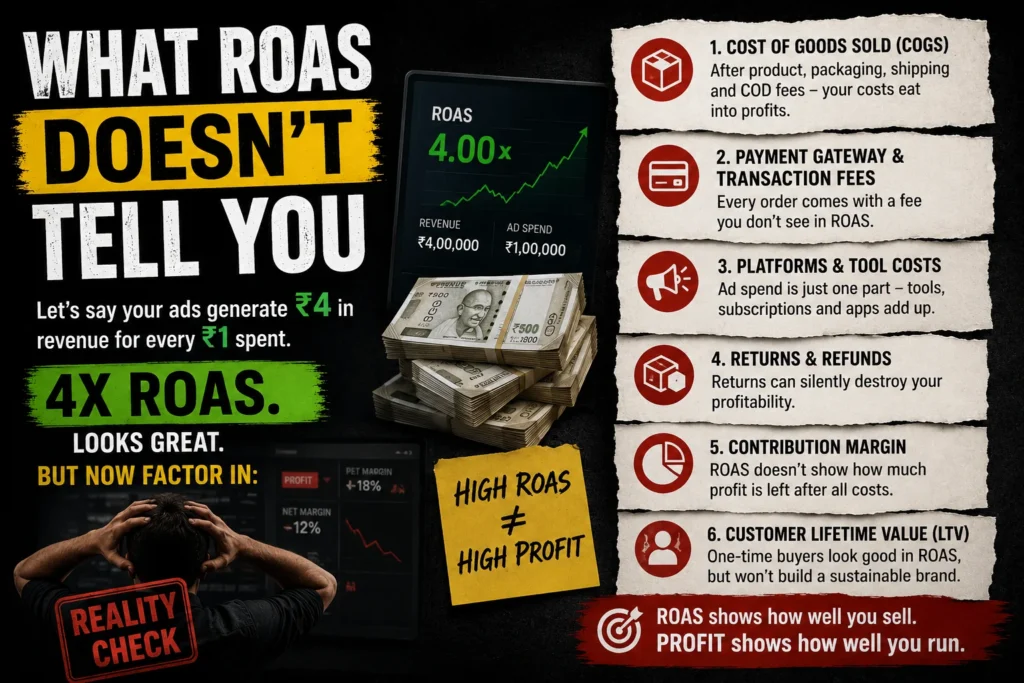
Let’s say your ads generate ₹4 in revenue for every ₹1 spent. 4X ROAS. Looks great. But now factor in:
Suddenly that 4X ROAS is a breakeven proposition — or worse, a loss.
ROAS is a top-line metric. It’s useful as one data point but catastrophic as a north star. Yet most agencies optimise for it because it’s easy to inflate and even easier to screenshot.
A results-oriented eCommerce performance marketing agency tracks these instead:
Cost Per Order (CPO)
How much does it cost to generate one order — across all ad spend? This is the metric that maps directly to your P&L.
Contribution Margin Per Order
Revenue minus cost of goods, shipping, returns, and ad spend. This is your real profit per order. If it’s negative, scale kills you faster.
Payback Period
How many days does it take to recover the cost of acquiring a customer? For healthy D2C brands, this is 30–60 days. If it’s longer, cash flow becomes a growth blocker.
Customer Lifetime Value (LTV)
How much does a customer spend across all orders over time? Brands with strong LTV can afford a higher CPO because they know the customer will return.
New Customer CAC vs Returning Customer Revenue
Are you acquiring new buyers, or just retargeting the same audience repeatedly? A healthy brand grows its new customer base while maximising revenue from existing buyers.
Stage 1 — Creative
The ad creative determines whether someone stops scrolling. The hook (first 2–3 seconds of video, or headline of a static) is everything. A weak creative wastes every rupee behind it.
Stage 2 — Landing Page
Where does the click go? A well-optimised product page with clear benefits, strong social proof, fast load speed, and a frictionless CTA converts. A generic Shopify default template doesn’t.
Stage 3 — Offer
Is the offer compelling? Bundles, free shipping thresholds, limited-time discounts, and gift-with-purchase offers all increase conversion rate and AOV simultaneously.
Stage 4 — Checkout
Every extra step in checkout loses buyers. A streamlined, mobile-optimised checkout — with COD, UPI, and card options prominent — is non-negotiable in the Indian market.
Stage 5 — Post-Purchase
The sale isn’t the finish line. Upsell offers, review requests, referral incentives, and reorder reminders all happen post-purchase — and they determine your LTV.
The single biggest variable in Meta ad performance is creative quality. Not audience targeting. Not bid strategy. Creative. Best-in-class execution looks like this:
At Aim n Launch, UGC is scripted, cast, and edited in-house — so the creative pipeline never runs dry and testing never stops.
You should receive daily performance updates — not weekly reports filled with screenshots — and real conversations about what’s working, what’s being paused, and why.
If your current agency sends you ROAS reports and you’re still wondering why profit isn’t growing, the answer is in the measurement framework — not the ad spend level.
The brands that scale profitably are the ones that track the right numbers, fix conversion leaks before scaling spend, and work with a partner that understands eCommerce unit economics at a fundamental level.
Ready to switch from vanity metrics to real growth? Work With Aim n Launch — India’s eCommerce Performance Marketing Agency