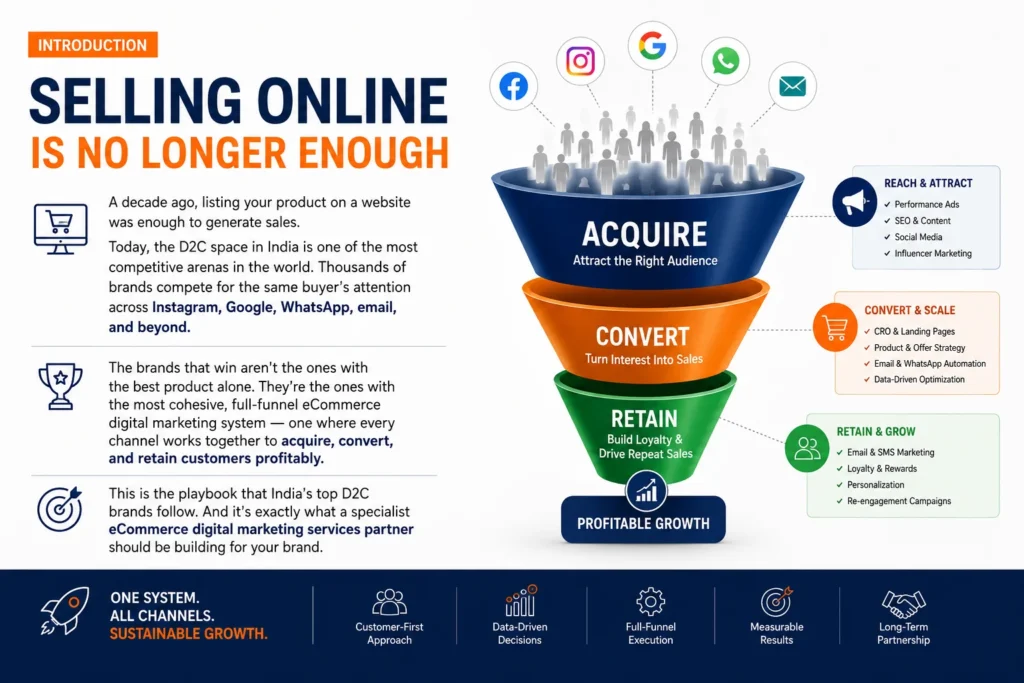
A decade ago, listing your product on a website was enough to generate sales. Today, the D2C space in India is one of the most competitive arenas in the world. Thousands of brands compete for the same buyer’s attention across Instagram, Google, WhatsApp, email, and beyond.
The brands that win aren’t the ones with the best product alone. They’re the ones with the most cohesive, full-funnel eCommerce digital marketing system — one where every channel works together to acquire, convert, and retain customers profitably.
This is the playbook that India’s top D2C brands follow. And it’s exactly what a specialist eCommerce digital marketing services partner should be building for your brand.
This is the fastest way to generate traffic and orders — but also the easiest place to burn budget without a system. Meta Ads (Facebook + Instagram) excel at discovery and cold audience acquisition. Google Ads capture high-intent buyers who are already searching for your product. Most scaling brands run both, but the sequencing and budget split depend on your stage of growth.
Organic traffic is your highest-margin acquisition channel. A well-executed SEO strategy — covering technical health, product and category page optimisation, and content marketing — builds a compounding traffic asset that keeps delivering even when ad spend is paused.
Email remains the highest-ROI channel in eCommerce, delivering an average return of ₹36 for every ₹1 spent. Welcome sequences, abandoned cart flows, post-purchase upsells, and win-back campaigns — each touchpoint is an opportunity to increase revenue without paying for another click.
In India, WhatsApp is where buyers live. Automated WhatsApp flows for cart abandonment, order updates, reorder reminders, and exclusive offers drive engagement rates that email can’t match. Brands using WhatsApp as a retention channel consistently outperform those that don’t.
Traffic without conversion is wasted spend. CRO covers everything that happens after the click — product page design, offer clarity, checkout speed, trust signals, and bundle structures. Improving your conversion rate from 1.5% to 2.5% is the equivalent of getting 67% more revenue from the same ad budget.
Early Stage (₹0–₹5L/month ad spend):
Start with Meta. It’s better for building awareness, testing creatives, and finding your winning audience cheaply. Google Shopping can run in parallel at a small budget to capture branded and category searches.
Scaling Stage (₹5L–₹25L/month):
Both channels run simultaneously. Meta drives new customer acquisition; Google retargets warm audiences and captures bottom-of-funnel searches. Performance Max campaigns begin here.
Established Stage (₹25L+/month):
Full-funnel operation. Meta handles prospecting with UGC and video creatives. Google runs Shopping, Search, and YouTube. Email and WhatsApp manage retention. SEO contributes 20–40% of total traffic organically.
No channel works without strong creative. For Meta, the creative IS the targeting — the right video or image finds the right audience. For Google, it’s your product feed quality and ad copy that determines click-through rate.
A professional eCommerce digital marketing services team doesn’t just run ads. It builds a creative testing system — weekly test maps across hooks, formats, and angles — retiring losers fast and scaling winners with budget.
UGC (User Generated Content) scripted and edited in-house consistently outperforms polished brand videos at the cold audience stage because it feels real, native, and trustworthy.
Here’s what a properly structured digital marketing system looks like for a D2C brand doing ₹50L–₹1Cr/month:
Each layer feeds the next. Awareness fills the top; retention maximises the bottom. Without all five working together, you’re leaving significant revenue on the table.
Not all agencies are built for eCommerce. Watch out for these warning signs:
A specialist eCommerce digital marketing services partner will align every campaign decision with your margins, not vanity metrics.
The D2C brands that scale to ₹10Cr and beyond don’t just run ads. They build systems — where paid, organic, email, WhatsApp, and CRO all work together as a single revenue engine.
That’s the difference between a brand that grows and a brand that survives.
Want to build that system for your brand? Explore Aim n Launch’s eCommerce Digital Marketing Services