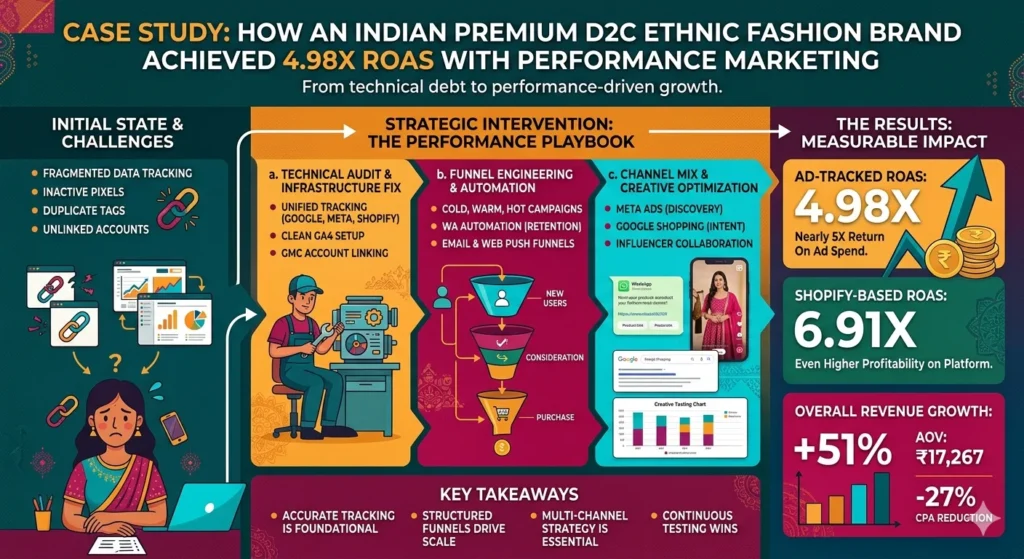
Fashion is one of the hardest categories to scale profitably online. It’s a high-consideration purchase, margins get eaten by discounting pressure, and most brands hit a ceiling where paid traffic converts fine at small spend but falls apart the moment you try to scale it. That was exactly where this home and fashion brand stood when we started working with them in August 2025.
Paid traffic was converting. It just wasn’t scaling. Organic revenue was sitting untapped. And there was no real system protecting average order value as discounting pressure crept up month over month. Over a single 31-day period, we took the brand to ₹42,33,340 in tracked revenue, anchored by a 4.98x ROAS on Meta and a 6.69x blended marketing efficiency ratio. Here’s the system behind that number.
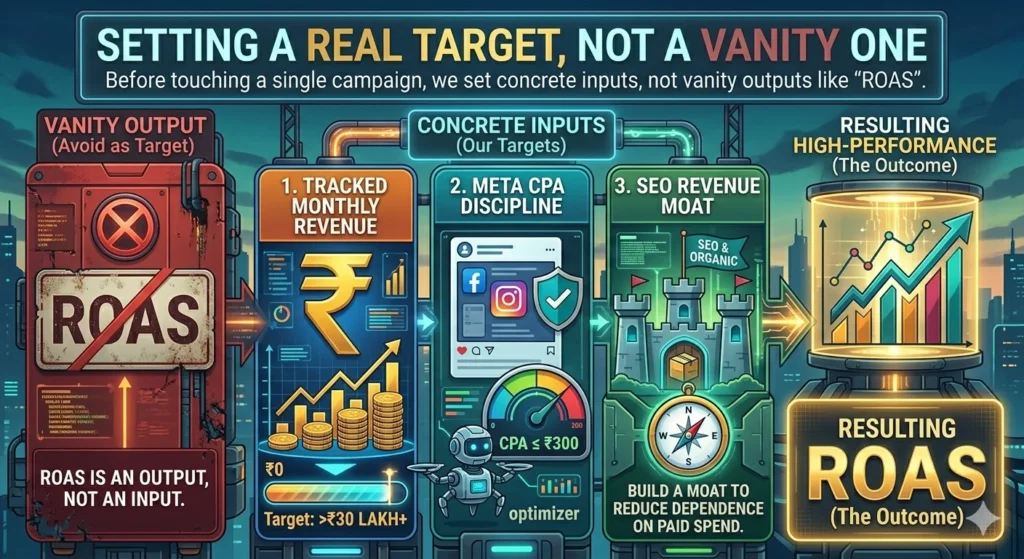
Before touching a single campaign, we set three concrete targets: break ₹30 lakh in monthly tracked revenue, keep Meta cost-per-acquisition at or below ₹300, and build an SEO revenue moat that would reduce the brand’s dependence on paid spend over time. Notice that none of these targets were “increase ROAS.” ROAS is an output. CPA discipline and channel diversification are the inputs that actually produce it.
On Meta, we moved away from product-only creative and leaned into static lifestyle and room-transformation visuals — content that showed the product in context rather than just on a white background. A “before/after” static format outperformed product-only angles by 18% on click-through rate, and once we saw that, we rolled it into the weekly creative rotation rather than treating it as a one-off win.
We also tested Advantage+ Catalog campaigns with broad targeting against the brand’s existing stacked interest segments. Broad targeting won, lifting ROAS by 12%. This runs counter to what a lot of advertisers assume — that narrower targeting performs better — but at this stage of Meta’s algorithm, broad targeting paired with strong creative consistently outperforms over-restricted audiences, because the algorithm gets more room to find genuine buyers instead of being boxed in by interest signals that may not even be accurate anymore.
Fatigue automation rules ran in the background, auto-pausing underperformers so the team’s attention stayed on what was working. The result: no campaign saw a ROAS dip greater than 8% week-on-week across the entire period, which is what real stability looks like at scale.
This is the piece most performance-only agencies skip entirely, and it’s the reason the brand’s growth had stalled. We built a category hub architecture with a proper internal linking framework, added PDP schema markup and SEO-optimized copy, and created topic clusters around “how to” search intent — things like arranging wall art or styling a small room — that intercept shoppers earlier in their decision process, before they’re even searching for the product by name.
Category hubs with internal linking lifted SEO sessions by 31%, and 60% of all SEO revenue ended up coming through hub-driven journeys rather than direct landing page visits. The topic cluster pages converted at 4%, which is a strong number for content sitting in the middle of the funnel. By the end of the period, SEO was contributing ₹10.78L in revenue at near-zero incremental media cost — a real moat, not a vanity metric.
High-consideration categories like fashion live or die on AOV defense. We introduced two-piece bundle sets specifically engineered to lift order value, and they delivered: a 9% AOV lift, with 28% of all Meta-driven revenue coming from bundled purchases. We also added size and fit guides, made the returns policy visible at the product page level, and rewrote checkout microcopy to clarify delivery timelines — small frictions that, removed together, cut cart abandonment by 6%.
A cart-level upsell module suggesting matching accessories added another ₹2.1L in incremental revenue with an 11% attach rate — pure margin-positive revenue that required no additional ad spend to generate.
| Metric | Value |
|---|---|
| Meta Spend | ₹6,33,114 |
| Purchases | 2,331 |
| Meta Revenue | ₹31,55,340 |
| ROAS | 4.98x |
| CPA | ₹272 |
| AOV | ₹1,354 |
| SEO Revenue | ₹10,78,000 |
| Total Tracked Revenue | ₹42,33,340 |
| Blended MER | 6.69x |
CPA held at ₹272 against a target ceiling of ₹300, and Meta remained the primary growth engine at 75% of total tracked revenue, with SEO contributing the remaining 25% at a fraction of the cost.
We don’t treat a strong month as a finished job, and we told this brand the same things we’re telling you now. A quarter of total revenue still depends on organic search, which means a backlink decay event or a Google algorithm update could hit hard — the next priority is building out an email and WhatsApp retention layer so the brand isn’t single-threaded on any one channel. The ₹1,354 AOV is solid but fragile, and the next lever is expanding bundle SKUs and introducing a premium tier. The creative pipeline behind the weekly rotation is thinner than we’d like, which means a structured UGC and influencer licensing program needs to come online before fatigue creeps back in. And at 4.1%, the add-to-cart-to-purchase rate is still low for fashion — there’s real room in testing one-click checkout, COD messaging, and EMI visibility directly at the cart.
A 4.98x ROAS doesn’t come from one good ad. It comes from CPA guardrails that were respected even while scaling, an SEO channel built in parallel so the brand isn’t entirely paid-dependent, AOV protected through bundling instead of blanket discounts, and a creative testing cadence that catches fatigue before it shows up in the numbers. Pull any one of those levers out and the ROAS number gets a lot harder to sustain past month one.
Want this level of clarity and control over your own numbers? Book a 20-minute audit and we’ll walk through where your account stands against each of these levers.