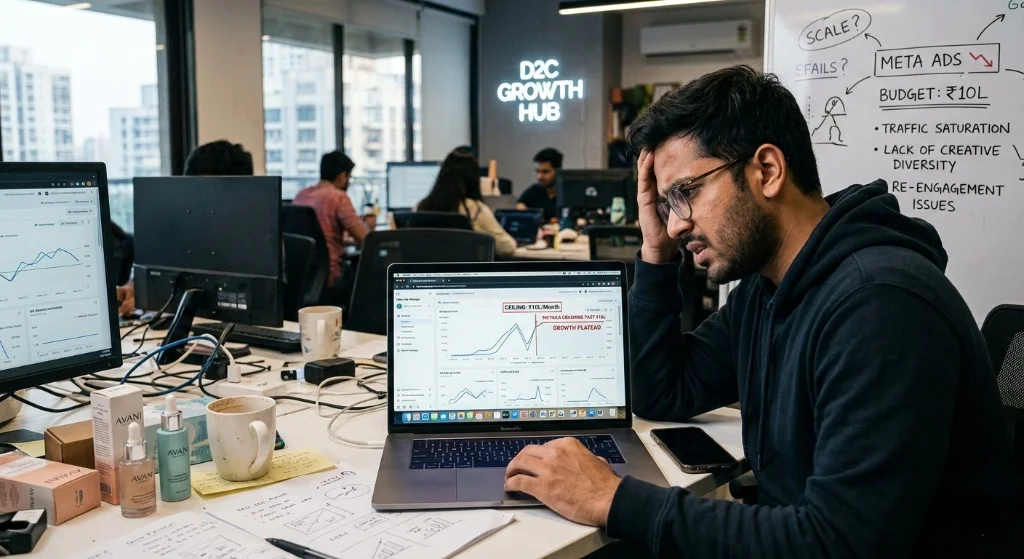
There’s a wall that almost every growing D2C brand hits on Meta.
You’re spending ₹2–3 lakh a month. The ROAS is decent, maybe 3x or 4x. You feel ready to push. So you increase the budget. And then, predictably, everything gets worse. CPO climbs. ROAS tanks. The creatives that were working suddenly stop performing. You pull back, things stabilise, and you try again next month. Same result.
This cycle is so common it has an unofficial name in performance marketing circles: the Meta spending ceiling. And breaking through it requires understanding something most agencies won’t tell you: the ceiling isn’t set by the algorithm, it’s set by the systems around your ads.
Here’s a complete breakdown of what’s actually going wrong, and how the brands that successfully scale past ₹10L, ₹20L, and ₹50L/month on Meta are built differently.
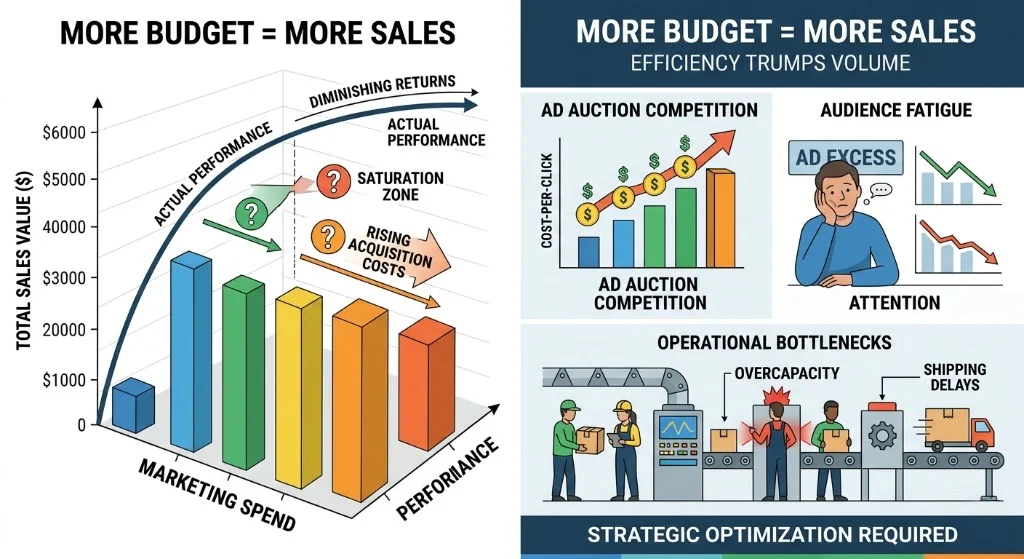
When you double your Meta budget, you’re not simply buying twice as many of the same customers. You’re exhausting your existing warm audience faster and forcing the algorithm to reach progressively colder prospects.
Colder audiences convert at lower rates. That’s not a Meta failure, it’s physics. The question is whether your broader system is built to handle the economics of reaching a colder audience at scale.
Most brands aren’t. And when they push budget into colder audiences without fixing the underlying infrastructure, CPO explodes.
The brands we see scaling successfully through our eCommerce performance marketing work have solved three problems that most don’t even know they have.
This is the number one scaling killer we see, and it’s the most fixable.
At ₹2L/month of spend, you might get away with 3–4 creatives cycling. At ₹8L+, you need fresh creative almost every week. Audience saturation happens faster at higher budgets, the same 10 lakh people see your creative much faster when you’re spending 4x more.
Without new creative going in, the algorithm has no fresh material to test. It keeps showing your existing ads to the same people, frequency climbs, CTR drops, CPO climbs, and the whole account looks like it’s “broken.”
What successful scalers do:
At Aim n Launch, we build and manage this creative engine in-house, scripting, casting, and editing UGC that feeds the Meta algorithm consistently. It’s why our eCommerce digital marketing service includes creative production, not just ad buying.
This is where the CRO problem we cover in our piece on Shopify stores with traffic but no sales (Blog 2 above) becomes a Meta scaling problem.
Warm traffic, people who’ve seen your brand before, who follow you, who were retargeted, converts at 3–5% even on an average page. Cold prospecting traffic, people who’ve never heard of you, converts at 0.8–1.5% even with a great page.
If your store converts at 1.2% overall, you’re probably converting cold traffic at 0.5–0.7%. At low budgets, that’s masked by your warm audience doing the heavy lifting. At higher budgets, the majority of your spend is hitting cold audiences, and your CPO becomes unviable.
The fix isn’t “get better at targeting.” The fix is a better page.
Specifically, a cold-traffic page needs to do significantly more work than a standard product page:
Without this infrastructure, no amount of Meta budget optimisation will fix your scaling ceiling.
This is the sneakiest problem, because it feels like you’re doing everything right.
Many brands scaling on Meta are optimising their campaigns for Purchase conversions, which sounds correct. But if your pixel data is thin (under 50 purchase events per week per ad set), the algorithm doesn’t have enough signal to find the right buyers. It’s essentially guessing.
The result: you get lots of add-to-carts that don’t convert, or you get purchases from people who return everything, or you get one-time buyers with zero LTV.
Fixes that work in 2026’s Meta environment:
The offer that works at ₹2L/month of spend often doesn’t work at ₹10L/month, not because the offer is bad, but because you’ve saturated the segment of the market most receptive to it.
As you reach broader, colder audiences on Meta, you need an entry offer that’s lower-friction. A ₹1,499 product with no trial, no guarantee, and no bundle is hard to sell to someone who’s never heard of your brand. A ₹799 starter kit with a money-back guarantee is a fundamentally different conversation.
The brands scaling past ₹10L+ on Meta typically have:
This offer architecture, tied to the D2C scaling framework we outline in Blog 1, is what allows brands to have a viable CPO at the spend levels required for real scale.
Across the brands we manage at Aim n Launch, the ones that successfully scale Meta spend past ₹10L/month share a consistent profile:
The ones that don’t scale past the ceiling are almost always spending the same budget on 2–3 creatives, have a store converting cold traffic at under 1%, and are optimising for a ROAS number that their finance team picked without reference to actual unit economics.
You can see this pattern across several of our client case studies.
If your Meta ads are stalling, here’s the diagnostic sequence we’d run:
Step 1: Pull your CPO by audience type, warm retargeting vs. cold prospecting. If cold CPO is more than 2x your warm CPO, your page isn’t built for cold traffic. Fix the page first (see CRO fixes for Shopify (Blog 2 above)).
Step 2: Count your active creatives. If you have fewer than 5 unique hooks currently in testing, you’re running out of creative fuel. Build a creative calendar.
Step 3: Check your pixel data. Are your ad sets getting 50+ weekly purchases each? If not, consolidate.
Step 4: Review your offer. Is your entry-point product one that a stranger would feel comfortable buying with no prior brand knowledge? If not, build a lower-friction entry offer.
Step 5: Calculate your LTV at 90 days. If you’re optimising CPO based only on first-order economics and ignoring repeat purchases, you’re likely capping your Meta budget unnecessarily.
There is no shortcut to scaling Meta past ₹10L/month. The brands that do it have built infrastructure: a creative engine, a converting store, a retention system, and an offer architecture that makes cold acquisition viable.
If any one of those is missing, the ceiling holds.
Our eCommerce performance marketing team works on all five levers simultaneously, because treating them as separate problems is exactly what keeps most brands stuck.
If you want to understand specifically what’s holding your Meta account back, book a free call and we’ll diagnose it together.