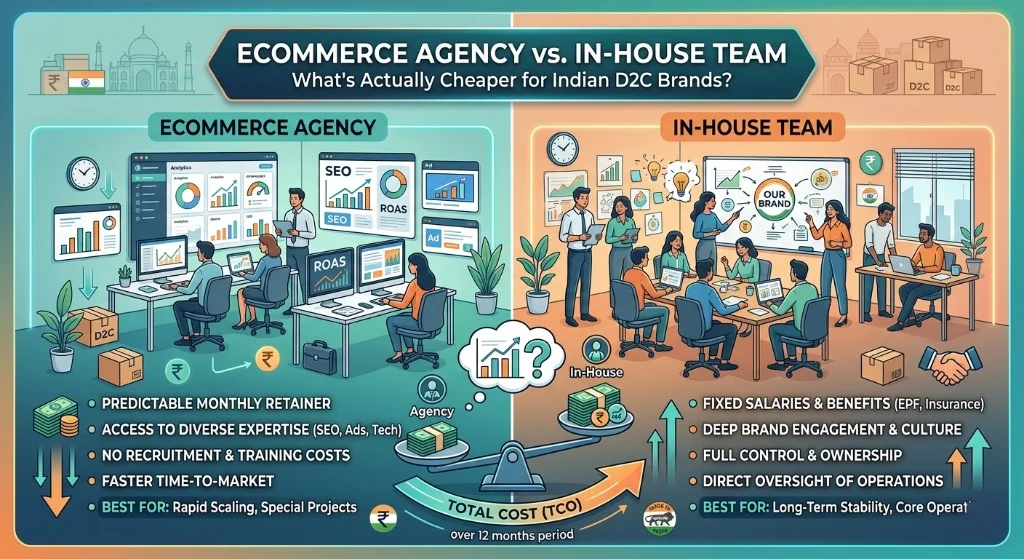
Every D2C founder eventually faces this question. And almost everyone calculates it wrong.
The conversation usually goes like this: the agency retainer feels expensive, so the founder hires someone in-house. Six months later, they’re paying more, moving slower, and wondering what happened. On the flip side, some founders outsource too early and lose strategic control of their brand at a critical growth stage.
The answer isn’t universal — but the math is clearer than most people think. Let’s break it down honestly.
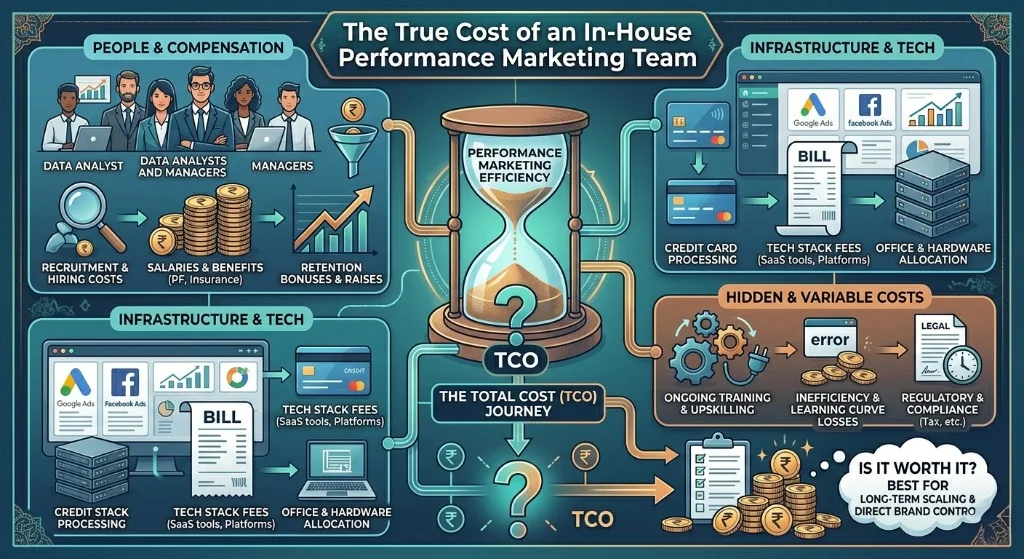
When founders say “we’ll hire in-house,” they’re usually picturing one good media buyer. What they actually need to run a competitive performance marketing operation looks more like this:
Conservative total: ₹2,00,000 – ₹3,80,000 per month in salaries alone — before you account for PF contributions, health insurance, recruitment costs, tool subscriptions (₹30,000–₹60,000/month for Klaviyo, SEMrush, creative platforms), and the hidden cost of onboarding time.
Then factor in attrition. The average tenure of a performance marketer in India’s startup ecosystem is 14–18 months. Every exit costs you 2–3 months of lost momentum, re-hiring costs, and an ad account that nobody fully owns.
A credible D2C-focused performance marketing agency in India typically charges between ₹50,000 and ₹2,50,000 per month, depending on ad spend managed, scope of services, and deliverables included.
At that retainer, a quality agency brings you the equivalent of an entire team — strategist, media buyer, creative team, analytics support — with battle-tested systems built across dozens of brands. You’re not paying for headcount. You’re paying for institutional knowledge and execution infrastructure.
The real comparison isn’t agency fee vs. one salary. It’s agency fee vs. the full cost of replicating what the agency does.
To be fair to the other side of the argument:
An in-house team makes more sense when your brand has passed ₹15–20Cr in annual revenue and your marketing complexity has grown to the point where deep brand immersion, real-time decision-making, and proprietary data advantages outweigh the cost of full-time specialists. It also makes sense when you’re in a highly regulated or technically niche category where external teams have a steep learning curve.
In-house also wins on brand voice consistency — when every creative piece needs to feel deeply native to a culture that’s hard to brief externally. Some premium lifestyle brands, for example, find that the subtle nuance of their storytelling is better guarded by someone sitting inside the brand every day.
For brands between ₹50L and ₹15Cr in annual revenue — which describes the vast majority of D2C companies in India today — an agency almost always wins on total cost, speed, and output quality.
Here’s why:
Speed of execution. An agency already has the tools, the creative workflows, and the testing frameworks in place. An in-house hire needs 60–90 days to become productive and another 90 to become truly effective.
Cross-brand intelligence. An agency running 20+ D2C brands has data signals you simply cannot replicate internally. They know which creative formats are fatiguing on Meta this quarter, which Google Shopping structures are winning in your category, and which offer mechanics are converting in your price band — because they’re seeing it in real time across their entire client portfolio.
No single point of failure. When your in-house media buyer resigns on a Thursday before a Friday campaign launch, you have a crisis. When your agency’s lead is unavailable, the team covers. Institutional knowledge doesn’t walk out the door.
The most sophisticated D2C operators in India are running a hybrid model: an agency handling performance marketing, creative production, and retention channels, while an in-house brand manager acts as the bridge — owning brand guidelines, approving creative direction, and managing the agency relationship.
This gives you the best of both worlds: external execution muscle with internal strategic ownership. It’s leaner than a full in-house team and more cohesive than a purely outsourced model.
The question isn’t “agency or in-house?” The question is: at your current revenue stage, which model gives you the highest output per rupee invested?
For most Indian D2C brands scaling from ₹50L to ₹10Cr, an agency that owns your performance marketing end-to-end — ads, creative, CRO, and retention — will almost always be the more efficient, lower-risk choice. The math just works out that way.