Most Indian D2C founders celebrate crossing Rs 10L/month in revenue. Then they spend the next 18 months stuck there.
The jump from Rs 10L to Rs 1Cr is not a linear scaling exercise. It is a complete rebuild of how you think about acquisition, retention, margins, operations, and team structure. The playbook that got you to Rs 10L will actively sabotage your attempt to reach Rs 1Cr. We see this every week at our agency.
According to industry data, roughly 60 to 65 percent of Indian D2C brands get stuck somewhere between Rs 1 crore and Rs 50 crore annually, with a huge concentration at the Rs 10-20L/month plateau. The brands that break through are not necessarily the ones with the best product. They are the ones who rebuild their scaling engine at the right moments.
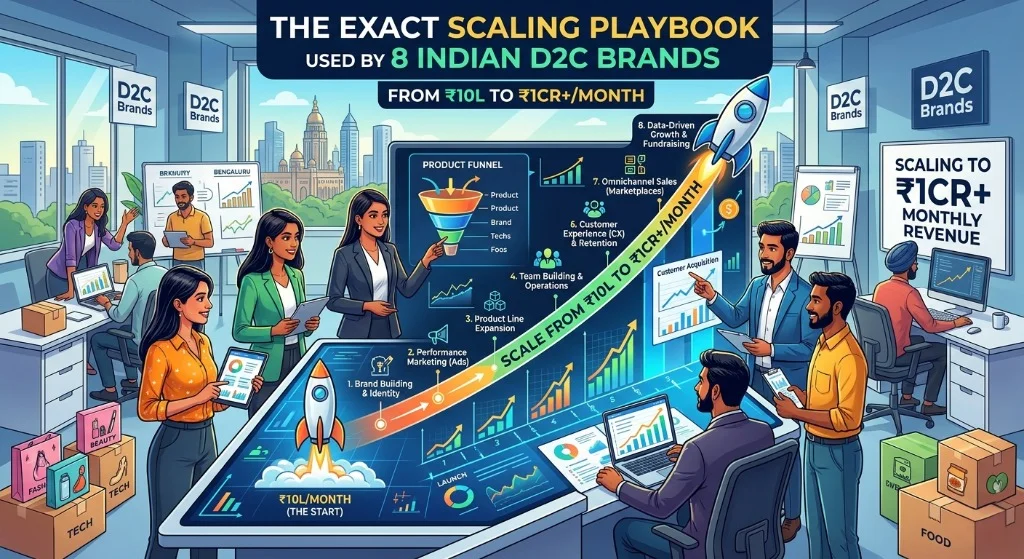
This post is the exact playbook we have used with eight Indian D2C brands who scaled from Rs 10L to Rs 1Cr/month across beauty, fashion, wellness, home, and nutrition categories. No theory. Just the specific decisions, numbers, and sequences that actually moved the needle.
Want us to handle this for you? Book a free growth audit and we will map your exact path from Rs 10L to Rs 1Cr.
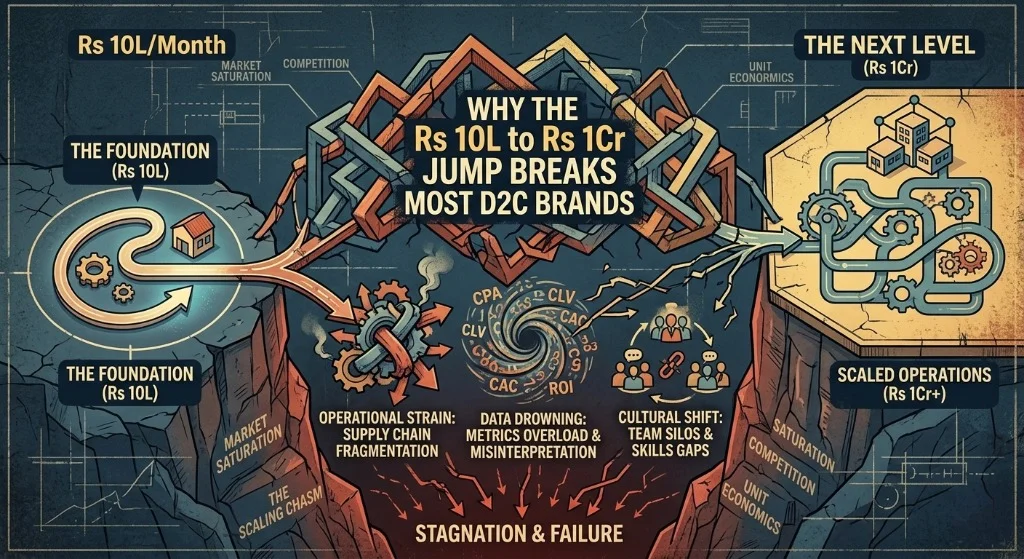
The reason this jump breaks brands is simple. At Rs 10L/month, you are running on founder energy, one or two winning creatives, a single strong ad set, and some repeat customers who liked the product. At Rs 1Cr/month, you need systems. Eight of them, to be exact.
Here is what actually happens when a brand at Rs 10L tries to 10X with the same playbook:
CAC inflates by 2 to 3X as soon as you push ad spend from Rs 3L to Rs 15L/month. The audiences that converted cheaply at low spend get exhausted within 4 to 6 weeks. Your best creative starts fatiguing at Rs 5L/month spend. Your COD percentage jumps from 55 to 72 percent because you start tapping tier 2 and 3 cities. Your RTO climbs from 18 to 28 percent. Your working capital cycle gets tighter. Founders start making decisions from cash flow panic rather than data.
We have seen brands scale revenue from Rs 10L to Rs 40L in three months and then go broke, because nobody recalculated CM2 at the new CAC and new RTO levels. Scaling revenue without scaling profitability is the fastest way to kill a D2C brand.
Your first action: Before you plan any growth, recalculate your break-even ROAS assuming CAC is 2X and RTO is 10 points higher. If the math still works, you can scale. If it does not, you need to fix unit economics first.
Every brand we have scaled past Rs 1Cr/month has the same eight systems running. Brands stuck at Rs 10L are usually missing five or six of them. Here is the complete framework.
First, a creative factory producing 20 to 40 new ad assets per month. Second, a retention engine driving 35 to 45 percent of monthly revenue from returning customers. Third, a unit economics dashboard updated weekly at SKU and channel level. Fourth, a COD and RTO control system with prepaid incentives and address-quality scoring. Fifth, a category-structured Meta ads account with proper testing and scaling budgets. Sixth, a CRO engine running two to four tests a month on PDP and checkout. Seventh, a product roadmap that compounds AOV, not just adds SKUs. Eighth, an operational layer covering inventory, fulfilment, and finance that can absorb 3X volume without breaking.
When we audit a Rs 10L/month brand, we literally score them against these eight systems. Almost always, creative factory and retention engine are the two weakest. These become the first two levers we pull.
Your first action: Score your brand from 1 to 10 on each of these eight systems. Any system below 5 is a scaling blocker. Fix the three lowest before increasing ad spend.
At Rs 10L/month, you can survive with 4 to 6 new ads per month because your spend is small enough that creative fatigue takes longer. At Rs 1Cr/month, you need at least 25 new ad assets per month, and 40 is better. This is not optional.
We built this exact creative system with a home fragrance brand in Mumbai. When we started, they were running three static ads and one UGC video at Rs 8L/month spend. Their ROAS had dropped from 3.1 to 1.8 over six weeks. Creative fatigue, pure and simple. We rebuilt their creative factory in 30 days.
The new system ran on four pillars. First, two UGC creators per week shooting four to six videos each, briefed on a rotating set of angles like problem-solution, unboxing, before-after, and testimonial. Second, a weekly static ad batch of eight images tested against the same audience. Third, one performance editor turning raw UGC into three to five cut-downs per week. Fourth, a weekly creative review call where we killed losers fast and scaled winners within 48 hours.
Within 60 days, they were pushing Rs 22L/month on Meta with a 2.6 ROAS and the creative bank was so deep that we never faced fatigue for more than a weekend. The cost of this creative system was Rs 1.8L/month total, roughly 8 percent of ad spend, which is exactly the benchmark we recommend for scaling D2C brands.
The Creative Velocity Math for Scaling: at Rs 10L revenue you need 6 to 10 active creatives. At Rs 30L revenue you need 15 to 20. At Rs 1Cr revenue you need 40 to 60 active creatives rotating across campaigns. Without this, no amount of budget increase will hold ROAS.
Your first action: Count how many new ad creatives you launched in the last 30 days. If it is under 15, your creative factory is the blocker. Start there before touching budgets.
Here is a number that shocks most founders. The eight brands we have scaled past Rs 1Cr/month all share one trait. Between 35 and 48 percent of their monthly revenue comes from repeat customers. At Rs 10L/month, most brands are at 10 to 15 percent repeat revenue. That gap is the scaling difference.
We worked with a protein bar brand that was stuck at Rs 12L/month for seven months. Their issue was not ads. Their Meta ROAS was a healthy 2.4. The issue was that every rupee of revenue required a new customer, which means CAC was the entire business. We rebuilt their retention engine using a simple seven-step sequence that took 45 days to implement.
The sequence looked like this. Day 0 was order confirmation with a product usage video. Day 3 was a delivery confirmation plus a usage tip. Day 7 was a how-to-use-it reminder with a review ask. Day 14 was a first repurchase nudge with a 10 percent loyalty discount. Day 30 was a replenishment reminder based on expected product finish date. Day 45 was a cross-sell to a complementary SKU. Day 60 was a subscription offer at 15 percent off.
This cost them Rs 22,000/month on a basic email and WhatsApp stack. Within 90 days, repeat revenue jumped from 14 percent to 38 percent of total. Total monthly revenue went from Rs 12L to Rs 34L without increasing ad spend by a single rupee. That is the power of a retention engine. You multiply your existing acquisition.
Here is the math every founder should obsess over. If your CAC is Rs 500 and AOV is Rs 800, your first-order economics are brutal. But if 40 percent of those customers come back within 90 days for another Rs 800 order, your effective 90-day revenue per customer is Rs 1,120. Your CAC to 90-day revenue ratio just dropped from 0.62 to 0.44. That difference is the entire reason some brands can scale and others cannot.
Your first action: Pull your last 90 days of orders and calculate repeat purchase rate. If it is under 25 percent, you cannot scale profitably. Build the retention sequence above in the next 14 days.
Most brands stuck at Rs 10L/month have a single blended CM2 number. Maybe they know it is 18 percent. They have no idea which SKU is carrying the business and which is silently bleeding cash.
One of our clients in the beauty category had 14 SKUs at Rs 15L/month. When we rebuilt their unit economics dashboard at SKU level, we found something brutal. Three SKUs were generating Rs 9L of revenue with a 31 percent CM2. Five SKUs were at Rs 4L of revenue with 12 percent CM2. Six SKUs were at Rs 2L of revenue with negative 4 percent CM2. The brand had been cross-subsidising dead SKUs for 11 months without realising.
We killed the six loss-makers, pushed ad budget into the top three winners, and bundled the middle five into kits that increased AOV by Rs 280. Within 90 days, revenue jumped from Rs 15L to Rs 38L and CM2 climbed from 18 percent blended to 27 percent blended. The brand eventually crossed Rs 1Cr/month in month 11.
The SKU-level CM2 calculation you need looks like this. Revenue per unit minus COGS minus fulfilment minus payment gateway minus returns cost minus RTO cost minus discounts minus marketing cost attributable to that SKU equals CM2 in rupees. Then divide by revenue for CM2 percent. Do this weekly. Every week. No exceptions.
The same logic applies at channel level. Your Meta, Google, Flipkart, Amazon, and Quick Commerce channels all have wildly different CAC, RTO, commission, and return profiles. Treating them as one is how brands die.
Your first action: Build a simple Google Sheet with CM2 calculated at SKU level for your top 10 SKUs. Update it every Monday. Kill any SKU with negative CM2 for two months running.
Here is a scaling trap nobody warns you about. When you go from Rs 10L to Rs 30L in monthly revenue, you start pulling customers from tier 2 and tier 3 cities at a much higher rate. COD share climbs from around 55 percent to 70 percent. RTO jumps from 18 percent to 28 percent or worse. And because RTO is the single biggest profit killer in Indian D2C, this alone can turn a profitable brand into a cash-burning one overnight.
One of our fashion clients hit exactly this wall. At Rs 11L/month, their COD was 58 percent and RTO was 19 percent. Three months later at Rs 24L/month, COD was 73 percent and RTO was 31 percent. Their CM2 dropped from 22 percent to 8 percent even though revenue had doubled. They were running faster to stay in place.
We built them a three-layer COD control system. First layer was prepaid incentives, a 5 percent discount on prepaid orders highlighted on PDP and checkout. This alone moved prepaid share from 27 to 41 percent in 45 days. Second layer was address quality scoring via a WhatsApp confirmation flow for any COD order above Rs 1,500, with a 6-hour confirmation window. Orders not confirmed got auto-cancelled. This dropped RTO by 6 points. Third layer was pincode-level RTO tracking, blocking COD in the top 50 worst-performing pincodes while still allowing prepaid orders from those zones.
Combined impact after 60 days: prepaid share at 49 percent, RTO at 21 percent, CM2 back up to 19 percent. The brand scaled to Rs 52L/month within the next four months without touching ad budget, purely on the back of recovered unit economics.
Your first action: Run a 30-day report of RTO by pincode. Block COD in the worst 30 pincodes. Add a 5 percent prepaid discount. These two moves alone typically add 4 to 6 points to CM2.
At Rs 10L/month, you can run three campaigns and a handful of ad sets and still perform. At Rs 1Cr/month, you need an account structure that can absorb budget without training-set conflicts, creative cannibalisation, and audience overlap.
The structure we use across every brand we have scaled looks like this. One Advantage Plus Shopping Campaign carrying 60 to 70 percent of the budget with the broadest creative pool. One manual broad prospecting campaign at 15 percent of budget, used for testing new angles before graduating them into ASC. One retargeting campaign at 10 percent of budget, split into 7-day and 30-day audiences. One brand search campaign on Google at 5 to 10 percent of total paid budget to intercept high-intent searches. One category testing campaign at 5 percent for rotating creative experiments.
When we rebuilt a nutrition brand’s account this way at Rs 14L/month, ROAS held steady at 2.3 all the way up to Rs 38L/month spend. Without this structure, the same brand would have seen ROAS collapse to below 1.8 before Rs 25L.
The key rules for scaling on Meta are simple. Never touch a winning ad set for at least 7 days. When you do scale, move in 20 to 25 percent increments, not doubles. Kill any creative that drops below 60 percent of campaign ROAS after 7 days and Rs 20,000 spend. Refresh creatives in ASC every 10 to 14 days. Run retargeting with dynamic product ads, not static creatives.
Your first action: Audit your current Meta account structure against the one above. Most Rs 10L/month brands have 8 to 15 small campaigns that fragment learnings. Consolidate into 5 clean structures this week.
Every Rs 1 of ad spend you push becomes Rs 1.20 to Rs 1.50 of revenue potential with a properly optimised site. Most brands at Rs 10L/month have a conversion rate of 0.9 to 1.3 percent. Brands we have scaled past Rs 1Cr/month are sitting at 2.2 to 3.4 percent. That is the multiplier effect of CRO.
We worked with a wellness brand where the entire Rs 10L to Rs 1Cr jump was driven by CRO, not scaling ad spend. At start, their site conversion rate was 1.1 percent and Meta ROAS was 1.9. Over four months, we ran 14 structured tests on product pages, checkout, and cart. Not every test won. Nine won, three were neutral, two lost. The cumulative impact was a site-wide conversion rate of 2.8 percent.
With the same ad spend of Rs 8L/month, revenue climbed from Rs 10L to Rs 26L. Then we were able to scale ad spend confidently because the math finally worked at higher CAC. Eighteen months after we started, they crossed Rs 1.1Cr/month.
The highest-leverage CRO tests we run at this stage in order of priority are these. PDP trust bar with delivery, return, and COD messaging. PDP quantity breaks for AOV uplift. Sticky add-to-cart bar on mobile. Checkout form field reduction, target under 8 fields. UPI as the top payment option with visible brand icons. Exit-intent popup with a first-order discount. Social proof bar showing recent purchases and review count. Free shipping threshold optimisation. Post-purchase upsell one-click offers. Abandoned cart sequence via WhatsApp and email.
Your first action: Install Microsoft Clarity on your site this week. Watch 30 session replays of users who did not convert. You will find three to five blocking issues in the first 20 minutes.
Here is a scaling secret most founders miss. You cannot scale from Rs 10L to Rs 1Cr by 10X-ing traffic. You need to 3X traffic, 1.5X conversion rate, and 2X AOV. The AOV piece is the most neglected because it is the hardest to see.
A client in the home care category was stuck at Rs 13L/month with an AOV of Rs 420. We rebuilt their product roadmap around one simple goal: take AOV to Rs 720 within 120 days. The roadmap had four moves.
Move one was introducing a 3-pack variant at a 20 percent discount, which became the default buy option on PDP. Move two was adding a complementary Rs 180 accessory as a checkout upsell, with a 34 percent attach rate once positioned correctly. Move three was creating two premium SKU extensions at higher price points, filling out the top of the range. Move four was a subscription option with 15 percent off that lifted AOV structurally for subscribed customers.
Within 90 days, AOV hit Rs 680. Within 150 days it crossed Rs 760. Revenue climbed from Rs 13L to Rs 29L with the same acquisition volume. Then we layered scaled Meta spend on top of the improved economics and pushed them through Rs 65L/month in the next five months.
The AOV scaling framework we use has three layers. First, offer architecture with single, 2-pack, and 3-pack options at progressively better per-unit pricing. Second, bundle kits that mix hero SKUs with secondary SKUs at 10 to 20 percent bundled discounts. Third, checkout upsells and order bumps carefully chosen to complement the hero purchase, not distract from it.
Your first action: Calculate your current AOV. Set a target 60 to 80 percent higher. Build a roadmap with three product moves to hit it in the next 90 days.
The cruel irony of scaling is that every operational weakness you ignored at Rs 10L/month becomes a catastrophe at Rs 30L/month. Inventory stockouts, fulfilment delays, customer support backlogs, finance reconciliation gaps, all of these become existential threats when volume triples.
A beauty brand we worked with scaled their Meta spend aggressively from Rs 6L to Rs 18L in six weeks. Revenue tripled. Then their hero SKU stocked out for 11 days because procurement had not been rebuilt for the new volume. They lost an estimated Rs 24L of revenue during that window and their Meta account learnings were disrupted for another three weeks after. Net impact, roughly Rs 40L of lost revenue, from one operational failure.
The operational checklist we run before any brand scales past Rs 20L/month includes these items. Inventory safety stock of at least 45 days for hero SKUs. Dual supplier relationships for top five SKUs. Fulfilment partner with at least two warehouses for multi-city dispatch. COD provider with pincode coverage across 28,000+ pincodes. Customer support team sized to handle 1 ticket per 20 orders. Weekly finance closure so cash flow visibility is always 7 days fresh. Return and refund SLAs under 72 hours to protect brand reviews. GST and compliance systems audited quarterly as volume climbs.
Your first action: Pick the three operational items from the list above you are weakest on. Fix them before you next increase ad budget.
The eight systems above are the what. The sequence is the how. Here is the 12-month rollout we use with D2C brands at Rs 10L/month.
Months 1 and 2 are diagnostic and foundation. We rebuild unit economics at SKU level, fix COD and RTO control, and launch a basic retention sequence. No aggressive scaling yet. Often revenue stays flat at Rs 10-12L but profitability climbs from 5 percent to 15 percent. This buys cash for later scaling.
Months 3 and 4 are the creative and CRO layer. We launch the creative factory, run 6 to 8 CRO tests, and build the category-structured ads account. Revenue typically climbs to Rs 18-25L/month as efficiency compounds.
Months 5 and 6 are the first scaling push. Ad spend goes from Rs 5L to Rs 12L/month in 20 percent weekly increments. Retention is now contributing 25 to 30 percent of revenue. Revenue usually crosses Rs 35L.
Months 7 and 8 are AOV and product roadmap. Introducing bundles, subscriptions, and premium SKUs. AOV climbs 40 to 60 percent. Revenue crosses Rs 55-65L/month.
Months 9 to 12 are the second scaling push and operational reinforcement. Ad spend climbs to Rs 25L+/month. Retention revenue is now 40 percent plus. Operational layer is stress-tested. Revenue crosses Rs 1Cr/month in month 11 or 12 for most brands that execute faithfully.
This sequence works because it scales profitability before scaling revenue, then scales revenue on top of a stable foundation. The brands that fail to make this jump almost always invert the sequence, scaling revenue first and hoping profitability follows. It never does.
Your first action: Map your current month position against this timeline. Be honest about what is built and what is not. Then commit to a 12-month sequence rather than a 3-month sprint.
Across the eight brands we have scaled past Rs 1Cr/month, three patterns separate them from the brands that got stuck.
First, they were ruthless about killing dead SKUs, dead creatives, and dead ad sets. Sentiment does not scale. Data does. The brands that hesitated to kill things never made it.
Second, they invested in retention before the ROI was obvious. Every founder we spoke to said the retention engine felt like a distraction at Rs 15L/month. Every single one said it was the single biggest lever at Rs 50L/month and beyond.
Third, they treated profitability and growth as one number, not two. CM2 was a north star alongside revenue, not a separate metric. Any growth that came at the cost of CM2 was reversed within two weeks. This discipline is rare and it is the biggest predictor of which brand will scale.
Your first action: Pick one of these three disciplines you are weakest on. Fix it before anything else.
For most brands executing a disciplined playbook, the realistic window is 10 to 14 months. Brands that try to compress it to 4 to 6 months almost always blow up on CAC inflation, operational failures, or unit economics collapse. The brands that take 18+ months usually are not rebuilding the right systems and are just pushing harder on a broken engine.
Assuming a healthy ROAS of 2.2 to 2.8 and a retention engine contributing 35 to 45 percent of revenue, you should expect to spend between Rs 22L and Rs 32L/month on Meta ads to support Rs 1Cr/month revenue. Brands that rely entirely on paid acquisition need to spend closer to Rs 40L/month, which is why retention is non-negotiable.
Based on hundreds of audits we have done, the single biggest reason is weak unit economics at SKU and channel level. Founders scale blended numbers without knowing which SKUs are profitable and which are silently bleeding cash. The second biggest reason is weak retention, forcing every rupee of revenue to come from new acquisition at inflated CAC.
At Rs 10L/month, an agency is almost always more cost-effective because you need senior-level thinking without paying Rs 15-20L/month for an in-house team. At Rs 3Cr/month and above, in-house starts making sense for media buying, though many brands keep creative and CRO with agencies even at Rs 10Cr/month. The real question is not agency versus in-house, it is capability versus cost at your current stage.
At Rs 10L revenue you need 6 to 10 new creatives per month. At Rs 50L revenue you need 20 to 30. At Rs 1Cr+ revenue you need 40 to 60 new creatives per month across static and video formats. Without this velocity, creative fatigue will cap your scaling regardless of budget.
The 10L to 1Cr jump is not about working harder. It is about rebuilding eight specific systems in the right sequence. We have run this playbook with eight Indian D2C brands across beauty, fashion, wellness, home, and nutrition categories. It works when it is executed faithfully.
If you are stuck at Rs 10L/month and want a clear, honest map of exactly what needs to change in your business to reach Rs 1Cr, we can help.
Book a free 30-minute growth strategy call and we will audit your eight scaling systems, identify your biggest blockers, and give you a 90-day action plan regardless of whether we work together. No pitch, just a map.