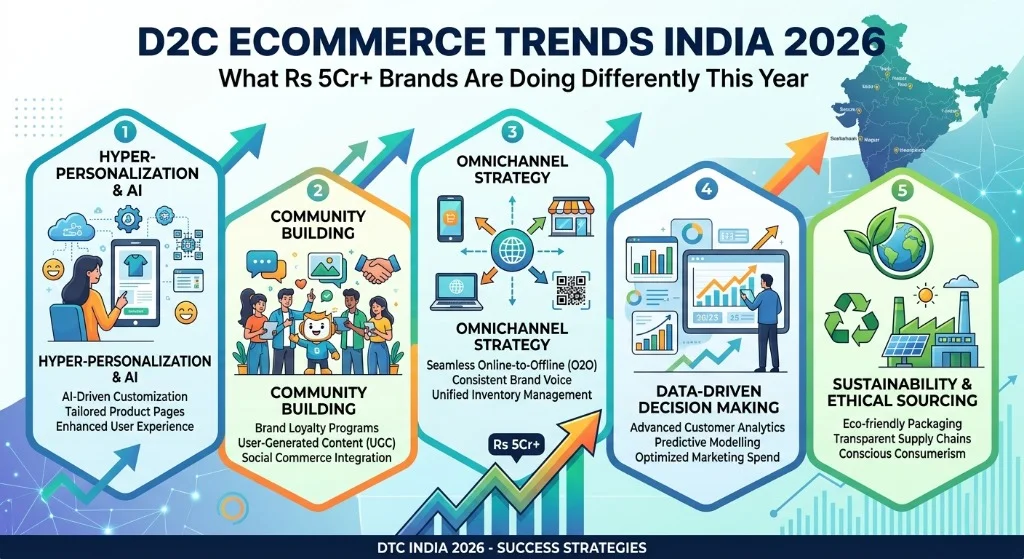
India’s D2C ecommerce market has crossed USD 108 billion in 2026, growing at a 24.3% CAGR. Over 10,000 active D2C brands are now selling through their own channels in India. But here is the uncomfortable truth: most of them are stuck below Rs 1Cr in monthly revenue, burning cash on acquisition, and hoping the next Meta ad campaign will fix everything.
The brands that have crossed Rs 5Cr+ in annual revenue? They are playing a completely different game. They are not just running ads better. They are rebuilding their entire business model around trends that most founders are still ignoring.
We have spent the last 12 months managing performance marketing for Indian D2C brands across categories, from skincare to fashion to food. This post breaks down the 9 trends that are actually moving the needle for high-growth brands in 2026, backed by real data and specific examples you can act on today.
Want us to audit your brand against these trends? Book a free strategy call with Aim n Launch.
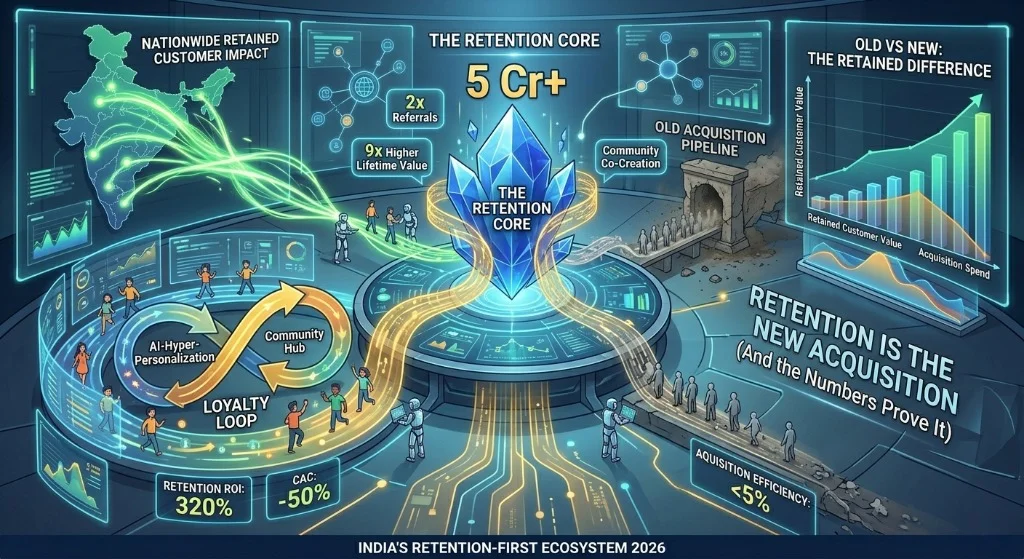
The single biggest shift among Rs 5Cr+ D2C brands in 2026 is this: they have stopped treating customer acquisition as their primary growth lever.
Here is why. The most profitable D2C brands in India now maintain repeat purchase rates above 35%. Unprofitable ones? Below 15%. That gap is not a coincidence. A 5% improvement in retention rate reduces your effective CAC by 15% to 25% because you need fewer new customers to hit the same revenue target.
What does this look like in practice?
Brands like Minimalist and Pilgrim are building post-purchase flows that kick in within 30 minutes of order confirmation. These include educational content about the product, usage tips via WhatsApp, and a replenishment reminder timed to the product’s typical usage cycle. Minimalist, for example, sends a “routine builder” WhatsApp message 7 days after delivery, prompting customers to add complementary products to their next order.
The retention-first brands are also investing in loyalty programs that go beyond basic points. Snitch, the menswear brand, runs a tiered loyalty program where higher tiers unlock early access to new drops, something that costs the brand almost nothing but drives significant repeat purchase behavior.
Action step: Calculate your current repeat purchase rate. If it is below 25%, you are leaving money on the table. Start with a simple 3-message WhatsApp post-purchase sequence: delivery confirmation with usage tips, a check-in at day 7, and a replenishment or cross-sell offer at day 21.
This is one of the most underrated shifts in Indian ecommerce right now. Quick commerce platforms like Blinkit, Zepto, and Swiggy Instamart have expanded far beyond groceries, and D2C brands are cashing in.
The numbers tell the story. India’s quick commerce market is generating roughly Rs 50,000 crore in annual GMV in 2026. Blinkit alone processes 6 lakh orders daily. Non-grocery categories are now growing 1.6x faster than groceries on these platforms, and over 30% of products listed on some quick commerce platforms are from D2C brands.
Here is what matters for your brand: sales through quick commerce platforms are growing at 45% year-on-year for D2C brands, and for some brands, Q-commerce now accounts for up to 87% of total sales.
Brands like boAt have been early movers here. Their charging cables and earbuds are now available for 10-minute delivery across metros. For personal care brands, this is even more relevant. A customer running out of face wash at 9 PM will order from Blinkit before they will visit your Shopify store.
Blinkit is expanding to 3,000 dark stores by March 2027 (up from about 1,800 currently). Swiggy Instamart has crossed 1,000 dark stores. This means the reach is only going to increase.
Action step: If your product has a use-it-up cycle (personal care, food, supplements, household) or an impulse purchase component (accessories, small electronics), list on at least one Q-commerce platform this quarter. Start with Blinkit, which currently holds over 50% market share.
Email open rates in India hover around 15% to 25%. WhatsApp? 85% to 95%, with most messages read within the first 5 minutes. That alone should tell you where to invest.
But open rates are just the beginning. WhatsApp cart recovery messages, sent within 15 to 30 minutes of abandonment, are recovering 15% to 25% of abandoned carts for Indian D2C brands. Compare that to email cart recovery rates of 3% to 5%.
The most sophisticated D2C brands are building entire commerce flows on WhatsApp. This includes product discovery (sending curated collections based on past purchases), order tracking, post-purchase education, review collection, and reorder prompts. Customers acquired through your own site and nurtured via WhatsApp have 2x to 3x higher lifetime value than marketplace customers.
Mamaearth has built a particularly effective WhatsApp strategy. They use the channel for everything from ingredient education to seasonal product bundles, turning what most brands treat as a notification channel into a genuine sales and relationship engine.
Action step: Set up three WhatsApp automation flows this month: abandoned cart recovery (trigger within 15 minutes), post-purchase review request (day 5 after delivery), and replenishment reminder (based on your product’s usage cycle). Tools like CampaignHQ, Interakt, and Wati make this straightforward for Indian D2C brands.
Want a done-for-you WhatsApp retention setup? Talk to our team at Aim n Launch.
Here is a stat that should make you uncomfortable if you are still showing the same homepage to every visitor: ecommerce brands using AI-driven personalization report 20% to 30% higher conversion rates and up to 25% higher Average Order Value. Companies using AI personalization earn 40% more revenue than those without it.
In India specifically, 49% of online shoppers say they are more likely to buy from a brand that offers tailored recommendations. That is not a nice-to-have. That is half your potential customers telling you they want a personalized experience.
What does this look like at the Rs 5Cr+ level?
Lenskart’s entire business model is built around personalization. Their virtual try-on feature, powered by AI, lets customers see how frames look on their face before buying. This is not just a gimmick. It directly reduces return rates and increases conversion. Lenskart crossed Rs 6,652 crore in revenue in FY25 and turned profitable with Rs 297 crore in net profit. Their AI investment is a core reason.
Bombay Shirt Company uses AI to build personalized “Fit Profiles” for every customer, making reordering effortless and reducing churn significantly.
For most D2C brands, you do not need Lenskart-level investment. Start with AI-powered product recommendations on your product pages and cart page. Tools like Glood.AI (built for Indian Shopify stores) can increase AOV by 10% to 15% with smart cross-sell and upsell recommendations.
AI-powered WhatsApp chatbots are another high-impact play. They handle 90% of customer queries instantly, reducing your support costs while improving response times. Brands using conversational AI see 15% to 25% higher conversion rates according to Accenture.
Action step: Implement AI-powered product recommendations on your Shopify store this month. Start with “frequently bought together” on product pages and “you might also like” on the cart page. Track AOV changes over 30 days.
Every major Indian D2C brand that has scaled past Rs 50Cr in revenue has one thing in common: they went omnichannel. Not because online was not working. Because online alone has a ceiling.
The data is clear. D2C brands’ share of retail leasing in India jumped from 8% in H1 2024 to 18% in H1 2025. That is a massive acceleration in offline expansion.
Look at the playbooks:
Lenskart operates 2,700+ stores globally and just filed for an IPO targeting a $10 billion valuation. Their offline stores are not cost centers. They are customer acquisition engines where people try on frames and then reorder online.
Mamaearth has invested heavily in general trade and modern trade distribution alongside digital. Their public filings explicitly describe offline expansion as a core growth driver.
Sugar Cosmetics expanded aggressively into offline retail, growing revenue 89% year-on-year to Rs 420 crore. Their physical retail footprint now spans thousands of counters in modern trade outlets.
The pattern is consistent: online for acquisition and retention, offline for trust-building and scale. In India, where many consumers still want to touch and feel products before committing to a brand, this hybrid approach is not optional at scale.
Action step: If you are above Rs 2Cr in monthly online revenue, start testing offline with pop-up stores or modern trade placements in your top 3 cities by customer volume. Use your online data to pick the exact locations.
If your D2C brand is still primarily focused on metro customers, you are competing in the most expensive, most saturated market in India.
Here are the numbers that should redirect your attention: over 60% of new D2C customers in 2026 are coming from Tier 2 and Tier 3 cities. The ecommerce market in these cities is expanding at 23% annually and is projected to reach Rs 8.3 lakh crore by 2026. Internet penetration in Tier 2 and Tier 3 cities is growing at 30% annually, nearly double that of metros.
D2C beauty and personal care brands have seen a 70% increase in revenue from Tier 3 cities like Guwahati and Rajkot. UPI adoption has hit 67% of consumers in non-metro markets, solving the payment friction that used to hold back online purchases in these areas.
The smart brands are not just expanding delivery to these cities. They are creating products and pricing specifically for these markets. Snitch, for example, prices its menswear between Rs 500 and Rs 1,500, a sweet spot that works well in Tier 2 cities where aspiration is high but wallet size is more measured than in metros.
Regional language content is another unlock. Brands that localize their product descriptions, WhatsApp messages, and ad creative in Hindi, Tamil, Bengali, and other regional languages see 25% to 40% higher engagement rates in non-metro markets.
Action step: Pull your Shopify analytics and identify your top 10 Tier 2 and Tier 3 cities by order volume. Create a dedicated Meta ad campaign targeting these cities with localized creative and region-specific offers. Test Hindi or regional language ad copy against English.
In 2026, the most important shift in D2C performance marketing is this: Meta and Google’s algorithms have gotten so good at finding the right audience that your targeting strategy matters less than your creative strategy.
Advantage+ Shopping Campaigns on Meta have made manual audience targeting nearly obsolete for most ecommerce brands. The algorithm finds buyers better than you can. What it cannot do is create compelling creative.
The Rs 5Cr+ brands have figured this out. They are not hiring more media buyers. They are building creative systems. That means producing 40 to 60 new ad creatives per month, testing different hooks, formats, and angles systematically. They are using frameworks: 3 hooks per concept, 2 formats per hook (static and video), tested across 3 audience signals.
Brands like boAt and Sugar Cosmetics run what is essentially a creative factory. New product launch? They produce 20+ creative variants in the first week, test them rapidly, and scale the top 3 performers.
The practical framework high-growth brands follow is what we call the “3-2-3 Creative System”: identify 3 customer pain points, create 2 creative formats for each (one static, one UGC video), and test each across 3 different hooks. This gives you 18 unique creative assets per cycle. Run each for 72 hours with a Rs 500 daily budget, then scale winners.
Need help building a creative system for your brand? Aim n Launch specializes in high-velocity creative production for D2C brands.
The old subscription model (sign up, get a box every month, maybe cancel after 3 months) is dying. What is replacing it is what industry observers call Subscription 3.0: AI-powered, flexible, and predictive.
The most innovative D2C brands are using purchase history data to predict when a customer will run out of a product and sending a replenishment prompt 3 to 5 days before. This is not a rigid subscription. It is a smart reorder system that adapts to actual usage patterns.
Brands in skincare, supplements, and food are leading this shift. For example, a protein supplement brand can track that a customer orders a 1kg pack every 28 days and trigger a WhatsApp message on day 25: “Your whey protein is probably running low. Reorder now and get 10% off.”
This approach works because it feels helpful, not pushy. It respects the customer’s actual consumption pattern rather than forcing an arbitrary schedule.
The subscription model also helps with forecasting and inventory management. Brands with 20%+ of revenue from predictive reorders report 30% better demand forecasting accuracy, which reduces stockouts and excess inventory.
Action step: Identify your top 5 products with repeat purchase patterns. Analyze the average time between purchases for each. Set up automated WhatsApp or email reorder prompts timed to 80% of the average repurchase cycle. Offer a small discount (5% to 10%) for reorders placed through the prompt.
Perhaps the biggest trend of 2026 is not a tactic. It is a mindset shift. The era of growth at all costs is over for Indian D2C brands. Investors, founders, and the market are all demanding profitability.
The data reflects this. Among the 42 fastest-growing D2C brands tracked by Inc42’s FAST42 ranking, consolidated revenue hit Rs 2,154 crore. But the brands getting the most attention are not the fastest-growing. They are the ones that are profitable while growing.
Lenskart’s Rs 297 crore net profit on Rs 6,652 crore revenue is the gold standard. They proved that scale and profitability are not mutually exclusive for Indian D2C brands.
What does this mean practically? Brands are obsessing over unit economics. CM2 (Contribution Margin 2, which accounts for marketing costs) has become the metric that matters. If your CM2 is negative, you are paying customers to buy from you. No amount of revenue growth fixes that.
The specific benchmarks Rs 5Cr+ profitable brands are hitting: CM2 above 15%, CAC payback period under 90 days, repeat purchase rate above 30%, and blended ROAS above 3x.
Brands are also getting ruthless about SKU rationalization. Instead of launching 50 products and hoping 5 work, they are launching 5 products with deep market validation and scaling the 2 that hit product-market fit. Fewer SKUs means less inventory risk, better marketing focus, and higher contribution margins.
Action step: Calculate your CM2 for each product and each acquisition channel. Kill any product or channel where CM2 is negative for more than 2 consecutive months. Focus your budget on the top 3 products by CM2, not by revenue.
Here is a simple framework to assess where your brand stands against these 9 trends. Score yourself 1 to 5 on each:
Score 35+: You are ahead of 90% of Indian D2C brands. Focus on optimization. Score 20 to 34: You have a solid foundation but are missing key growth levers. Prioritize your lowest-scoring areas. Score below 20: You need a strategic overhaul. Start with retention, unit economics, and creative systems.
Want a personalized D2C trend readiness audit for your brand? Book a free 15-minute strategy call with Aim n Launch. We will walk you through exactly where to focus for maximum growth in 2026.
The 9 biggest trends are retention-first growth strategies, quick commerce expansion beyond groceries, WhatsApp as a primary commerce channel, AI-powered personalization, omnichannel expansion to offline retail, Tier 2 and Tier 3 city penetration, creative systems over audience hacking, smart subscription models, and a shift toward profitability over growth at all costs. The overarching theme is that discipline and efficiency are beating brute-force spending.
India’s D2C ecommerce market is valued at approximately USD 108.76 billion in 2026, growing at a 24.3% CAGR. It is projected to reach USD 322.1 billion by 2031. Over 10,000 active D2C brands are currently selling through their own channels in India. The ecommerce market in Tier 2 and Tier 3 cities alone is projected to reach Rs 8.3 lakh crore by 2026.
According to Inc42’s FAST42 ranking, the 42 fastest-growing D2C brands in India recorded a consolidated revenue of Rs 2,154 crore. Brands like Lenskart (Rs 6,652 crore revenue, Rs 297 crore profit), Sugar Cosmetics (89% YoY revenue growth), Snitch, Minimalist, and Pilgrim are among the standout performers. The common thread is that profitable brands with strong unit economics are outperforming those chasing topline growth.
Yes, quick commerce has become a critical channel. India’s Q-commerce market generates roughly Rs 50,000 crore in annual GMV in 2026. Blinkit processes 6 lakh orders daily and holds over 50% market share. D2C brand sales on Q-commerce platforms are growing 45% year-on-year. Non-grocery categories like personal care, electronics accessories, and fashion are growing 1.6x faster than groceries on these platforms.
Profitable D2C brands in India are targeting CM2 (Contribution Margin 2) above 15%, CAC payback under 90 days, repeat purchase rates above 30%, and blended ROAS above 3x. Brands using AI personalization see 20% to 30% higher conversion rates, while WhatsApp marketing delivers 85% to 95% open rates compared to 15% to 25% for email.
There is no neutral ground. Every visitor who lands on your product page either converts or leaves, and the 12 elements above determine which outcome is more likely.
The good news? You do not need to fix everything at once. Start with the three highest-impact changes: improve your hero images, add trust signals designed for Indian buyers, and fix your mobile page speed. These three alone can move your conversion rate by 0.5-1%, which at scale, means lakhs in additional monthly revenue.
Ready to find out exactly where your product pages are leaking conversions? Get a free product page audit from Aim n Launch. We will score your pages on all 12 elements and give you a prioritized fix list. No fluff, just data. Book your free 15-minute audit call now.