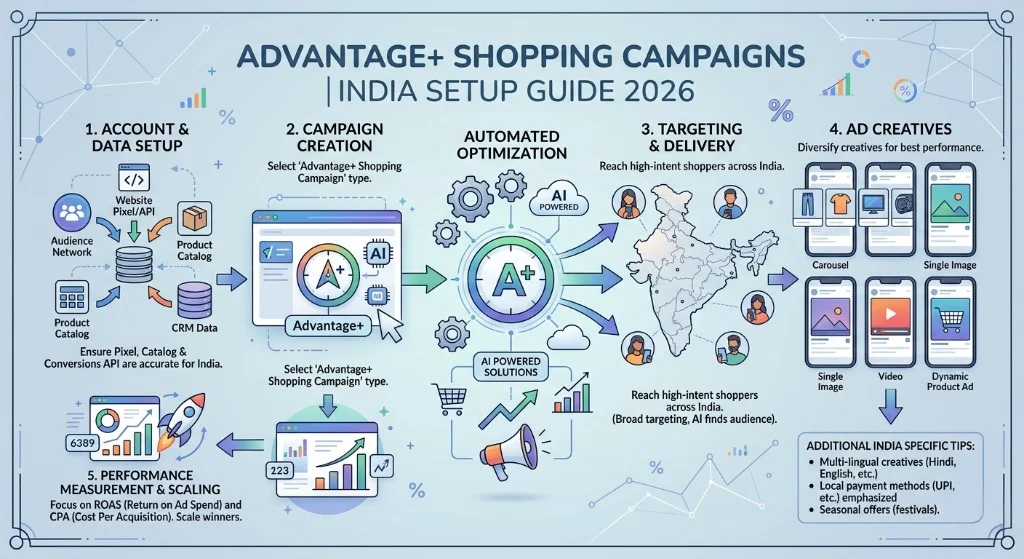
If you are running Meta ads for an Indian D2C brand in 2026 and you are still relying entirely on manual campaign structures, you are leaving money on the table. That is not an opinion. Meta’s own data shows that Advantage+ Shopping Campaigns (ASC) deliver 22% higher ROAS and 17% lower cost per acquisition compared to manually managed campaigns. Across 50+ Indian ecommerce accounts we have managed at Aim n Launch, ASC has become the single most important campaign type for scaling profitably.
But here is the catch. Most brands set up ASC wrong. They throw in a few creatives, set a budget, hit publish, and wonder why results are mediocre. Advantage+ is powerful, but only when you understand how the algorithm thinks, what inputs it needs, and how to structure everything for the Indian market specifically.
This guide walks you through the exact setup process, budget allocation, creative strategy, and optimization playbook we use for brands spending Rs 5L to Rs 30L per month on Meta ads. No theory. Just the system that works.
Want us to set this up for you? Book a free Meta ads audit and we will review your current campaign structure in 15 minutes.
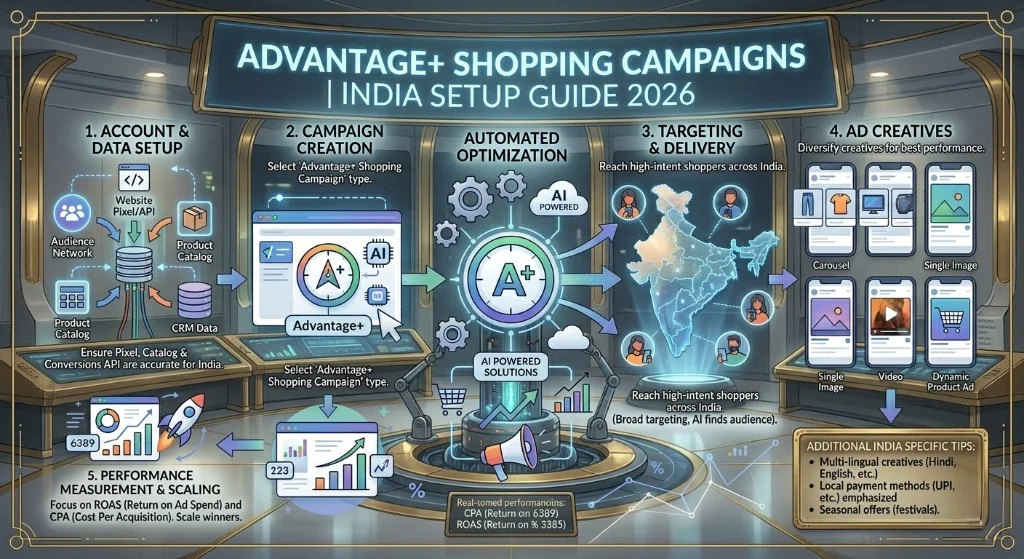
Advantage+ Shopping Campaigns, now officially called Advantage+ Sales Campaigns in Meta’s updated naming convention, are Meta’s AI-driven campaign type designed specifically for ecommerce. Unlike manual campaigns where you control every lever (audiences, placements, bidding), ASC hands most of those decisions to Meta’s machine learning algorithm.
Here is what ASC automates for you: audience targeting across prospecting and retargeting, placement optimization across Facebook, Instagram, Messenger, and the Audience Network, creative testing and rotation, and bid adjustments in real time.
The algorithm processes signals from your pixel data, your product catalog, user behavior patterns, and creative performance to find the highest-intent buyers at the lowest cost. Think of it as handing Meta a budget and a set of creatives, and letting the machine figure out who to show them to, where, and when.
Why does this matter for Indian ecommerce specifically? India’s D2C market now has 800+ brands competing for the same audiences on Meta. CPMs have risen steadily since 2024. Manual campaigns that worked two years ago are now too expensive to scale. ASC gives the algorithm freedom to find pockets of efficiency that no human media buyer can manually identify across millions of users.
As of Q1 2026, ASC now accounts for 62% of all ecommerce conversion spend on Meta globally, up from 34% in 2024. The shift is happening fast, and Indian brands that delay the migration are competing with one hand tied behind their backs.
Before you create a single campaign, you need to get your foundations right. Skipping this step is the number one reason ASC underperforms for Indian brands.
Your Meta pixel must be firing correctly on all key events: ViewContent, AddToCart, InitiateCheckout, and Purchase. But in 2026, pixel-only tracking is not enough. You need the Conversion API (CAPI) running server-side to capture events that browser-side tracking misses due to iOS privacy restrictions, ad blockers, and network issues.
For Shopify stores, the native Meta sales channel handles CAPI automatically. For custom-built stores on WooCommerce or headless setups, you will need server-side integration through a partner like Stape or a custom implementation.
Check your Events Manager. If your Event Match Quality (EMQ) score is below 6 out of 10 for Purchase events, fix this before launching ASC. Low EMQ means the algorithm is working with incomplete data and will make poor optimization decisions.
ASC pulls products from your Meta catalog for dynamic ads. Your catalog needs to be clean, updated, and complete. Every product should have high-quality images (minimum 1080×1080), accurate pricing in INR, correct availability status, and detailed product titles that include the category, brand, and key attributes.
Brands that maintain a well-optimized catalog see 15-25% better performance in ASC compared to those running with incomplete or outdated product feeds.
Even though ASC automates targeting, you still need to define two critical audience segments in your Advertising Settings: Existing Customers (people who have already purchased) and Engaged Audience (people who have interacted with your brand but have not purchased).
Upload your customer list from Shopify, set up a Purchase custom audience from your pixel, and create engagement audiences from your Instagram and Facebook page interactions. These definitions help the algorithm distinguish between prospecting and retargeting, which directly affects how your budget gets allocated.
Here is the exact process we follow at Aim n Launch when setting up ASC for a new brand.
Open Ads Manager, click Create, and select “Sales” as your campaign objective. On the next screen, select “Advantage+ Shopping Campaign.” Click Continue.
Name your campaign clearly. We use the format: “ASC – [Brand] – [Month] – [Objective].” For example: “ASC – Snitch – Apr 2026 – Purchase”.
This is where most Indian brands go wrong. They start with Rs 500 per day and expect results. The algorithm needs enough daily budget to generate 50 optimization events per week to exit the learning phase. If your average cost per purchase is Rs 800, you need at least Rs 5,600 per day (Rs 800 x 7 purchases per day) to give the algorithm room to learn.
Here is our recommended budget framework for Indian brands:
Starting brands (testing ASC for the first time): Rs 3,000 to Rs 5,000 per day minimum. This translates to roughly Rs 90,000 to Rs 1,50,000 per month just for ASC.
Scaling brands (proven product-market fit, good unit economics): Rs 10,000 to Rs 30,000 per day. This is where ASC really shines because the algorithm has enough data and budget to find efficient pockets at scale.
Enterprise brands (Rs 20L+ monthly ad spend): Rs 50,000+ per day with multiple ASC campaigns segmented by product category or collection.
Here is an important update for 2026. Meta has removed the “Existing Customer Budget Cap” feature that previously allowed you to limit how much of your ASC budget went to existing customers. This means the algorithm now decides the split between prospecting and retargeting on its own.
To maintain control over new customer acquisition, we recommend running a parallel structure: one ASC campaign for broad prospecting (with existing customers excluded via a manual sales campaign ad set) and one ASC campaign with your full audience. This hybrid approach ensures you are not just retargeting warm audiences and calling it “scaling.”
Define your audience segments in the campaign settings. Add your Existing Customer and Engaged Audience custom audiences. Select your target country (India) and any age or location restrictions relevant to your brand.
ASC lets you add up to 150 creative combinations per campaign. You do not need 150 on day one, but you need far more than 3-4 ads. Our minimum recommendation is 15 to 20 active creatives at launch.
Why so many? Because ASC’s algorithm works by testing creative combinations against different audience segments. More creative diversity gives it more room to find winners. Brands testing 20+ new creatives monthly achieve 65% higher ROAS than brands testing fewer than 10, according to MHI Media’s 2026 benchmark data.
Here is the creative mix we recommend for Indian D2C brands:
UGC testimonial videos (40% of creatives): Real customers talking about your product. This works exceptionally well in India where trust is a major purchase barrier, especially for brands in beauty, health, and premium fashion.
Product demo or unboxing videos (20%): Show the product in action. For fashion brands like Snitch, this means try-on videos. For beauty brands, this means application and results videos.
Static carousel ads (20%): Product images with benefit-driven copy. Use price anchoring (MRP crossed out with offer price) since Indian consumers respond strongly to visible discounts.
Offer or sale creatives (10%): Time-sensitive promotions, festive sale creatives, or bundle offers. These work as conversion accelerators alongside your evergreen content.
Brand story or founder videos (10%): Why you started the brand, your manufacturing process, or your mission. This builds the trust layer that turns cold audiences into buyers.
Use vertical formats (9:16) as the default since the majority of Indian users consume Meta content on mobile through Reels and Stories. Keep text minimal with bold fonts and ensure your hook appears in the first 3 seconds.
Select “Purchase” as your conversion event (not AddToCart or ViewContent). Set your attribution window to 7-day click, 1-day view for most Indian ecommerce brands. If you sell high-consideration products (above Rs 5,000), consider using 7-day click only to get cleaner attribution data.
Select your pixel and make sure the correct conversion event is tied to your domain.
Hit Publish. Your campaign will enter the learning phase, which requires approximately 50 purchase events within 7 days. During this phase, do not make any changes to the campaign. No budget adjustments, no creative swaps, no audience changes. Every edit resets the learning phase.
This is the hardest part for most brand founders. You will see fluctuating CPAs during learning. Resist the urge to panic and make changes. Let the algorithm do its job.
Once your campaign exits the learning phase (you will see “Active” instead of “Learning” in the Delivery column), here is our weekly optimization process.
Monitor these metrics daily but do not make changes: cost per purchase, ROAS, CPM, CTR (link), and frequency. Build a baseline. For Indian ecommerce, healthy ASC benchmarks in 2026 look like this:
CPM: Rs 150 to Rs 400 depending on category (beauty and fashion tend to be higher) CTR (link): 1.2% to 2.5% Cost per purchase: Rs 400 to Rs 1,200 for products priced Rs 1,000 to Rs 3,000 ROAS: 2.5x to 4x (top performers hit 5x+)
Creative fatigue is the number one performance killer in ASC. Audiences tire of ads within 5 to 10 days depending on your budget size. By week 3, start rotating in fresh creatives.
Our system: produce 8 to 10 new creatives every two weeks. Test new hooks, new formats, and new offers. Kill any creative with a frequency above 3 and a declining CTR. The brands we manage that maintain a 15+ active creative count consistently outperform those running fewer than 8.
If your ASC campaign is profitable at your target CPA, scale budget by 20% every 3 to 5 days. Avoid doubling budget overnight, as this resets the learning phase and causes CPA spikes.
For brands scaling from Rs 5L to Rs 20L per month, we typically run 2 to 3 ASC campaigns simultaneously: one for bestsellers, one for new launches, and one for seasonal collections. This prevents any single campaign from carrying too much budget and losing efficiency.
boAt, operating in one of India’s most competitive electronics categories, faced severe creative fatigue when scaling Meta spend. Their solution was a creative velocity system: using AI-assisted tools to generate 15 to 20 variations per product with different hooks, captions, and CTAs. They shifted from monthly to weekly creative refresh cycles and focused on mobile-first, short-form creatives designed for Reels and Stories. The result was a sustained ROAS improvement even as they scaled spend significantly.
Brands like Snitch, which has been described as the “ZARA of India,” built momentum through rapid product drops paired with aggressive ASC campaigns. Their playbook: launch a new collection, create 20+ creatives around it within 48 hours, feed everything into ASC, and let the algorithm find the winners. The speed of creative production directly correlates with ASC performance because the algorithm always has fresh material to test.
In the beauty category, where average ROAS on Meta in India sits around 3.2x for top performers, brands using ASC with UGC-heavy creative mixes are consistently outperforming those relying on polished brand content. Indian consumers, especially women aged 18 to 34, respond to authentic before-and-after content and real user reviews more than studio-shot product photography. Brands like Minimalist and Pilgrim have leaned heavily into this approach.
Want results like these for your brand? Get a free ASC setup checklist and strategy call. We will audit your current Meta campaigns and show you exactly where Advantage+ can improve your performance.
Mistake 1: Starting with too little budget. If your daily budget cannot generate at least 50 purchase events per week, the algorithm never exits the learning phase. You burn money without getting meaningful data. Calculate your minimum budget as: target CPA x 7 conversions per day.
Mistake 2: Running too few creatives. Three or four ads in an ASC campaign is not enough. The algorithm needs creative diversity to find winning combinations. Start with 15 minimum and refresh every two weeks.
Mistake 3: Making changes during the learning phase. Every significant edit resets the clock. Set your campaign, launch it, and leave it alone for 7 days. Check metrics for directional trends but do not touch anything.
Mistake 4: Ignoring the catalog. Dynamic product ads within ASC rely on your product catalog. Broken links, missing images, or incorrect pricing tank performance. Audit your catalog monthly.
Mistake 5: Not defining audience segments. Even though ASC automates targeting, failing to define your Existing Customer and Engaged Audience segments means the algorithm cannot distinguish between prospecting and retargeting spend. This leads to inflated ROAS numbers driven by retargeting existing customers rather than actual growth.
ASC should not be your only campaign type. Here is how we structure Meta ad accounts for Indian ecommerce brands at Aim n Launch:
60-70% of budget in ASC: This handles your core prospecting and conversion engine. Let the algorithm do the heavy lifting.
20-30% in manual sales campaigns: Use these for specific audience exclusions (like retargeting-only campaigns), testing new offers before feeding them into ASC, or targeting specific geographies (like tier 1 cities only for premium brands).
5-10% in brand awareness or engagement campaigns: These feed your ASC funnel by building the engaged audiences that ASC can convert more efficiently.
This structure gives you the efficiency benefits of ASC while maintaining the control you need for strategic initiatives.
While there is no hard minimum, we recommend at least Rs 3,000 per day (roughly Rs 90,000 per month) for Indian brands. The algorithm needs enough budget to generate 50 purchase events per week. If your cost per purchase is Rs 600, that means at least 7 to 8 purchases per day, which requires adequate daily spend.
Meta removed the Existing Customer Budget Cap feature in late 2025. You can no longer directly control this split within ASC. The workaround is to run a parallel manual campaign that excludes existing customers while your ASC campaign runs with the full audience. Define your customer segments in Advertising Settings so the algorithm at least has the data to make informed decisions.
We recommend 15 to 20 creatives at launch, with a mix of UGC videos, product demos, static carousels, and offer creatives. Plan to add 8 to 10 new creatives every two weeks to combat creative fatigue. Brands testing 20+ new creatives monthly see 65% higher ROAS than those testing fewer than 10.
The learning phase requires approximately 50 optimization events (purchases) within 7 days. For most Indian D2C brands, this takes 5 to 10 days depending on budget and conversion rates. Do not make any campaign changes during this period.
Not necessarily. ASC works best for brands with at least 30+ SKUs, 15+ active creatives, and solid pixel data (minimum 50 purchases per week historically). If you are a brand-new store with zero purchase data, start with manual campaigns to build your pixel data first, then migrate to ASC once you have a conversion history.
Advantage+ Shopping Campaigns are not optional for Indian ecommerce brands in 2026. They are the default. The brands that set them up correctly, with the right budget, creative volume, and optimization cadence, are pulling ahead. The brands that stick to manual campaigns or set up ASC incorrectly are watching their CAC rise quarter after quarter.
If you are spending Rs 5L or more per month on Meta ads and want to see how ASC can improve your performance, we have built a free ASC Setup Checklist that covers every step in this guide as a downloadable template. And if you want our team to handle the entire migration, book a 15-minute strategy call and we will audit your current setup for free.
Get your free ASC Setup Checklist and book a strategy call with Aim n Launch