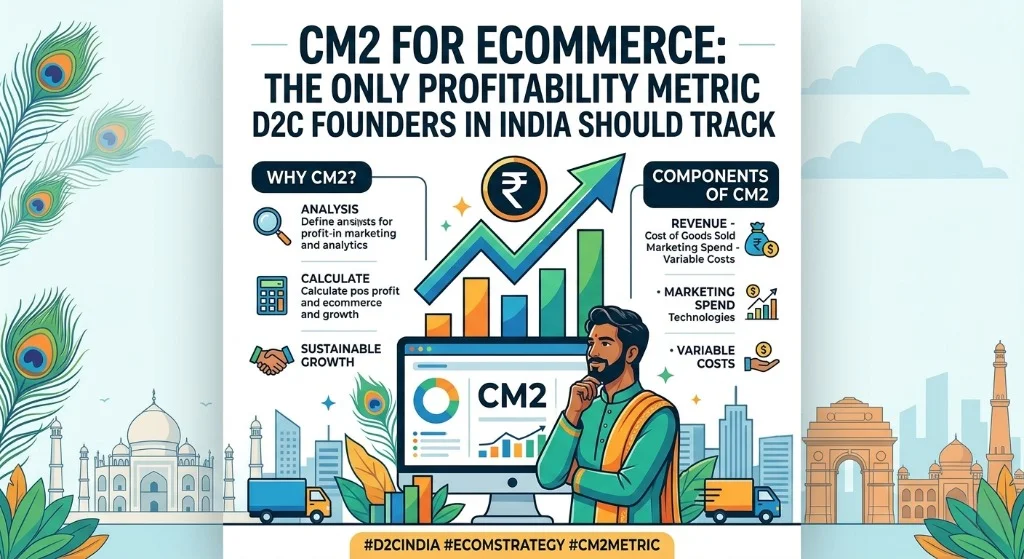
Here is a number that should terrify every D2C founder in India: 68% of Indian D2C brands with negative unit economics are expected to shut down by 2026. Not because they lacked product-market fit. Not because they ran out of ideas. Because they never figured out how much money they actually made (or lost) on every order.
The metric that separates the brands scaling to Rs 1Cr/month from the ones bleeding cash? CM2, or Contribution Margin 2.
If you are running a D2C brand in India, spending Rs 5L or more per month on Meta and Google Ads, and you cannot tell me your CM2 per order within 10 seconds, you have a problem. A big one.
This guide breaks down exactly what CM2 is, how to calculate it with Indian cost structures (COGS, shipping, COD charges, payment gateway fees, RTO losses, ad spend), and what benchmarks you should aim for in 2026. We will walk through real examples, give you a framework to find your profit leaks, and share the exact template we use with our clients at Aim n Launch.
Want us to calculate your CM2 for you? Book a free unit economics audit and we will map your entire order-level profitability in 30 minutes.
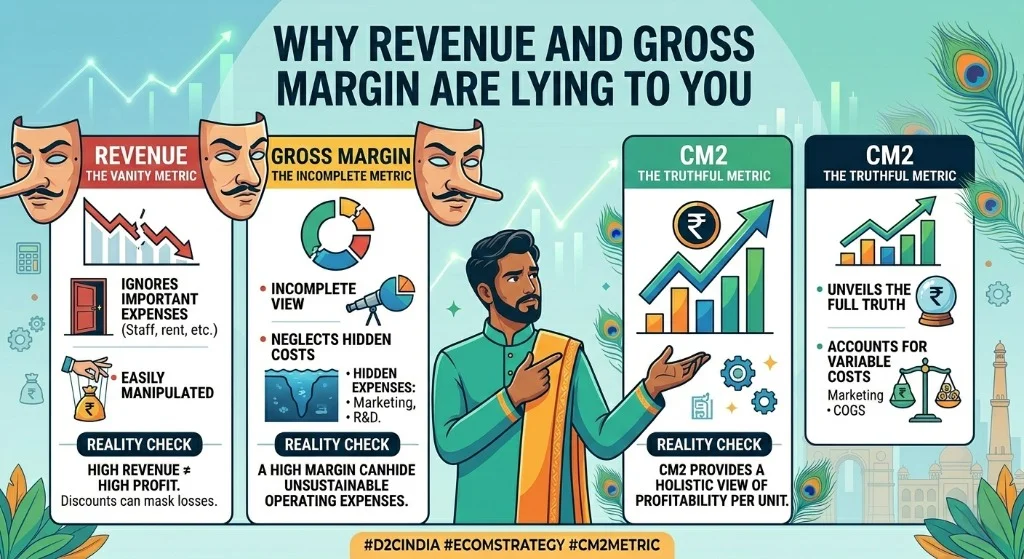
Most Indian D2C founders track two numbers religiously: revenue and gross margin. “We did Rs 40L this month.” “Our gross margins are 65%.”
Sounds great on paper. But here is what gross margin does not account for:
The Rs 80 you paid Shiprocket per order. The 2% payment gateway fee on every transaction. The Rs 150 you spent on Meta Ads to acquire that customer. The Rs 120 you lost when 25% of your COD orders got returned. The Rs 15 packaging cost per unit.
When you subtract all of these from your “65% gross margin,” many brands discover they are making Rs 30 to Rs 50 per order. Some discover they are losing money on every single sale.
Gross margin tells you how much your product costs to make. CM2 tells you how much your business actually earns per order after everything it takes to sell and deliver that product. That is the difference between a vanity metric and a survival metric.
Before we dive deep into CM2, let us understand the full contribution margin stack. Think of it as peeling layers off an onion, where each layer reveals more about where your money actually goes.
Formula: CM1 = Net Revenue – COGS – Packaging – Shipping – Payment Gateway Fees – Returns/RTO Costs
CM1 answers one question: “After making, packing, shipping, and processing the payment for this order, how much is left?”
For an Indian D2C brand, CM1 typically includes:
Benchmark: Healthy Indian D2C brands aim for CM1 of 40-55% of net revenue, depending on category.
Formula: CM2 = CM1 – Marketing Spend (allocated per order)
CM2 answers the critical question: “After I account for the cost of acquiring this customer, did this order actually make money?”
This is where most Indian D2C brands get a rude awakening. You take your CM1, subtract the marketing cost per order (total ad spend divided by total orders), and suddenly that “profitable” brand is underwater.
Benchmark: Best-in-class Indian D2C brands maintain CM2 of 15-25% of net revenue. If your CM2 is negative, you are literally paying customers to buy from you.
Formula: CM3 = CM2 – Fixed Overheads (team salaries, rent, software, subscriptions)
CM3 tells you if the business as a whole is viable. But CM3 is a business-level metric. CM2 is the order-level metric that determines whether scaling will make you richer or broker.
This is why CM2 matters most: If your CM2 is positive, scaling makes sense because every additional order adds profit. If your CM2 is negative, scaling just means you lose money faster. No amount of “we’ll make it up on volume” fixes a negative CM2.
Let us walk through this with a realistic example. Say you sell premium skincare products through your Shopify store.
Start with what you actually receive, not the MRP.
| Line Item | Amount |
|---|---|
| Average Order Value (MRP) | Rs 1,200 |
| Discount (15% average) | - Rs 180 |
| GST (12%) | - Rs 109 |
| Net Revenue | Rs 911 |
Most founders make the mistake of using their AOV as the starting point. Your net revenue after discounts and GST is what matters.
| Line Item | Amount |
|---|---|
| Product manufacturing cost | Rs 180 |
| Packaging (box, fillers, inserts) | Rs 45 |
| Total COGS | Rs 225 |
Most founders make the mistake of using their AOV as the starting point. Your net revenue after discounts and GST is what matters.
This is where India-specific costs hit hard.
| Line Item | Amount |
|---|---|
| Product manufacturing cost | Rs 180 |
| Packaging (box, fillers, inserts) | Rs 45 |
| Total COGS | Rs 225 |
A few notes on these numbers. The blended shipping rate assumes you are using a 3PL aggregator like Shiprocket or Pickrr. The COD split of 35% is realistic for a brand actively pushing prepaid (industry average is 30-50%). The 8% RTO rate is optimistic. Many Indian D2C brands see 15-25%, especially in Tier 2 and Tier 3 cities. If your RTO rate is above 15%, this single line item can destroy your entire unit economics.
CM1 = Net Revenue – COGS – Fulfillment Costs CM1 = Rs 911 – Rs 225 – Rs 115 = Rs 571 CM1 % = 62.7%
At 62.7%, this looks healthy. Most founders stop here and assume their business is profitable. But we have not accounted for the biggest variable cost: marketing.
| Line Item | Amount |
|---|---|
| Monthly Meta Ads spend | Rs 8,00,000 |
| Monthly Google Ads spend | Rs 2,00,000 |
| Total monthly orders | 2,500 |
| Marketing cost per order | Rs 400 |
This gives you a blended CAC of Rs 400 per order. For context, beauty and personal care brands in India are now spending Rs 800 to Rs 1,200 to acquire a single new customer through paid channels. If your numbers look better, it is likely because you have a mix of repeat customers (who cost Rs 0 in acquisition) bringing your blended cost down.
CM2 = CM1 – Marketing Cost Per Order CM2 = Rs 571 – Rs 400 = Rs 171 CM2 % = 18.8%
There it is. From a Rs 1,200 order, after every variable cost, you are left with Rs 171. That Rs 171 has to cover your team salaries, rent, software subscriptions, influencer payments, and everything else before you see actual profit.
Is Rs 171 good? It depends on your overhead. But at least it is positive. Many brands we audit at Aim n Launch discover their CM2 is negative, meaning they are losing money on every order and did not even know it.
Action step: Pull up your numbers right now. Open your Shopify analytics, your 3PL dashboard, and your Meta Ads Manager. Calculate your CM2 using the formula above. If you do not know where to start, grab our free CM2 calculator template that auto-calculates everything.
Once you know your CM2, the next question is: how do you improve it? We use a framework called the “5 Leak Audit” with every client we onboard. Here is how it works.
Symptom: Your AOV is Rs 1,200 but your average discount is 20-30%.
Many Indian D2C brands run perpetual discounts, 10% welcome offers, 15% sale events, buy-2-get-1 promotions. Each percentage point of discount comes straight out of your CM2.
Fix: Calculate your discount rate as a percentage of gross revenue over the last 90 days. If it is above 15%, you are over-discounting. Replace blanket discounts with targeted offers: first-purchase discounts only, bundle pricing that maintains margin, or loyalty rewards for repeat buyers.
Real example: Minimalist, the skincare brand, maintains premium pricing with minimal discounting. Their strategy of transparent ingredient costing (“this serum costs us Rs X to make”) creates value perception without needing constant 30%-off sales.
Symptom: More than 40% of your orders are COD, and your RTO rate is above 12%.
COD is a uniquely Indian problem. Each COD order costs you Rs 30-60 in additional charges, and when that order gets returned (RTO), you eat the forward shipping, reverse shipping, and often product damage costs. For many brands, the all-in cost of an RTO order is Rs 150-250.
Fix: Push prepaid aggressively. Offer Rs 50 off on prepaid orders (it still costs less than COD + RTO). Use address verification tools like Kwik or GoKwik to flag high-risk COD orders. Implement COD confirmation via WhatsApp or IVR before shipping.
Real example: Snitch, the menswear brand, brought their prepaid ratio above 70% by offering clear prepaid incentives and using GoKwik for COD-to-prepaid conversion. This single change reportedly improved their per-order profitability by Rs 60-80.
Symptom: You are paying more than Rs 70 per 500g shipment on blended rates.
Fix: Renegotiate with your 3PL every quarter based on volume. If you are shipping 2,000+ orders per month, you should be getting rates of Rs 55-65 for 500g shipments. Consider zone-based shipping strategies, where you stock inventory closer to your highest-demand pin codes.
Symptom: Your cost per purchase on Meta Ads has risen 30%+ in the last 6 months, but your CM2 has not improved to compensate.
Meta CPMs in India have risen 40-60% since 2023. If your creative strategy and funnel have not evolved, your CAC is eating into CM2 every month.
Fix: Increase creative velocity, top-performing Indian D2C brands test 50+ ad creatives per month. Diversify acquisition channels: Google Shopping, influencer whitelisting, organic content. Most importantly, invest in retention. A repeat order with Rs 0 CAC is the fastest way to improve blended CM2.
Real example: boAt, now doing over Rs 3,300 crore in revenue, built a massive repeat purchase engine through their “boAtheads” community. Their blended CAC is significantly lower than pure-play D2C brands because 40%+ of their revenue comes from repeat customers.
Symptom: You have not renegotiated with your manufacturer in over 12 months, or you are ordering in small batches.
Fix: Get three competing quotes annually. Increase batch sizes to unlock volume pricing. Review your packaging, do you really need that Rs 40 premium box for every order, or can a Rs 20 alternative work for non-gift purchases?
Action step: Run the 5 Leak Audit on your brand this week. Rank the leaks from biggest to smallest. Fix the top two, and you will likely see a 5-10% improvement in CM2 within 30 days.
Here is where most guides fail. They give you global benchmarks that mean nothing for an Indian brand dealing with COD, high RTOs, and Rs 70+ shipping costs. These benchmarks are based on data from 50+ Indian D2C brands we have worked with or analyzed at Aim n Launch.
| Category | Typical CM2 Range | What "Good" Looks Like |
|---|---|---|
| Beauty and Skincare | 12-22% | Above 18% |
| Fashion and Apparel | 8-18% | Above 15% |
| Food and Beverages | 5-15% | Above 10% |
| Health and Wellness | 15-25% | Above 20% |
| Electronics and Accessories | 8-15% | Above 12% |
| Home and Living | 10-20% | Above 15% |
| Monthly Revenue | Realistic CM2 Target |
|---|---|
| Rs 5-15L/month | 5-10% (acceptable, focus on growth) |
| Rs 15-50L/month | 10-18% (must be positive) |
| Rs 50L-1Cr/month | 15-22% (scaling zone) |
| Rs 1Cr+/month | 18-25% (optimize aggressively) |
In 2026, investors in the Indian D2C space have a clear mandate: they want CM2-positive brands. The era of “growth at all costs” is over. Capital deployment is now favoring enterprises with positive contribution margins, sustained 15-20% monthly revenue growth, and proven retention economics.
If you are seeking funding, your CM2 is the first number any serious investor will ask for. Brands achieving a 3.9x LTV:CAC ratio, which is attainable only if a customer completes at least 2.5 purchase cycles, are the ones getting term sheets.
Pilgrim, the beauty brand that crossed Rs 200 crore in revenue, maintains healthy unit economics by keeping their product line focused and their AOV high through bundles and kits. Their “routine” bundles (cleanser + serum + moisturizer) push AOV above Rs 1,000 while maintaining strong margins because the bundle packaging costs less per unit than shipping three separate orders.
Snitch, the Bangalore-based menswear brand, has built one of the healthiest CM2 profiles in Indian D2C fashion by obsessing over two things: prepaid conversion (above 70%) and creative velocity on Meta Ads (they test hundreds of creatives monthly). Their approach to reducing COD from the default 40-50% down significantly has been a masterclass in unit economics optimization.
While Lenskart operates at a much larger scale, their CM2 discipline is instructive. They vertically integrated manufacturing to control COGS, built their own logistics network to reduce shipping costs, and created a repeat purchase cycle through progressive lenses and frame upgrades. The lesson: every rupee saved in the CM1 layer compounds when you scale.
Monthly CM2 reviews are too slow. By the time you spot a problem, you have burned 30 days of budget. Here is a weekly tracking system.
Track these seven numbers every Monday morning:
Plot CM2% on a simple line chart week over week. If it drops two weeks in a row, something changed. Investigate immediately.
You do not need expensive analytics platforms to track CM2. A well-structured Google Sheet pulling data from Shopify (revenue, orders, discounts), your 3PL dashboard (shipping costs, RTO), Razorpay (payment fees), and Meta/Google Ads Manager (ad spend) is enough for brands under Rs 1Cr/month.
For brands scaling past Rs 1Cr/month, tools like Saras Analytics, BeProfit, or Lifetimely can automate CM2 tracking at the order, product, and channel level.
Action step: Set a recurring Monday 9 AM calendar reminder titled “CM2 Check.” Pull the seven numbers above. If you do this consistently for 8 weeks, you will understand your business better than 90% of D2C founders in India.
If your CM2 is negative or below 10%, here is a prioritized action plan:
Week 1-2: Fix your COD/prepaid ratio. Implement prepaid discounts (Rs 50-100 off) and COD confirmation calls. This alone can improve CM2 by 3-5 percentage points.
Week 3-4: Audit your ad spend allocation. Kill campaigns with cost-per-purchase above your CM1 per order (if your CM1 is Rs 500, no campaign should have a cost-per-purchase above Rs 500). Reallocate budget to your top 3 performing ad sets.
Week 5-6: Launch a retention push. Email and WhatsApp campaigns to past buyers cost almost nothing and generate orders with Rs 0 CAC. Even converting 5% of your past buyer list into repeat customers will meaningfully improve blended CM2.
Week 7-8: Renegotiate shipping and packaging costs. Get three competing quotes. Optimize box sizes to reduce volumetric weight charges.
CM2 is an order-level metric that includes only variable costs (COGS, shipping, payment fees, and marketing spend per order). Net profit includes all fixed costs too: team salaries, office rent, software subscriptions, legal fees, and everything else. CM2 tells you if each order is profitable. Net profit tells you if the entire business is profitable after overheads.
For Indian D2C brands in 2026, a CM2 of 15-25% of net revenue is considered healthy. Early-stage brands (under Rs 15L/month) can operate at 5-10% CM2 while focusing on growth, but brands spending Rs 5L+ on ads must be CM2-positive. Anything negative means you are losing money on every order.
If influencer payments are directly tied to sales (affiliate commissions, performance-based deals), include them in CM2. If they are brand awareness spends with no direct order attribution, they belong in CM3 or fixed overheads. The key principle: CM2 includes only costs that scale directly with each order.
Weekly is ideal. Monthly is the minimum. Daily is overkill for most brands unless you are spending Rs 20L+ per month on ads. The important thing is consistency, track it the same way every time so you can spot trends.
Marketplace orders typically have lower CM2 because you pay 15-30% commission fees to the platform, which replaces your direct marketing cost but is often higher. Shopify orders give you more control over CM2 through your own ad spend optimization, pricing strategy, and customer retention. Calculate CM2 separately for each channel to understand true profitability.
CM2 is not a fancy finance term. It is the single most important number that tells you whether your D2C brand is building toward real profitability or just burning cash faster as you scale.
The India D2C market is projected to reach USD 108.76 billion in 2026. The brands that will capture that growth are the ones obsessing over CM2, not just revenue.
Calculate yours today. If you do not like what you see, that is actually the best starting point, because now you know exactly where to fix.
Ready to get your CM2 mapped and optimized? At Aim n Launch, we run a free unit economics audit for Indian D2C brands spending Rs 5L+/month on ads. We will calculate your CM2, identify your top 3 profit leaks, and give you a 30-day action plan to improve it. Book your free 15-minute CM2 audit call now.