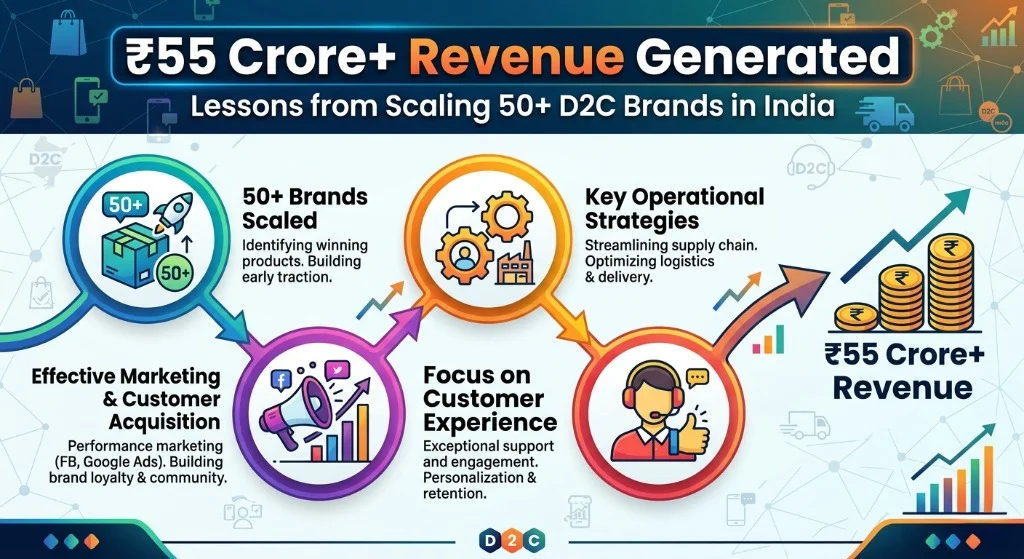
We’ve now worked with over 50 D2C brands across India — protein and nutrition, fashion, FMCG snacks and beverages, jewellery, wellness, home and beauty — and helped generate more than ₹55 crore in client revenue along the way, with an average return on ad spend of 4.2x. Some of these brands had appeared on Shark Tank India. Others were quietly profitable businesses nobody outside their category had heard of. A few were burning cash on ads with no idea why.
Across all of them, the same patterns kept repeating — the same five or six mistakes that cap a brand’s growth, and the same five or six fixes that consistently break the ceiling. This isn’t a highlight reel. It’s what we’ve actually learned from sitting inside dozens of Shopify stores, ad accounts, and P&Ls.
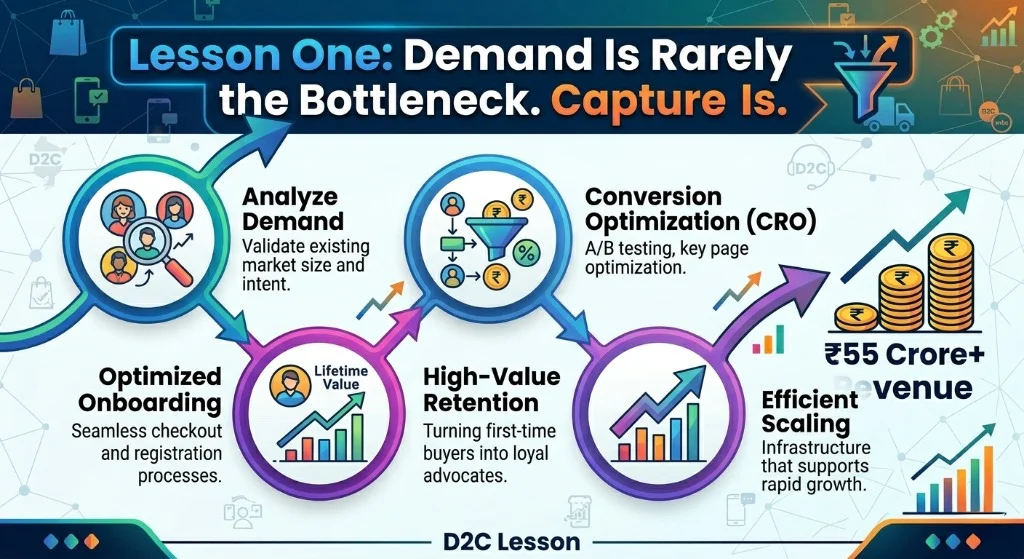
We’ve lost count of how many founders come to us convinced their problem is “not enough demand,” when the real issue is that their existing demand is being captured inefficiently. One Shark Tank-featured protein snacks brand was stuck at ₹7–8L a month despite genuine product-market fit and national visibility from the show. The bottleneck wasn’t traffic. It was that ad spend was scattered across a dozen SKUs, none of which ever generated enough conversion data for Meta’s algorithm to optimize properly. Once we consolidated spend behind a single hero bundle, that same brand hit ₹30.2L the following month — a 289% jump with no increase in underlying demand, just a fix to how that demand was being routed.
This is the single most common pattern across our client base: brands assume they have a top-of-funnel problem when they actually have an offer-architecture problem.
Founders default to discounting because it’s the fastest lever to pull. It’s also usually the most expensive one, because most discounts are applied reactively — 10% off this week, a flat ₹100 off the next — with no math behind what the margin can actually absorb.
The brands that scale profitably treat bundling as the primary AOV lever, not discounting. In one fashion brand engagement, two-piece bundle sets lifted AOV by 9% and ended up contributing 28% of all Meta-driven revenue. In the protein snacks case mentioned above, a “3+1” bundle alone generated 65% of total gross sales in its breakout month. Bundles increase perceived value, give the ad algorithm a stronger purchase-value signal to optimize toward, and protect margin in a way that blanket discounting structurally can’t.
We see this constantly — a brand growing nicely on the back of one channel, whether that’s Meta, SEO, or a single hero SKU, with no real diversification underneath. It works fine until that one channel softens. In one fashion brand case, organic search was contributing over 25% of total tracked revenue, which is genuinely impressive — but it also meant a single algorithm update or backlink decay event could take a quarter of the business’s revenue overnight. The fix isn’t to abandon what’s working. It’s to build a second and third channel in parallel — email, WhatsApp, SEO content — so growth isn’t single-threaded.
Across consumable categories especially — protein powders, snacks, beverages, wellness products — we routinely see returning customer rates sitting below 5%, sometimes as low as 3%. For products that people physically run out of every three to four weeks, that’s not a minor leak. It means the brand is rebuilding its entire customer base from scratch every single month, paying full acquisition cost every time, with zero compounding.
The fix is almost always simpler than founders expect: a post-purchase tagging system, timed reorder nudges aligned to the product’s actual consumption window, and a loyalty hook that doesn’t require a full subscription infrastructure to start. In one engagement, this alone moved returning customer rate from 3.3% to 5.13% in a single month — a 53% improvement before the retention system was even fully built out.
This is the one that separates profitable scaling from cash-burning growth, and it’s the mistake we see most often among brands that have already raised funding or built some momentum. They scale ad spend based on top-line ROAS without ever calculating CM2 — contribution margin after product cost, shipping, payment gateway fees, discounts, and ad spend per order.
We run this calculation before recommending any scale-up, every single time. In one case, this discipline let us responsibly push discounts up 505% month-over-month, because the math showed the bundle’s margin could absorb it — and net sales grew 263% as a direct result, with AOV rising rather than falling. Without that math done first, the same discount increase could just as easily have destroyed the brand’s margin while looking like a win on the surface.
Cash-on-delivery feels like it removes friction at checkout, but it quietly drains margin through higher return-to-origin rates, slower cash realization, and weaker repeat behavior. We’ve seen brands shift from roughly 60% prepaid to near-total prepaid simply by making one-click checkout the default experience and layering in small prepaid-specific incentives — a move that alone can swing margin per order by three to five percent. It’s not glamorous work, but it’s pure margin recovered without spending another rupee on ads.
If there’s one thread connecting every brand we’ve grown past its ceiling, it’s this: scaling is never really about spending more. It’s about fixing the system underneath the spend — the offer, the catalog architecture, the discount logic, the retention loop, the payment mix — so that every additional rupee of ad spend actually compounds instead of leaking out somewhere you’re not watching.
The brands that plateau are almost never short on demand or starved for traffic. They’re running growth on infrastructure that was never designed to scale past its first six figures. The ones that break through are the ones willing to slow down for two weeks, audit the unit economics properly, and then scale with the confidence that comes from knowing the math actually works.
Curious where your brand sits against these patterns? Book a free scaling analysis and we’ll show you, with your own numbers, exactly where the growth opportunity is sitting.