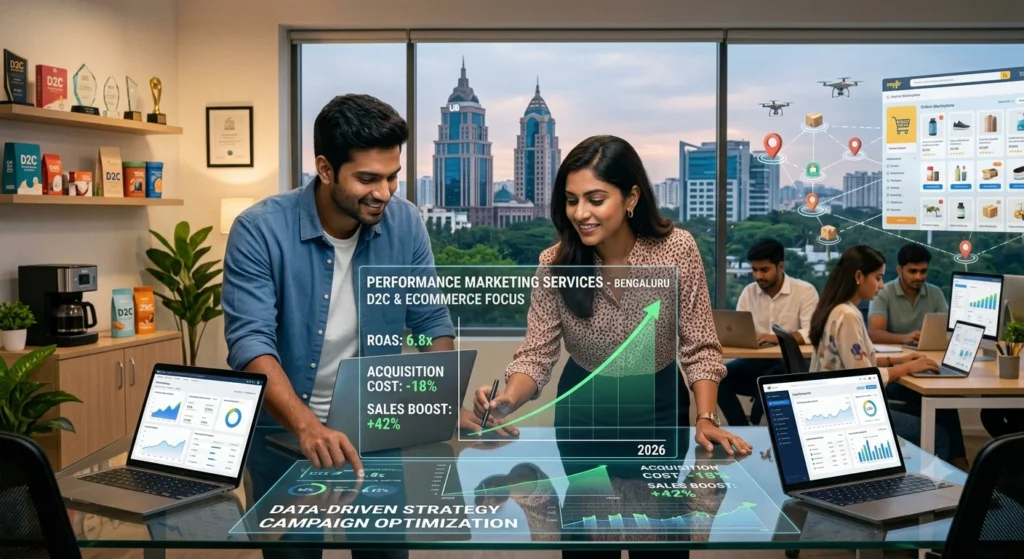
Performance Marketing Services in Bangalore: Why Data-Led Buyers Need a Different Approach
Bangalore’s D2C buyers are some of the most digitally native and data-comfortable in India — no surprise, given the city’s tech industry base. That changes what actually works in performance marketing here. Generic ad copy and surface-level offers don’t land with an audience that’s used to scrutinizing products, comparing options, and spotting a weak value proposition instantly.
If you’re a Bangalore-based D2C or ecommerce brand looking for performance marketing services, the agency you work with needs to build campaigns for a buyer who researches before they convert — not one who impulse-buys off a flashy ad.
Why Bangalore’s Market Behaves Differently
Higher research intent before purchase Bangalore buyers are more likely to check reviews, compare pricing, and visit a brand’s website multiple times before converting. That means retargeting, clear product information, and trust signals on the landing page matter more here than in markets with faster impulse-driven buying behavior.
Strong D2C and quick-commerce competition Bangalore has a dense concentration of D2C-native brands, especially in wellness, nutrition, personal care, and consumer tech accessories, alongside heavy quick-commerce penetration. Standing out requires sharper positioning, not just higher spend.
A buyer base that responds to proof, not hype Data, specifics, and clear before/after value communication tend to outperform generic emotional hooks with Bangalore’s audience — which shifts how creative and ad copy should be written.
What Performance Marketing Services in Bangalore Should Include
Meta and Google Ads built around informed-buyer behaviorCampaigns need a retargeting structure that accounts for longer research cycles, not just top-of-funnel awareness spend expecting immediate conversion.
Landing pages built on proof, not just polishProduct pages need clear specifications, social proof, and honest value communication — Bangalore buyers tend to bounce fast from pages that feel like hype without substance.
Creative testing rooted in specificityRather than broad emotional hooks, ads that lead with concrete benefits, ingredients, specs, or outcomes tend to perform better with this audience. Testing should reflect that from the start.
CRO focused on trust signalsReviews, guarantees, clear return policies, and transparent pricing on the product page matter more here — fixing these often lifts conversion rate more than additional ad spend would.
Data-driven reporting Bangalore founders will actually trustGiven how data-literate this market’s founders and buyers tend to be, reporting needs to go beyond surface metrics into CAC versus LTV, contribution margin, and funnel-stage drop-off.
How Aim n Launch Approaches Performance Marketing for Bangalore Brands
For Bangalore-based D2C and ecommerce brands, our system is built to match a research-driven buyer and a founder base that expects rigor in reporting:
Retargeting structures built for longer consideration cycles, not just first-touch conversion
Product page and offer audits focused on proof and trust signals before scaling spend
Weekly creative test maps built around specificity — features, outcomes, and honest positioning
Daily tracking calls with CAC, LTV, and contribution margin visibility
SEO layered alongside paid media, since Bangalore’s research-heavy buyers frequently discover brands organically before converting through ads
Across our client base, we’ve generated ₹55 crore+ in tracked revenue at a consistent 4.2x ROI, working with wellness, nutrition, fashion, and consumer brands — including ones that scaled after appearing on Shark Tank India.
Why do Bangalore buyers need a different ad approach than other cities?
Bangalore’s audience tends to research more before purchasing, which means retargeting, trust signals, and specific, proof-led creative typically outperform broad emotional hooks that work better in faster-converting markets.
Which categories do well with performance marketing in Bangalore?
Wellness, nutrition, personal care, and consumer tech accessories consistently perform well, largely due to strong overlap with the city’s health- and tech-conscious buyer base.
How long does it take to see results in Bangalore's market?
Given longer research cycles, initial signal often takes slightly longer to emerge than in impulse-driven markets — typically 3-5 weeks of structured testing before a clear picture forms.
Does SEO matter alongside paid ads for Bangalore brands?
Yes, more than in most markets. Bangalore’s research-heavy buyers frequently search for a brand or product multiple times before converting, so strong organic presence directly supports paid performance.