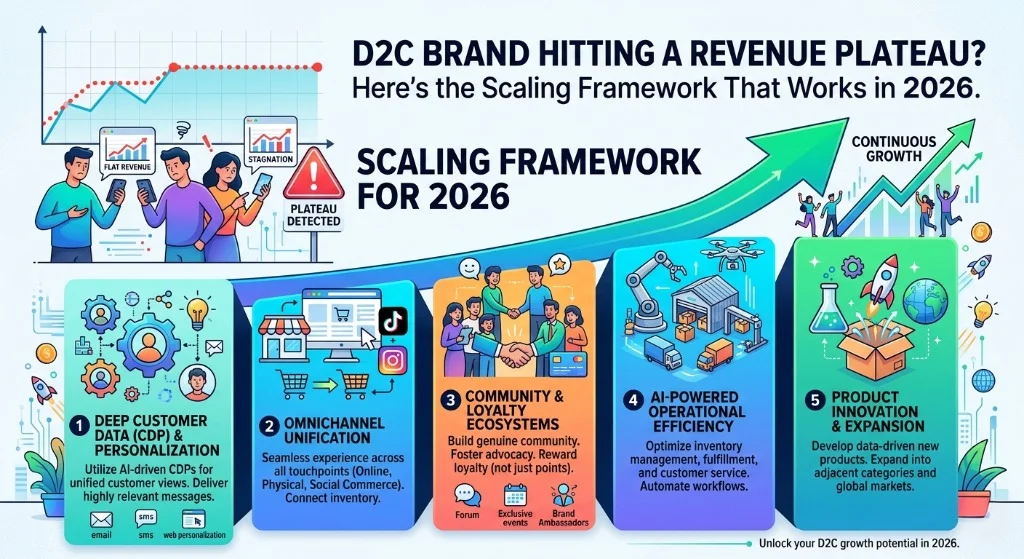
You hit ₹8 lakh in month three. Then ₹9 lakh. Then… ₹8.5 lakh again.
The ads are running. The product reviews are good. The team is working hard. But the number on the dashboard just won’t move.
This is the D2C plateau, and it’s one of the most demoralizing places a founder can find themselves. The cruel irony is that the tactics that got you here are exactly what’s keeping you stuck.
In this post, we’ll break down why D2C brands plateau, what the actual scaling levers are in 2026, and the end-to-end framework that’s helped brands we work with at Aim n Launch move from flat months to consistent growth toward ₹50L, ₹1Cr, and beyond.
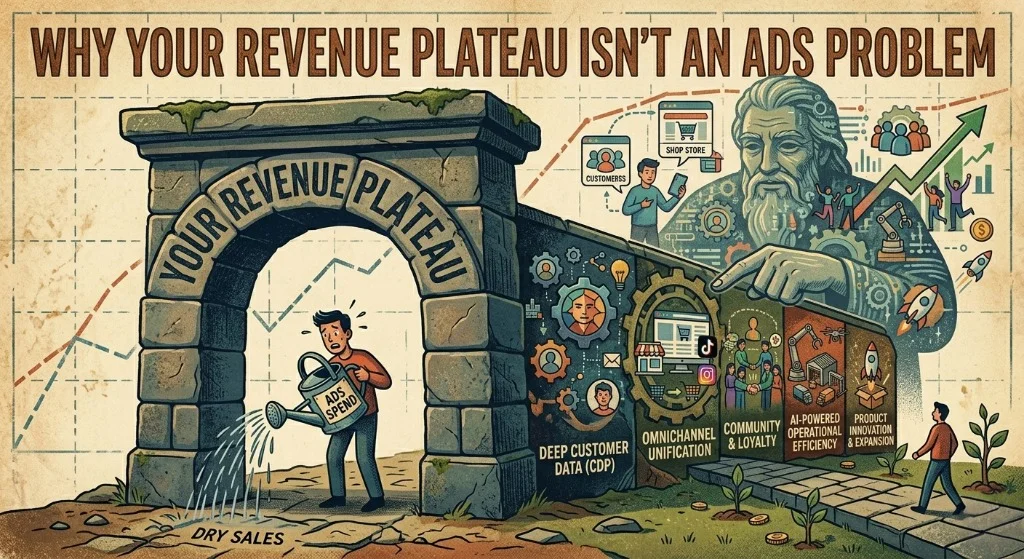
The first thing most founders do when revenue stalls is blame the ads. ROAS drops slightly and suddenly there’s a full audit of creatives, targeting, budgets. Sometimes that’s relevant, but more often, the plateau has nothing to do with the top of the funnel.
Here’s what’s actually happening across the three most common plateau stages:
The ₹3–5L Plateau: Your product-market fit is real, but your unit economics are broken. You’re discounting too aggressively to drive first orders, CAC is creeping up, and you have zero retention infrastructure to make any of it profitable.
The ₹8–12L Plateau: You’ve figured out acquisition on one or two creatives, but audience saturation is setting in. You have no creative refresh system, no second channel, and your landing page is still the generic Shopify template you launched on.
The ₹20–30L Plateau: You’re profitable but you can’t scale spend without your Cost Per Order (CPO) blowing up. This is almost always a conversion problem, the offer, the page, or the checkout, not an ads problem.
Understanding which plateau you’re actually in determines everything about your next move.
We’ve worked with 50+ D2C brands across fashion, beauty, food, and lifestyle through our eCommerce performance marketing services, and the brands that break through plateaus all do five things differently.
Stop optimising for ROAS. It is a vanity metric that tells you nothing about profitability. The brands that scale have one number at the centre of every decision: Cost Per Order (CPO) relative to their Average Order Value (AOV).
Before you change a single ad, define:
Once you’re optimising for a profitable CPO rather than an impressive ROAS screenshot, decision-making becomes dramatically clearer.
This is the one that most agencies skip because it requires actual work beyond the ads dashboard.
If your store converts at 1.2% and you double your ad spend, you’ll get double the losses. A store that converts at 2.8% on the same spend generates 2.3x the revenue.
Your product page, offer structure, checkout flow, and page speed are the real multiplier on your ad spend. We go deep on this in our post on why your Shopify store gets traffic but no sales, which is worth reading before you touch your budget.
The brands we see plateau hardest are the ones who made three great UGC videos six months ago and are still running them. In 2026, creative fatigue sets in within 2–3 weeks on Meta.
A scaling brand runs a creative testing system: weekly launches of 3–5 new ad variations, clear tracking of hook performance in the first 3 seconds, and a ruthless policy of retiring anything that’s fatigued, even if it worked brilliantly last month. Our eCommerce digital marketing services include in-house UGC scripting, casting, and editing for exactly this reason.
Many brands try to launch Google, Meta, and influencer campaigns simultaneously and end up mediocre at all three. The right sequencing matters.
Start with Meta, it’s the fastest feedback loop for Indian D2C brands with a visual product. Once you’ve validated your CPO target and have a creative system, layer in Google Shopping and Search for high-intent buyers. Then use email and WhatsApp to recover carts, upsell, and drive repeat purchases.
Retention alone, handled well, can add 15–25% to your monthly revenue without spending a single rupee more on acquisition.
Most D2C brands have one offer: buy the product at full price, or buy it at a discount during a sale. That’s leaving enormous revenue on the table.
High-scaling brands build an offer ladder:
This is not complicated to build, but it requires thinking about your catalogue as a revenue system, not just a product list.
Looking across the case studies on our results page, the brands that go from plateau to consistent growth share one pattern: they stopped treating each channel as a standalone department and started treating their entire growth stack as a connected system.
Ads feed the page. The page converts or leaks. Email and WhatsApp retain or abandon. The offer determines if any of it is profitable. When one breaks, the others suffer, and fixing only one rarely produces lasting results.
If you’re staring at a flat revenue chart, here’s the honest starting point:
If two or more of these are broken, you don’t have an ads problem. You have a systems problem.
The D2C brands we work with that break through their plateaus fastest are the ones who accept that the next phase of growth requires building infrastructure, not just spending more.
If you want a clear-eyed look at what’s actually holding your brand back, book a free growth call and we’ll work through the numbers with you.